Navigation
Compass bearing
How to take and walk a compass bearing with compass and map — from the parallel lines in the compass housing to a sighting point in the terrain. With film and practical tips.
How to take and walk a compass bearing
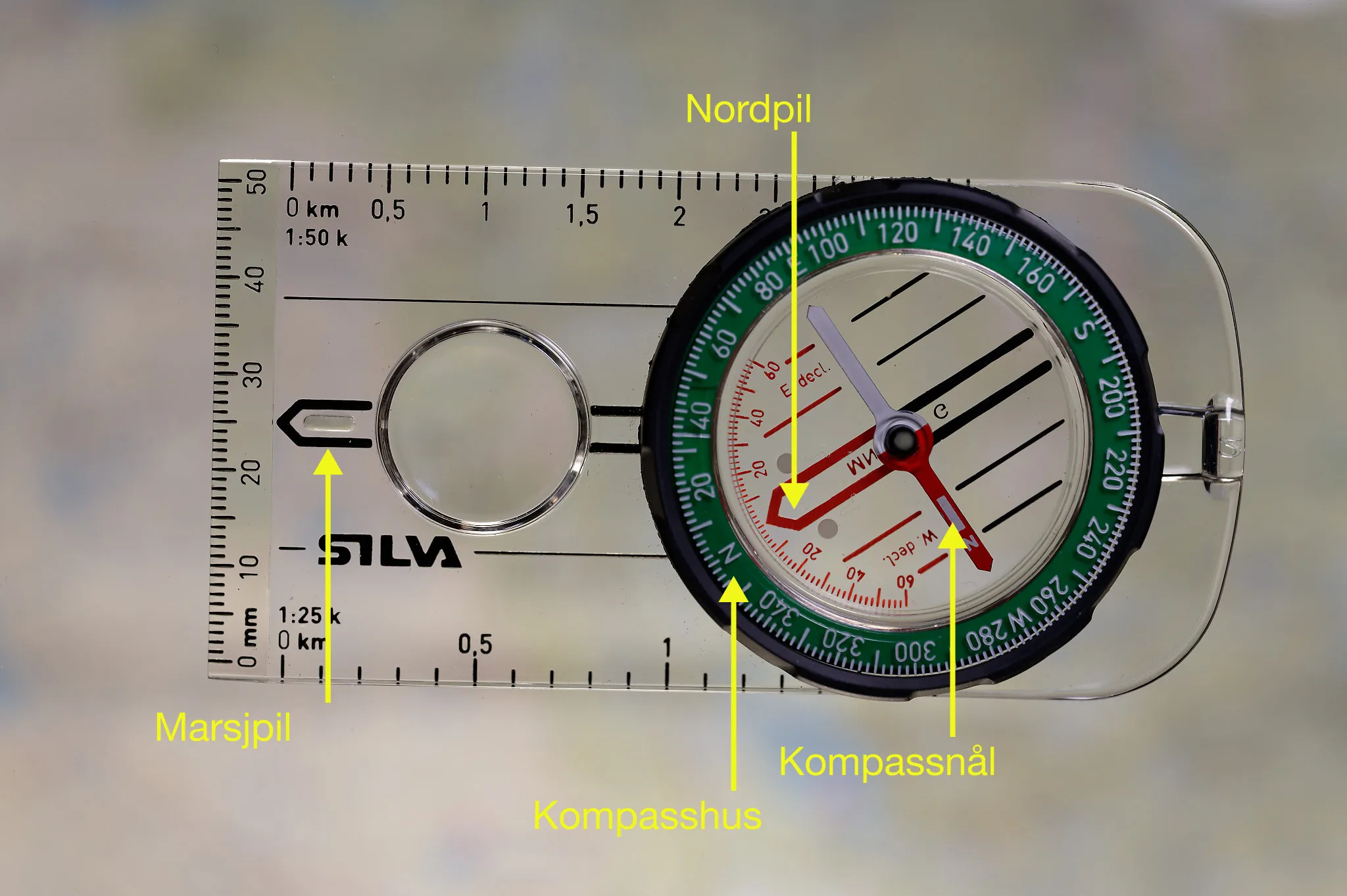
An overview of the different parts of the compass. Photo: Ola Njå Bertelsen, Snuitide.
-
Place the compass so that the edge follows the straight line from where you are standing to where you are going. Make sure the direction-of-travel arrow points in the direction you want to go.
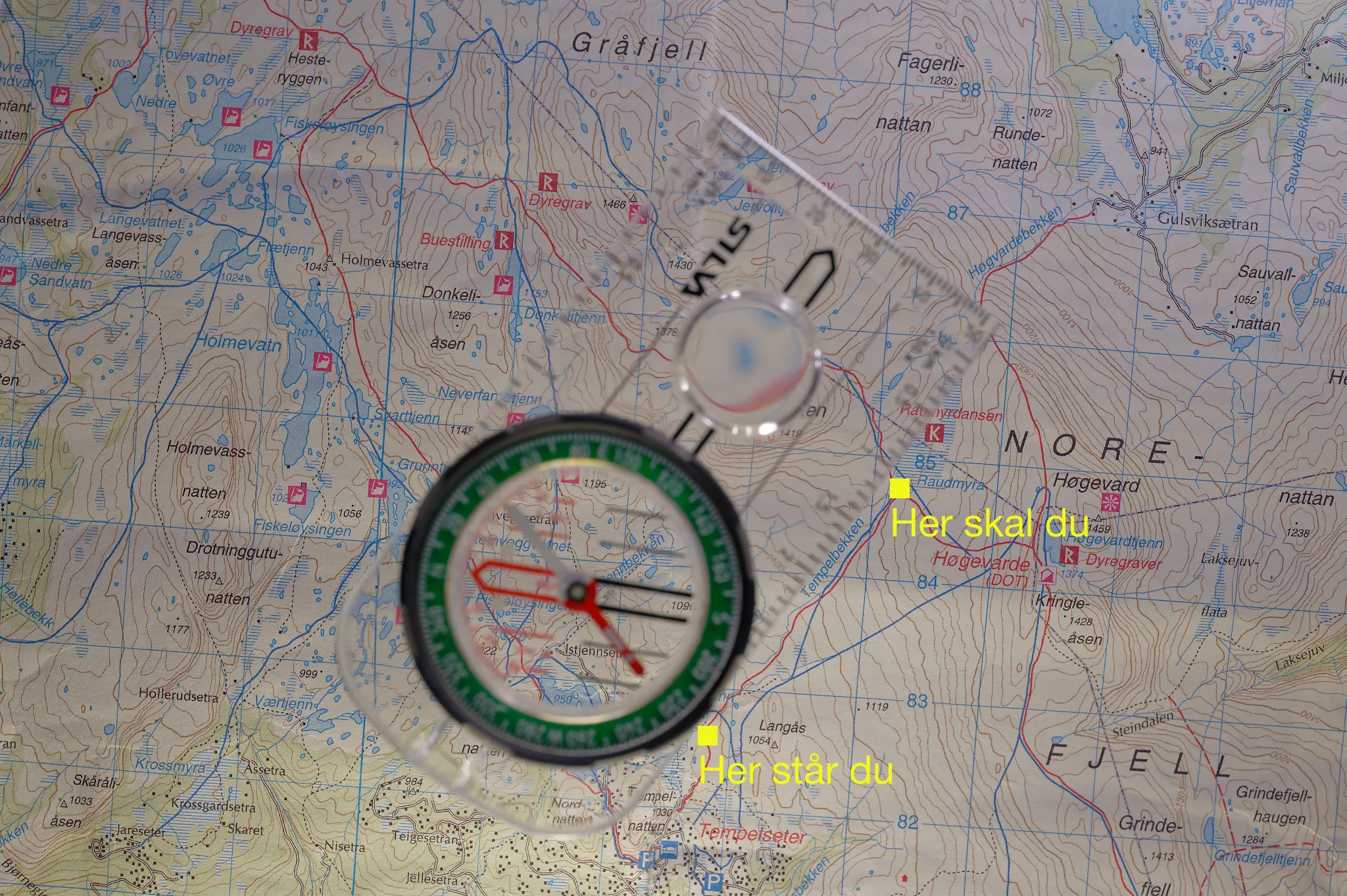
Photo: Ola Njå Bertelsen, Snuitide.
-
Turn the compass housing so that the lines inside it run parallel to the north–south lines on the map (the blue grid). Make sure the north arrow in the compass housing points towards north on the map. North is upwards on the map when the map lies so that you can read the words.
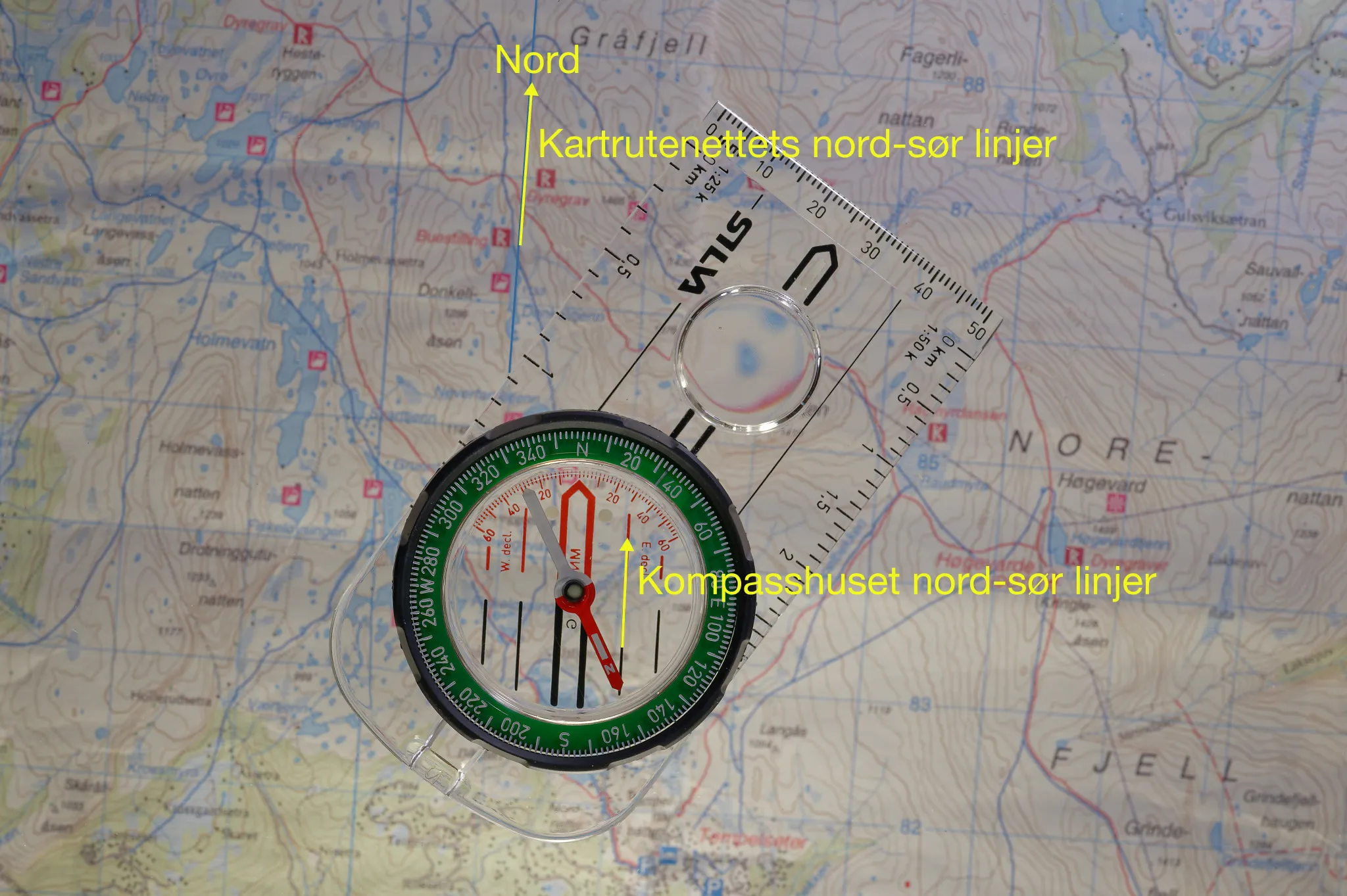
Photo: Ola Njå Bertelsen, Snuitide.
-
Hold the compass flat in your hand. The red compass needle will swing freely and settle so that it points towards north. Turn the compass until the needle lines up with the red north arrow.
-
The direction-of-travel arrow now points the way you want to go. Sight a point that lies in the direction the direction-of-travel arrow points. Walk to it, then find a new sighting point.
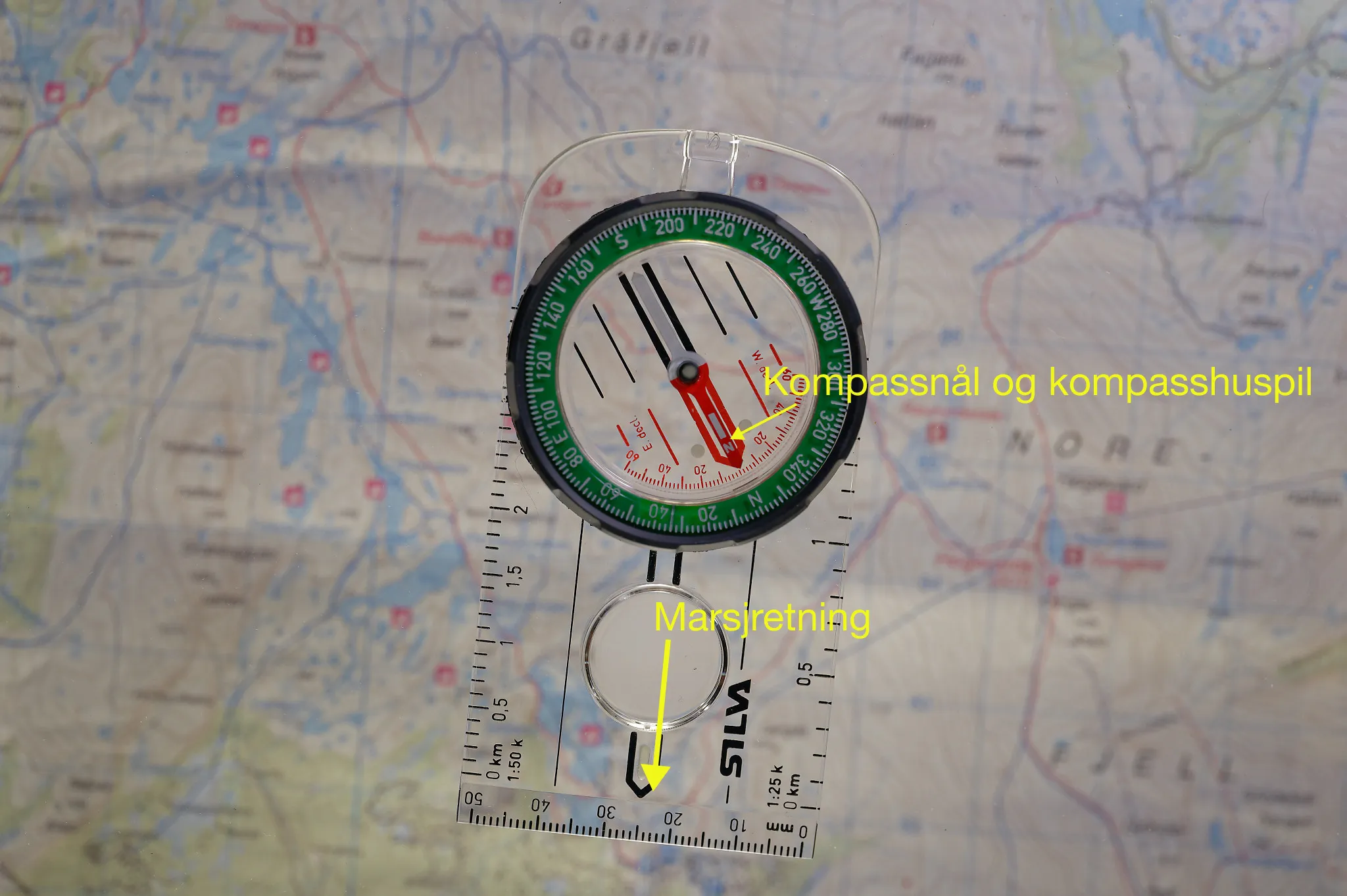
Photo: Ola Njå Bertelsen, Snuitide.
NB! Some old orienteering compasses have 400 degrees on the graduated dial. Always check that everyone has a 360-degree compass before you take a bearing — otherwise you will get different bearings.
A few tips for compass bearings
- The direction-of-travel arrow should always point at the target (the place you are heading for).
- Be precise when you take the bearing. It is easy to be several degrees out if you are careless.
- Check that the degrees match the compass direction you mean to walk:
- NORTH will be around 360 or 0 degrees
- EAST will be around 90 degrees
- SOUTH will be around 180 degrees
- WEST will be around 270 degrees
- Take short compass bearings — a couple of kilometres at most, as it is then easier to hold the line.
- Find a sighting point or a catching feature — that makes it easier to hold the line and to know that you are in the right place.
- Check your GPS at regular intervals if you walk for a long time without sighting points or reference points, so that you know you really are where you think you are.
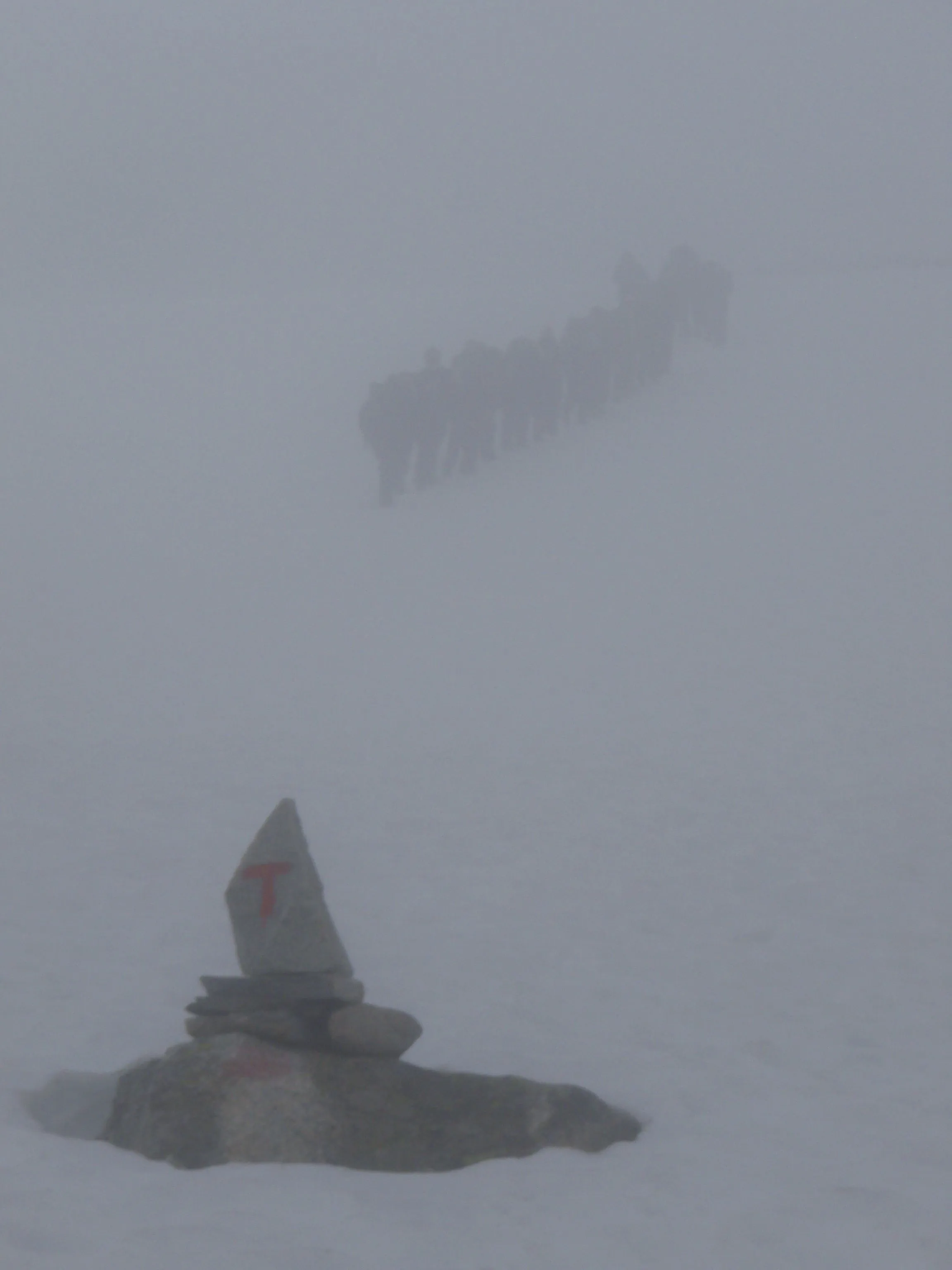
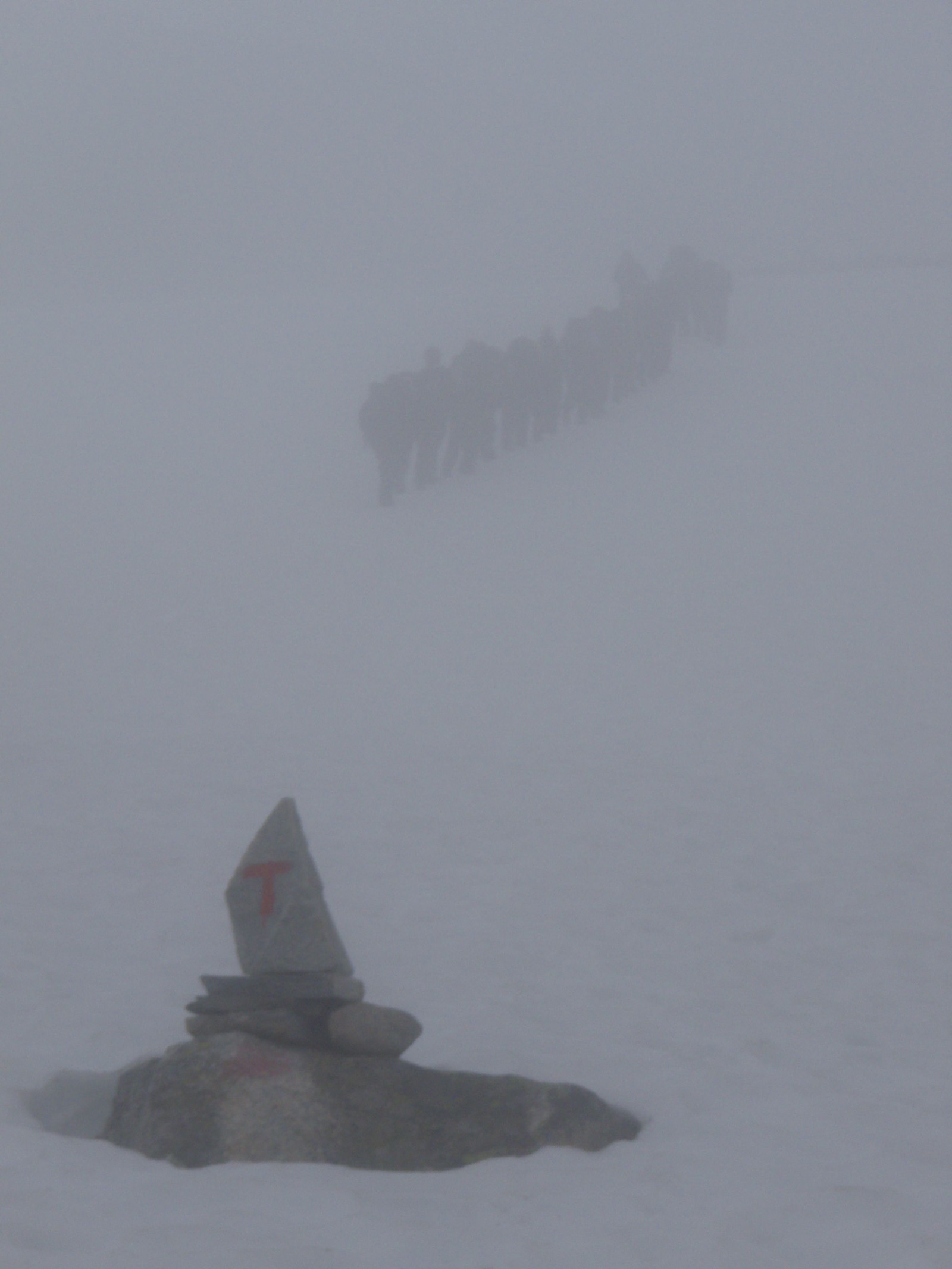
In fog it is very hard to find your way without a compass and GPS. Practise taking a compass bearing, so that you can do it when you need to. Photo: Anne Wagner, Turlederboka.
More on navigation
Contour interval and scale · GPS · Magnetic variation · Cross-bearing · Map reference · Navigation at sea · Navigating by nature’s signs
Text: Gina Wigestrand, Snuitide (2021), revised 2026.
Sources: Blystad, J.T. (ed.) (2010). Turlederboka. Oslo: Den Norske Turistforening. · Friis, K.N. (2010). Slik tar du ut en kompasskurs. In Blystad, J.T. (ed.), Turlederboka (p. 74). Den Norske Turistforening. · Kjeldsen, R., Furuly, C.D. and Rolseth, B.E. (2019). Bruk av kart og kompass. NDLA. · Kolbjørnsgard, S. (2021). Ta ut kompasskurs [Video clip]. https://vimeo.com/736818133 · Statens kartverk (2021). Lær deg kart og kompass. · Unger, L.C. (2010). Orientering. In Blystad, J.T. (ed.), Turlederboka (pp. 67–83). Oslo: Den Norske Turistforening.