First Aid
Lifesaving first aid
The most important thing we do to keep an injured person alive is to make sure oxygen reaches the lungs, that this oxygen is carried in the bloodstream out to the different parts of the body, and to prevent cooling.
The most important thing we do to keep an injured person alive is to make sure oxygen reaches the lungs, that this oxygen is carried in the bloodstream out to the different parts of the body, and to prevent cooling. In this section we will go through a little physiology, the examination of an injured person, and lifesaving measures.
Examining an injured person is not all that difficult, but it takes practice. It is worth practising on the different injuries that can occur.
Contents
Breathing – Bleeding – Warmth
When we examine and treat an injured person, we focus on three points — in order of priority:
- We check that the casualty is breathing.
- We check whether the casualty is bleeding.
- We make sure to prevent heat loss.
(A simplification of the examination principles in Fauske & Bruland, 2019, p. 36).
Here is why each point matters, so that you understand why it is precisely these points we examine.
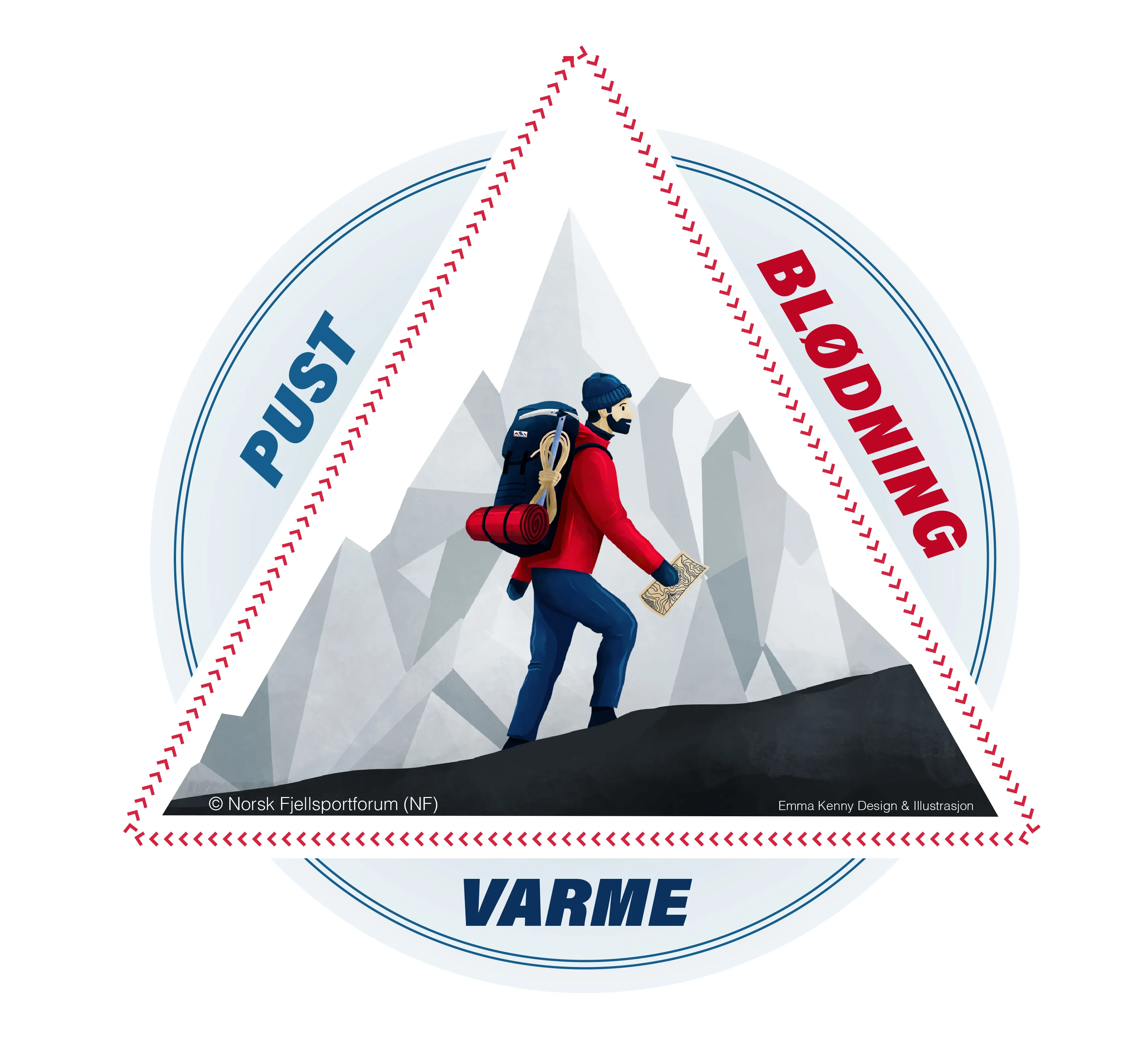
Illustration: Emma Kenny, Emma Kenny Design & Illustrasjon
Breathing
The body depends entirely on oxygen to function. When we stop breathing, the heart will in time also stop pumping blood around the body. From that moment, it is only a matter of minutes before the brain suffers permanent damage.
For a person to breathe unaided, air must pass freely through the mouth or nose, down into the throat, on through the windpipe, and down to the lungs. If air moves freely through these parts, the person has a clear airway.
The person must also be able to draw breath. Breathing is a mechanical process, in which various muscles in the body increase the volume of the lungs and so “draw” air down into them.
The airways Illustration: Biorender, https://biorender.com/
Examining breathing + measures
Checking breathing is the first and most important thing we examine. If the casualty is awake, we can start by making contact with the person. Introduce yourself by name, and ask what has happened. If the person answers you and can speak normally, we know that the person has a clear airway and is breathing normally.
If the casualty is not awake, we have to work out whether they are
- not awake, but breathing — that is, unconscious, or
- not awake and not breathing either — which we call lifeless.
This is how you check whether an unconscious person is breathing:
- Position yourself at the head.
- If you cannot clearly see that the person is breathing, open the airway.
- Make sure the head is in a natural position, and lift the chin or jaw upwards.
- Check again whether the person is breathing once you have opened the airway.
- Use your senses. Put your ear over the mouth, and feel or listen for warm air. Place a hand on the abdomen or chest and feel for movement; watch to see whether the chest rises.
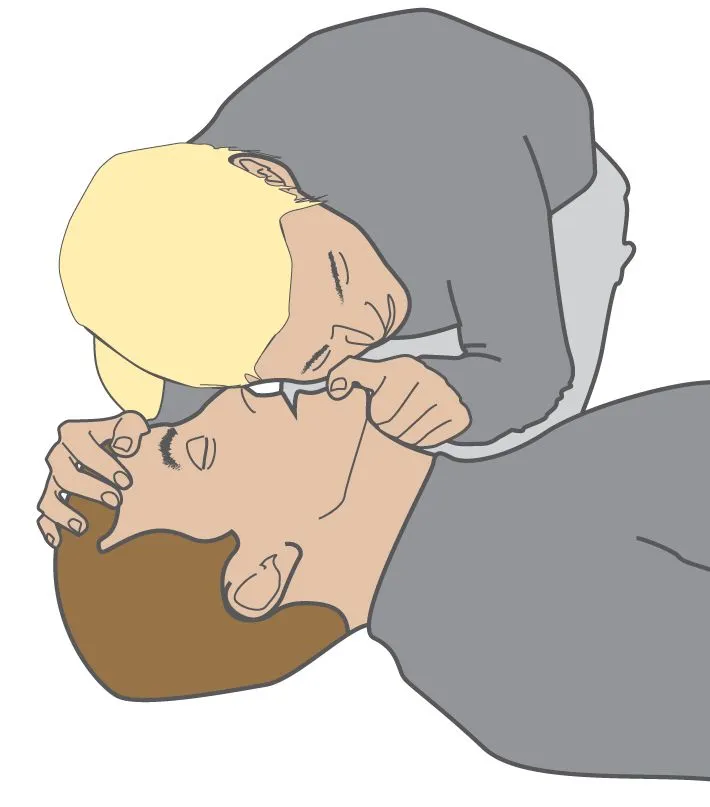
Illustration: K. N. Friis, Turlederboka
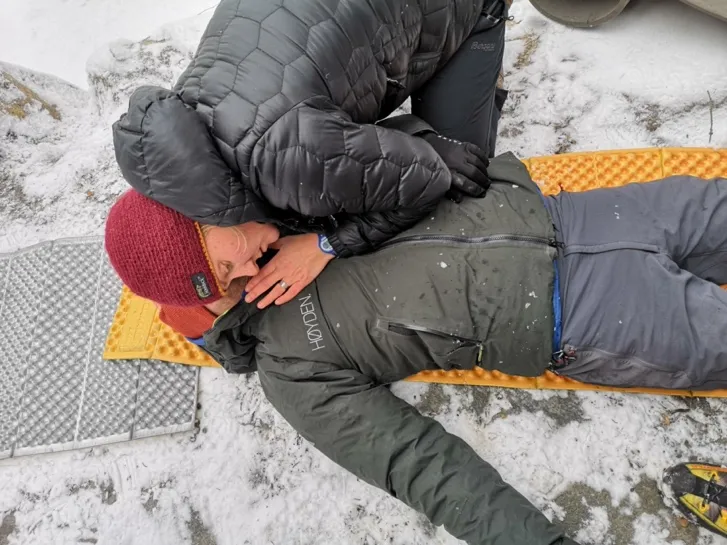
Photo: Snuitide
If the unconscious person is breathing unaided, the person should be placed in the recovery position. The recovery position keeps the airway clear, and it also means the person will not choke if they are sick.
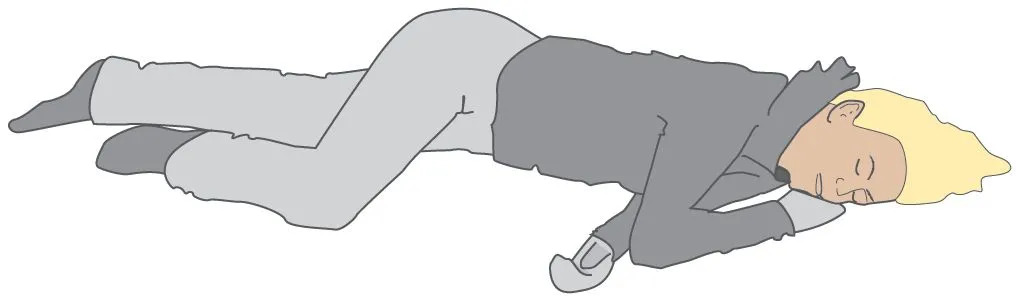
Illustration: K. N. Friis, Turlederboka
Placing a person in the recovery position. Film: LHL, with support from Gjensidigestiftelsen
If the person is not breathing unaided, or is breathing abnormally, they are lifeless. Abnormal breathing that can be mistaken for “normal breathing” is breathing that resembles odd gasps — much like a fish out of water stretching its gills.
If the casualty is lifeless, we must start cardiopulmonary resuscitation.
Demonstration of CPR. Film: LHL, with support from Gjensidigestiftelsen
Bleeding
For the various parts of the body to receive oxygen from the air, it is not enough that we get air down into the lungs; the oxygen must also be carried from the lungs out to the parts of the body.
Oxygen is carried by the blood, which constantly circulates around all parts of the body. When we lose blood, we lose the ability to carry oxygen, and this is why it is important to stop bleeding.
An adult of 70 kg has about 5 litres of blood in the body, and we can compensate for blood loss up to a point. How much blood a person can lose before it becomes serious depends on several factors, but as a rule of thumb, losing 0.75 litres of blood will not affect us to any great degree. If the casualty loses as much as 2 litres of blood, the chances of survival start to fall (National Association of Emergency Medical Technicians, 2020, p. 56).
Internal injuries occur when we are subjected to great forces, such as a fall from a great height or having something heavy come down on us. Such events can damage blood vessels, so that blood leaks into the body’s cavities. Internal bleeding can be hard to detect, but we can suspect internal bleeding on the basis of what the casualty has been subjected to, together with severe pain.
There is nothing we can do about internal bleeding, other than keeping the person warm and getting them to hospital quickly.
External bleeding is injury that lets blood out through openings in the skin. Typically this comes from cuts or puncture wounds. The drawback of external bleeding is that we can lose a great deal of blood, but the advantage is that such bleeding can be stopped. That is why it is important to check whether the casualty has external bleeding, and to take measures to stop the bleeding as quickly as we can.
What makes bleeding stop?
When we bleed, it is because one or more blood vessels have been breached, and the pressure inside the vessel is higher than the pressure outside. Bleeding only stops once the counter-pressure around the vessel is as high as the pressure inside it. Internal bleeding stops by itself once the tissue around the vessel fills with blood and creates counter-pressure, while the pressure in the vessel falls. With external bleeding, we as first aiders have to create this counter-pressure.
Once the blood has stopped flowing, a plug forms from the components of the blood. We call this plug a clot. Once we have managed to stop the bleeding, it takes around 10 minutes for the body to form such a clot.
Examining for bleeding + measures
The whole body should be examined for bleeding, not just where the casualty says it hurts. This may mean that clothing has to be cut away to expose the skin.
- If the casualty is awake, start by examining where the casualty has pain.
- If the casualty is unconscious, we carry out a head-to-toe examination. Bleeding is stopped as it is found.
How to stop bleeding?
Below are some ways to stop bleeding. One thing worth knowing is that bleeding-control measures hurt the casualty. The person you are trying to help may well fight against you, so be ready for that.
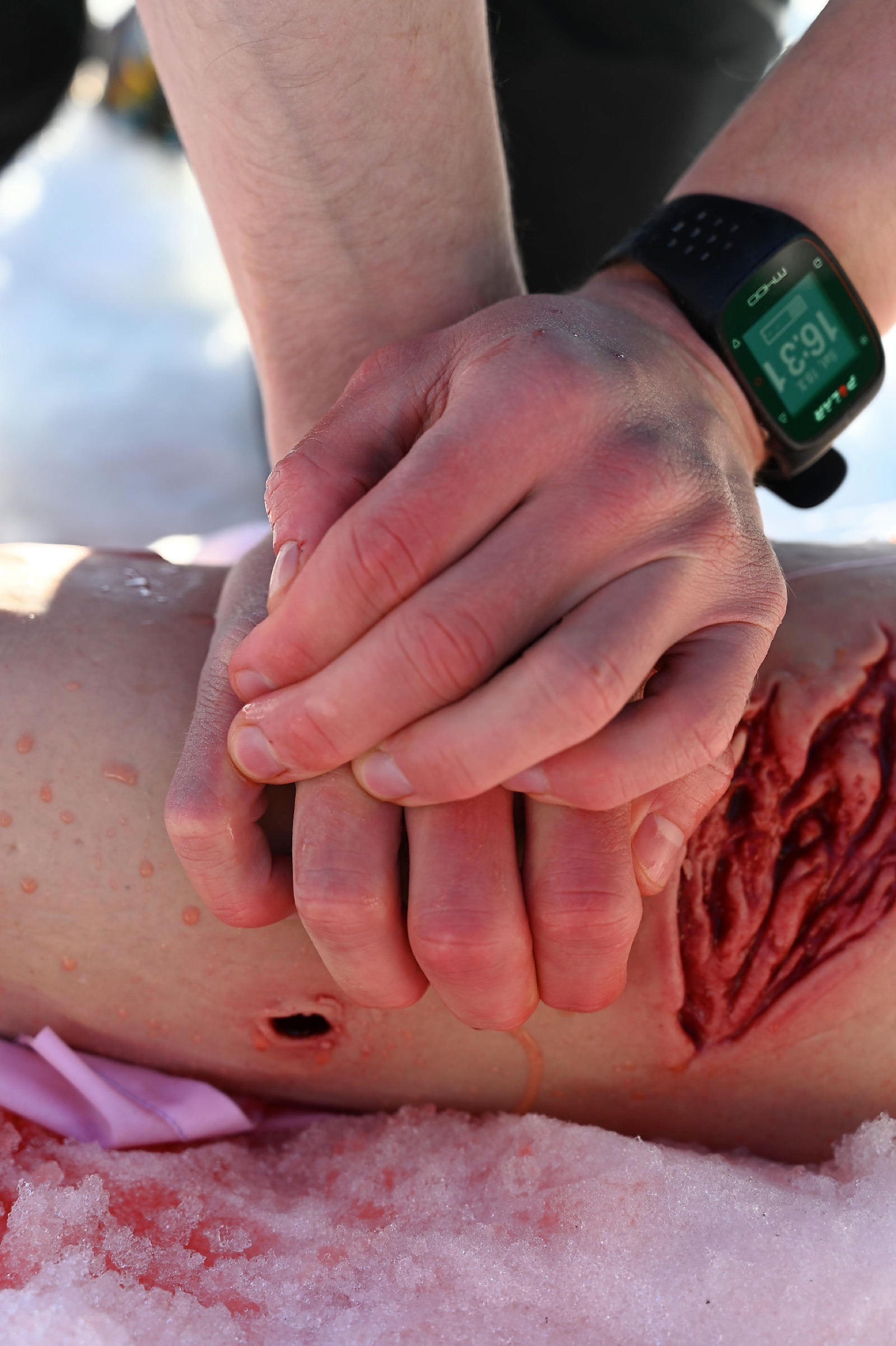
The first tool in the kit is manual compression. This means we apply pressure from the outside against the wound, and in that way stop the flow of blood. If the injury is deep, we may really have to use our body weight to stop the bleeding. Use gloves and a compress against the wound if you have one to hand, but if time is short, just use the palms of your hands. Raise the injured part of the body above the level of the heart, if possible.
Most bleeding can be stopped with manual compression, but be patient and keep up the pressure for at least 10 minutes so that the clot has a chance to stabilise.
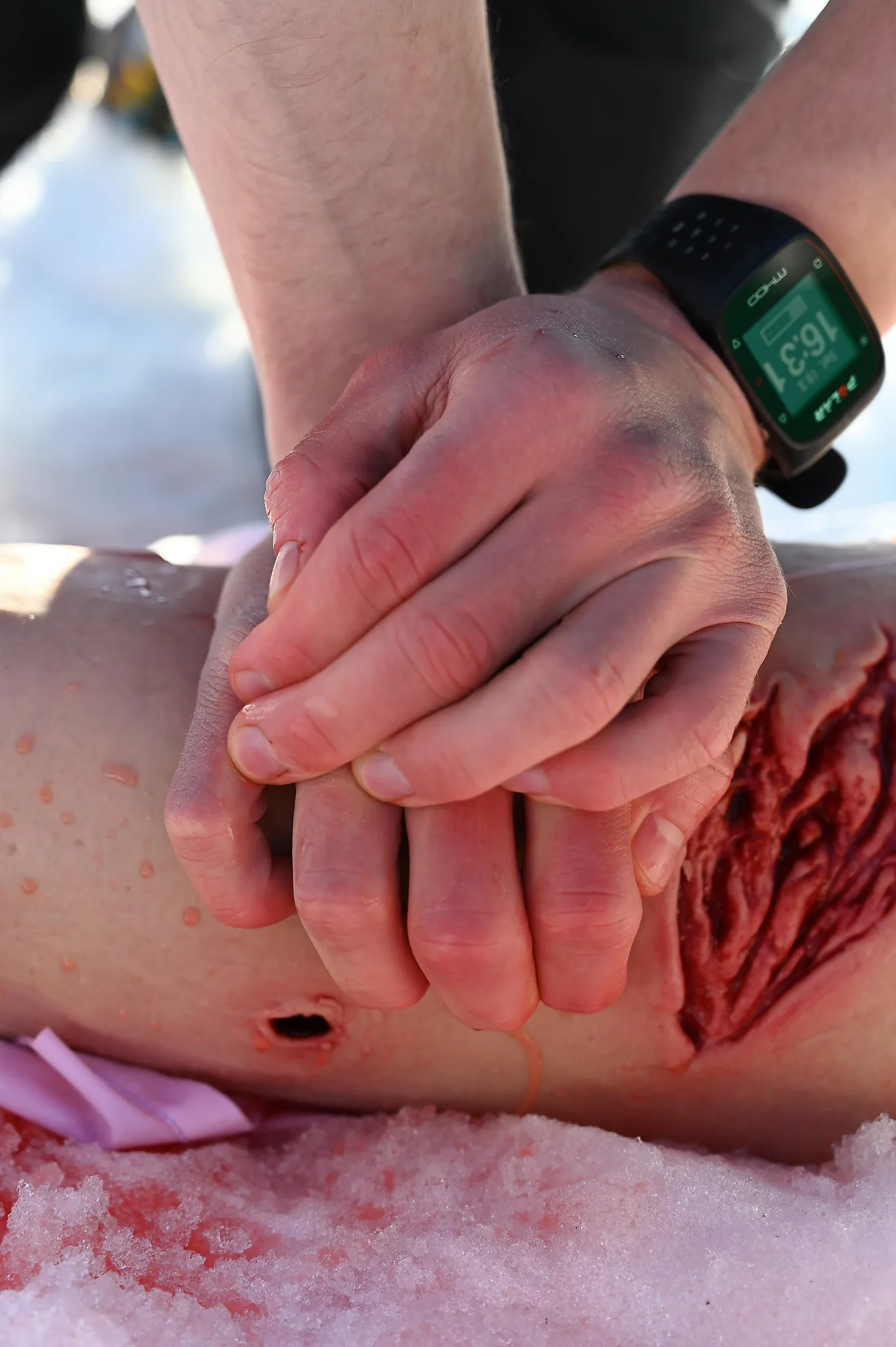
Photo: Ola Njå Bertelsen
With heavier bleeding, which tends to come from deep wounds, manual compression may not be enough. Then we have to use a technique called wound packing.
Wound packing means filling the wound with compresses or dressings, as tightly as we can manage. For the technique to work, you have to fill the entire cavity of the wound as tightly as you can, to create enough counter-pressure to stop the bleeding. A bandage can also be suitable for packing the wound.
Once the wound is packed, you can wrap it with an elastic bandage to create greater counter-pressure.
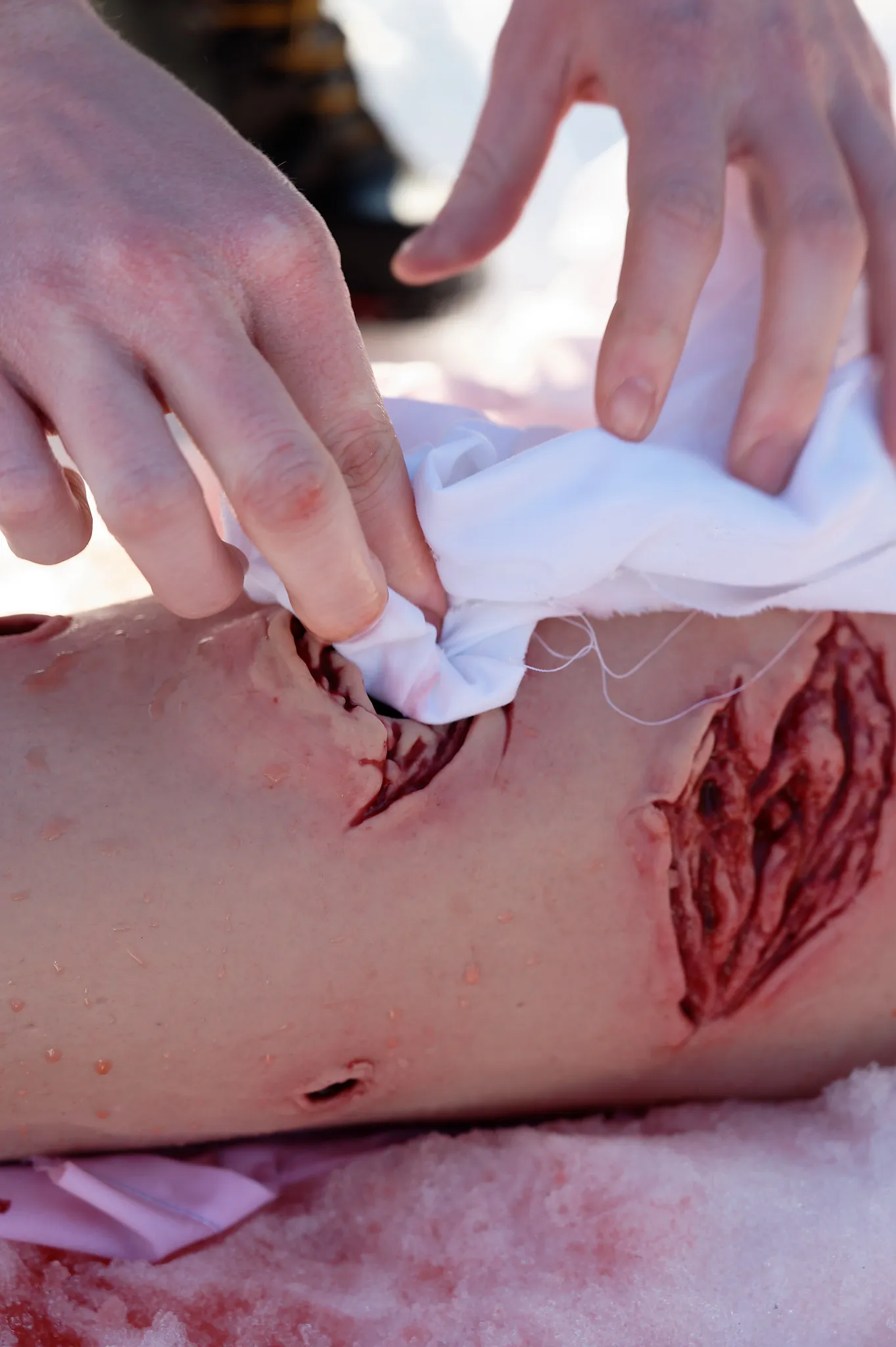
Photo: Ola Njå Bertelsen
Warmth
When we get cold, the body’s need for energy and oxygen rises, and the body’s own ability to stop internal bleeding is impaired. That is why it is very important that we take measures to prevent heat loss.
Conserving warmth is something we should keep in mind in every situation where a person is injured or ill. Even on a warm summer’s day we lose heat outdoors. That is why it is important to carry clothing and equipment that lets us keep warm.
Preventing heat loss
Film: Norsk Fjellmedisinsk Selskap
To prevent heat loss in an injured or ill person, we make sure the patient gets several layers of dry, insulating clothing, including a hat (Hovedredningssentralen, n.d.). The outermost layer should be waterproof and windproof.
The casualty is wrapped in a vapour-tight material close to the body, for example a large plastic bag. Over the vapour barrier goes an insulating layer, for example a sleeping bag. The casualty is then laid on a sleeping mat and enclosed in an outer, waterproof and windproof layer — for example a bothy bag.
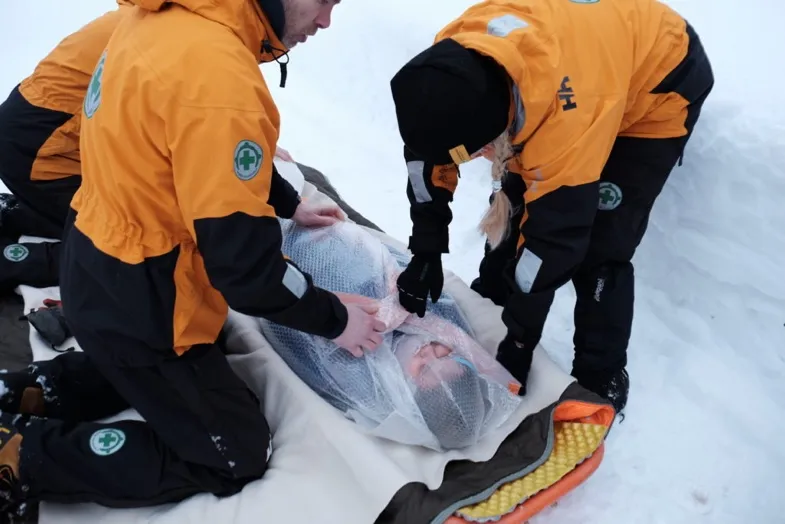
Photo: Hovedredningssentralen.
Next steps
- Alerting the emergency services — alongside lifesaving treatment
- Head injuries — a specific type of injury
- Neck and back injuries — a specific type of injury
- First-aid equipment — what you need in the pack
- First-aid scenarios — a practice template for training
Learn more
- Norsk Folkehjelp — first-aid courses and wilderness medicine
- Norges Røde Kors — first aid and rescue corps
- Norsk Fjellmedisinsk Selskap — mountain and wilderness medicine
- Helsedirektoratet — first aid