First Aid
Fractures, sprains and dislocations
This section is about fractures, sprains and dislocations. When you examine the casualty, remember to begin every examination with:
This section is about fractures, sprains and dislocations. When you examine the casualty, remember to begin every examination with:
- We check that the casualty is breathing (a cry of pain is a sign of good breathing).
- We check whether the casualty has any bleeding.
- We make sure to prevent heat loss,
before we move on to a focused examination where the casualty has pain.
Contents
Sprain / rolled ankle
A joint is a connection between bones in the body that lets us move the bones in relation to one another. The joints are surrounded by ligaments, which are there to make sure the joint is not stretched too far.
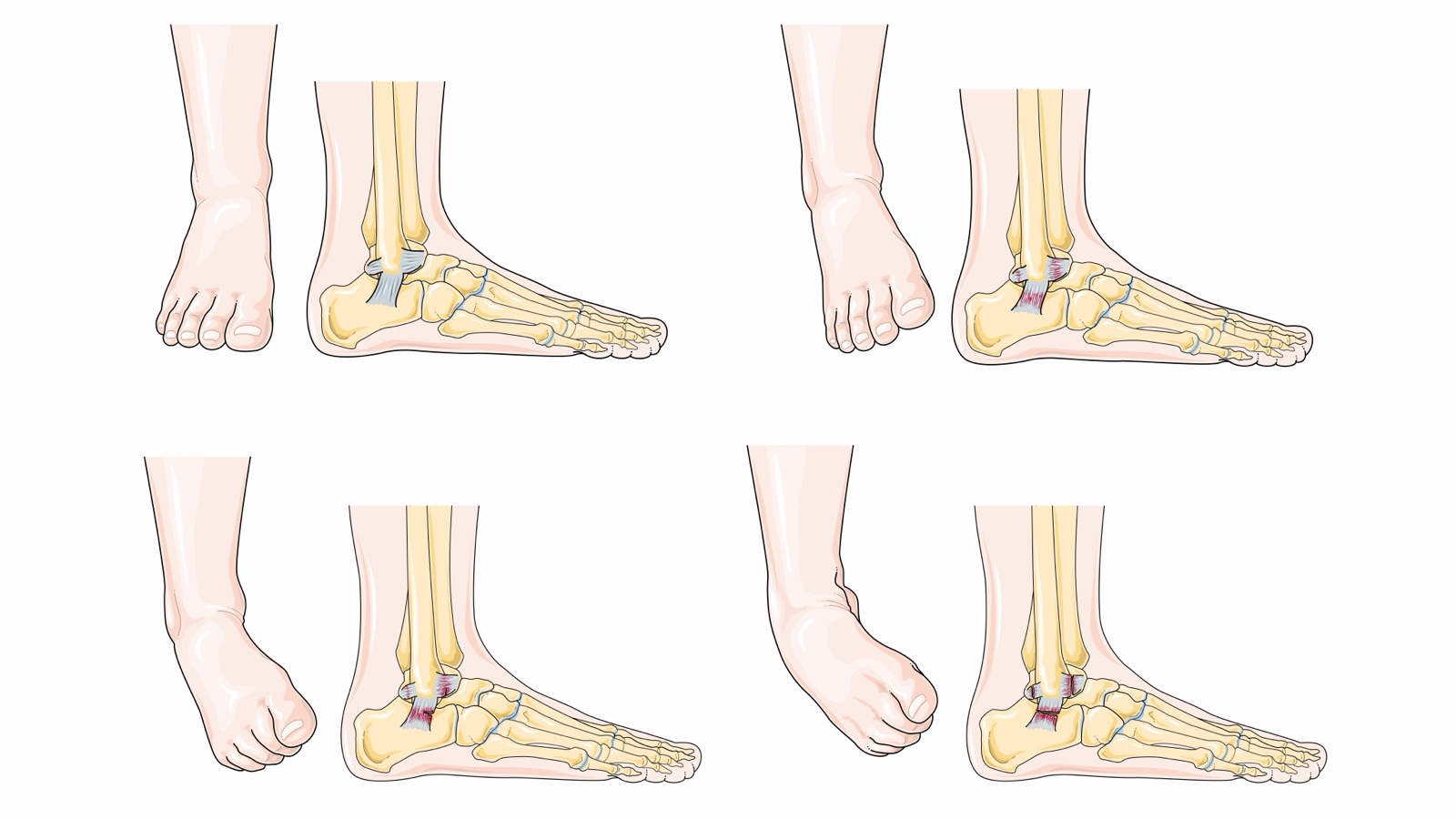
A joint sprain, often referred to simply as a sprain, occurs when a joint is twisted or stretched more than it can tolerate. This causes an injury to the ligaments surrounding the joint, and leads to an inflammatory reaction. After the joint has been stretched, for example in a rolled ankle, it is precisely these signs of inflammation that lead us to suspect a sprain.
A rolled ankle. Illustration: Laboratoires Servier, https://smart.servier.com/category/anatomy-and-the-human-body/locomotor-system/bones/
There are four signs of inflammation:
- heat
- redness
- swelling
- pain.
An ankle sprain is not uncommon on trips over rough terrain, and it is also a common sports injury.
Treatment of sprains
Suggested treatment for a rolled ankle.
Suggested treatment for a rolled ankle.
Treatment of a sprain, in cases where we do not suspect a more serious injury, consists of compression and elevation of the injured area (Lasota, n.d.).
-
Compress the joint, for example with a coban bandage.
Compression reduces pain and swelling, and can also help to stop small bleeds in the ligament.
[Apply the bandage firmly, to prevent swelling. After ten minutes you should loosen the bandage a little so the foot does not lose all its blood supply.
Apply the bandage firmly, to prevent swelling. After ten minutes you should loosen the bandage a little so the foot does not lose all its blood supply.
-
Keep the injured body part elevated in the acute phase, until the joint can bear weight. This relieves pain and reduces any bleeding from the ligament.
It is perfectly fine to move the injured joint – as long as it does not hurt a great deal. Loading it in this way increases the blood supply to the injury and speeds up the healing process.
Note that it can be difficult to tell a sprain from a fracture. If we are unsure, we must treat the injury as if it is a fracture, until this can be ruled out by medical personnel.
Dislocations
A dislocation is the same as something having ‘gone out of joint’, or the ends of the joint being displaced in relation to one another. The causes can be the same as for a sprain, but the joint has come even further out of position, so that it does not return of its own accord. A shoulder dislocation is not uncommon, and is something you may come across while climbing or on kayaking trips.
Dislocations are often painful, and the best pain relief comes either from taking the load off the joint, or from the joint returning to its original position. Putting the joint back into its original position is not without risk, as it is difficult to know whether the incident that led to the dislocation has also caused other injuries in the joint. If a fracture has occurred in any of the bones around the joint, reduction can make the injury worse. The only way to rule out a fracture is to take an X-ray of the joint before reduction.
Fractures
A bone fracture, that is, a broken bone, most often comes from someone in the party falling. Here we cover only fractures in the arms and legs, which is the most common type, and the kind we can do something about.
Symptoms of a fracture are pain and swelling, and it will also be accompanied by redness and heat at the fracture site, and resembles the symptoms of a sprain. So how are we to tell a fracture from a sprain?
Signs of a fracture:
- cannot bear weight on the injured body part
- pain when you touch the body part that is broken (not only the fracture site)
- has heard a cracking sound (cannot always be heard)
- shortened body part
- the body part is held in an unnatural position.
One concern with a fracture with deformity is that the fracture may obstruct the circulation of blood below the fracture site. If circulation below the fracture site is cut off for more than two hours, there is a risk of irreversible injury (Kjærvik, 2020). For this reason it may be relevant to consider rough re-positioning (rough reduction) of the body part if such injury occurs (National Association of Emergency Medical Technicians, 2020, p. 396).
-
Reduction of fractures
Rough reduction can be wise if the body part below the fracture site is lying in an unnatural position.
The main point of rough reduction is to straighten the limb. If you are far from help, it is almost always better to make an attempt at rough reduction than to leave the limb in a deformed position (Kjærvik, 2020). Do not let the perfect be the enemy of the good – the injury has already happened, and it takes a great deal to make it worse!
Principles for reduction of fractures (Kjærvik, 2020):
-
Tell the casualty what is going to happen, and tell them that it is going to hurt.
-
Take a firm grip below the fracture site and pull along the length of the body part, while at the same time straightening out the deformity as best you can. It is an advantage if there are two people who can help each other, so that one can hold back on the side of the fracture that is towards the centre of the body, and the other can pull below the fracture site.
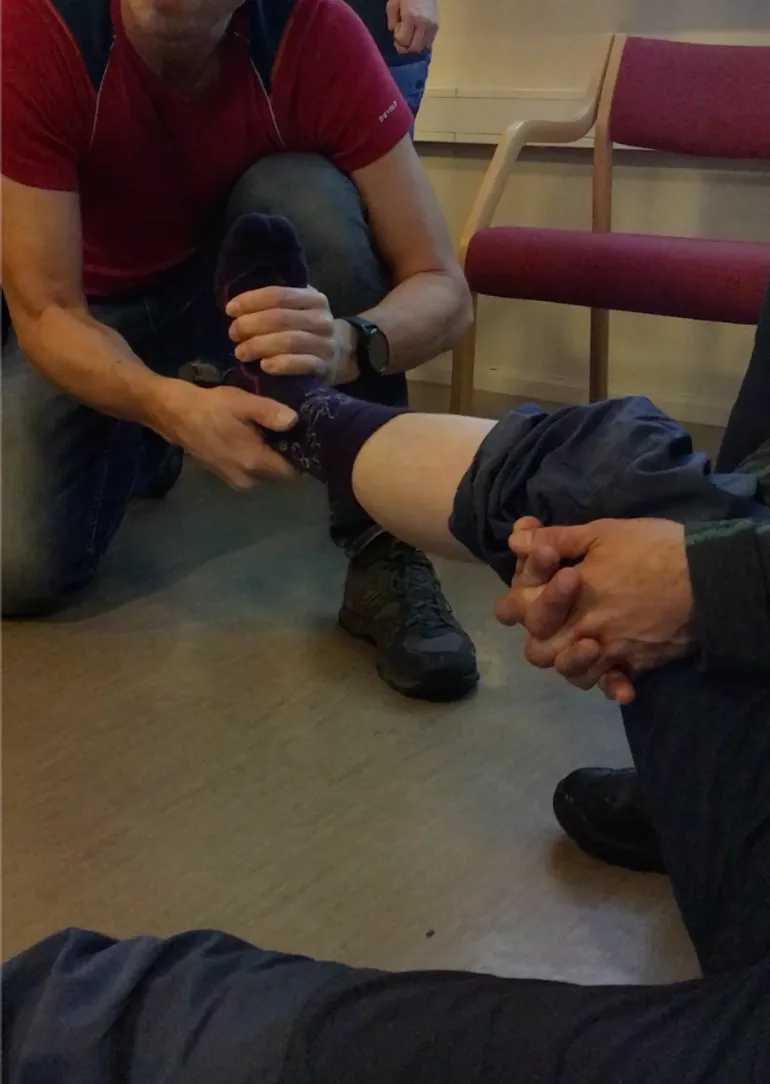
Photo: Snuitide
-
Stabilise the injured body part.
-
With treatment in mind, it is useful to divide fractures into two categories:
Treatment of open fractures
Suggested treatment for a fracture.
- If there is visible dirt in the wound, it should be rinsed away with clean water.
- Stop any bleeding using gauze compresses and a bandage.
- Note that the bandage should not be tighter than is necessary to stop the bleeding, or just as a covering if the wound is no longer bleeding.
- Consider rough reduction.
- Stabilise the injured limb with a splint.
(Simplification of the principles in National Association of Emergency Medical Technicians, 2020, p. 396)
Treatment of closed fractures
- Consider rough reduction in the case of deformity.
- Stabilise the injured limb with a splint.
What is a splint?
A splint is something that stabilises the injury during transport or while awaiting treatment. A splint can be bought, or improvised. Principles for splinting:
- The splint should be long enough that the joints both above and below the fracture are held still.
- The splint must be rigid.
- The blood circulation must not be obstructed, and it must not press against the skin.
- Avoid metal directly against the skin, given the risk of cooling.
Next steps
- Life-saving first aid — breathing and bleeding always come first
- Wounds and infection — if the fracture is open
- First-aid equipment — splints, support bandages, tape
- About pain relief — paracetamol, ibuprofen and what works
- Alerting the emergency services — transport and evacuation
Learn more
- Norwegian People’s Aid — first-aid courses and wilderness medicine
- the Norwegian Red Cross — first aid and rescue corps
- Norsk Fjellmedisinsk Selskap — mountain and outdoor medicine
- the Norwegian Directorate of Health — first aid