First Aid
First aid - scenarios
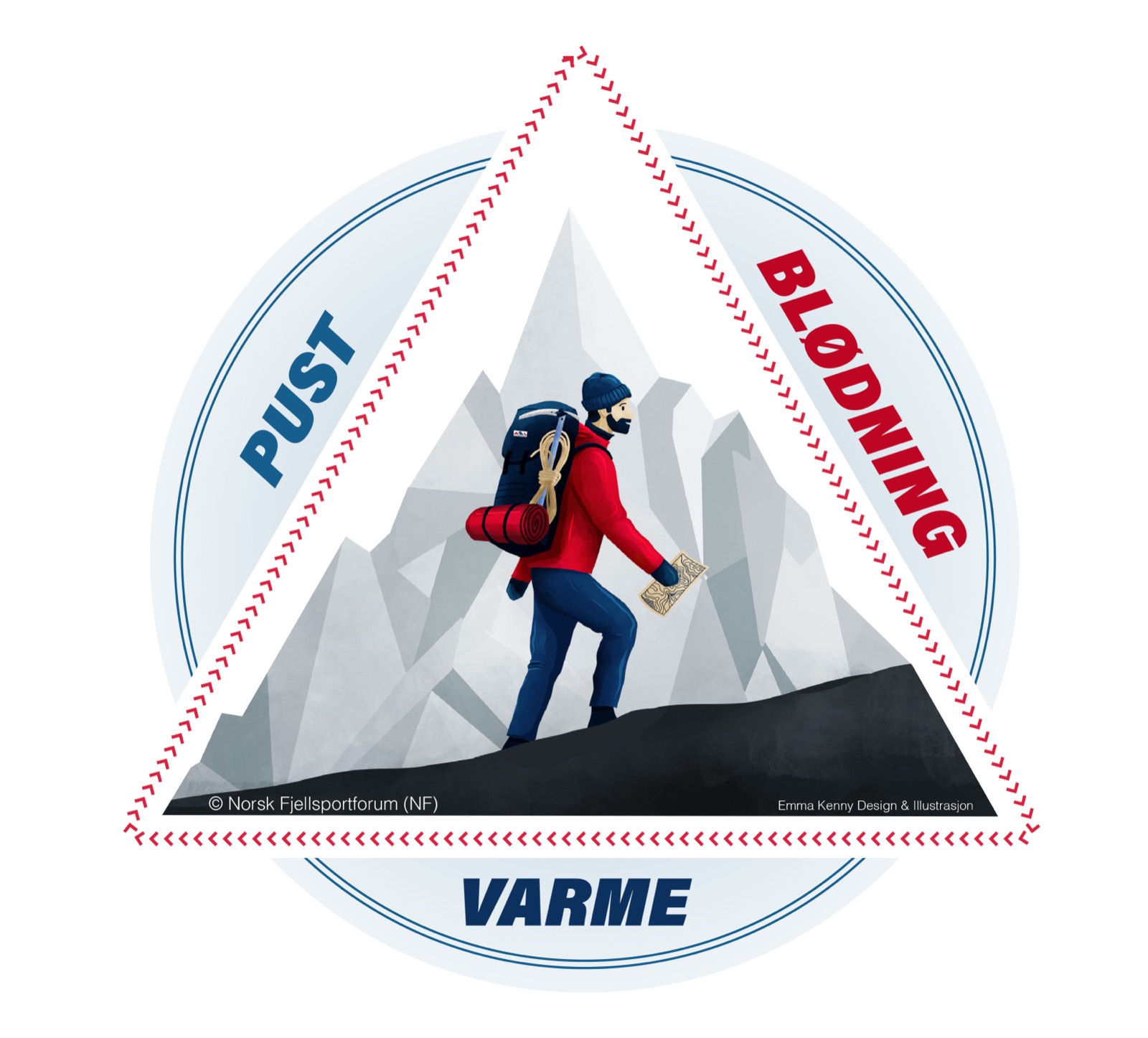
You are out on a tur and suddenly someone rolls their ankle. This can happen almost anywhere, but typically in slightly rough terrain. The person playing the casualty will experience…
Treating injuries
- Contents
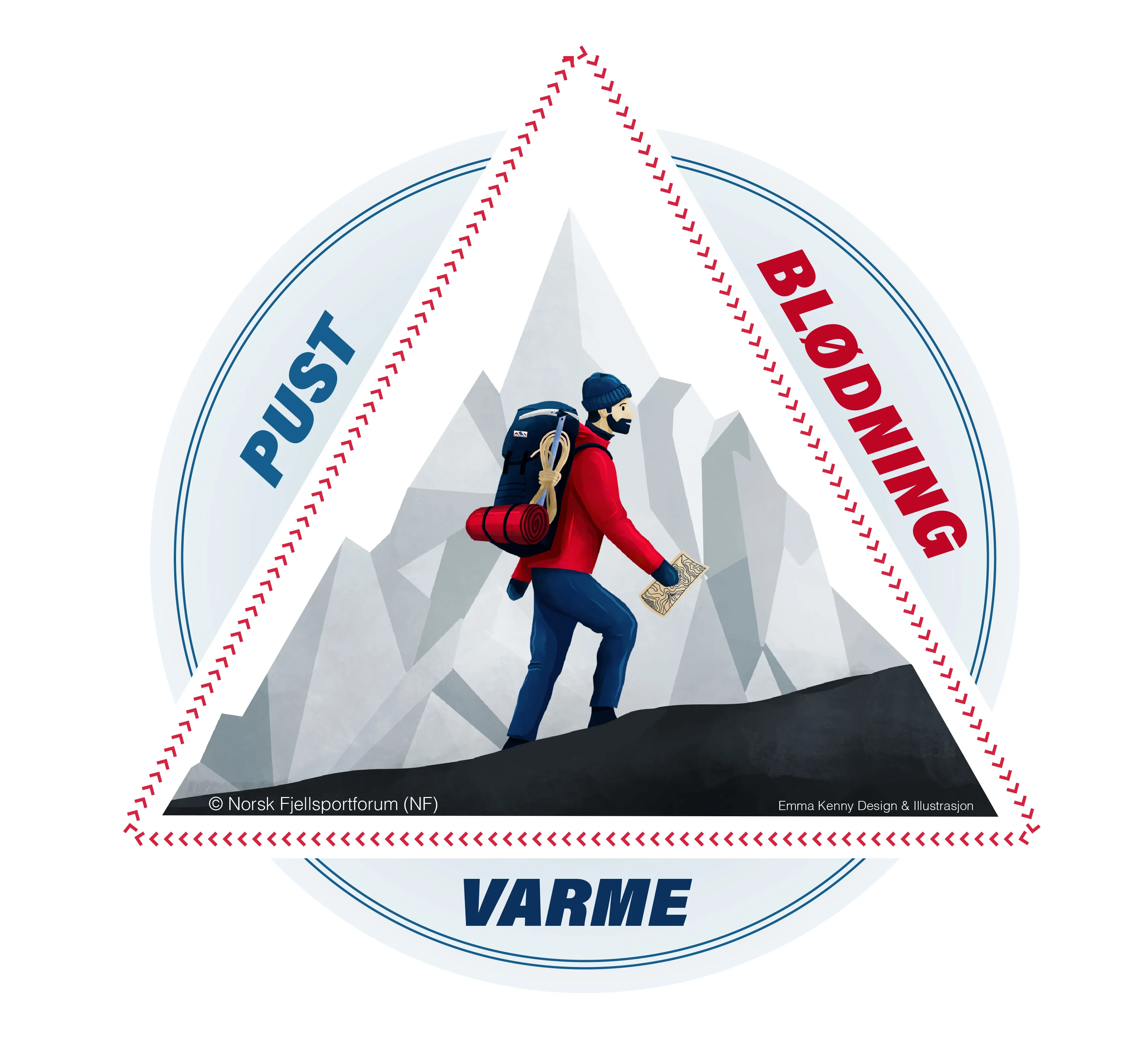
Illustration: Emma Kenny, Emma Kenny Design & Illustrasjon
Rolled ankle
Case
You are out on a tur and suddenly someone rolls their ankle. This can happen almost anywhere, but typically in slightly rough terrain. The person playing the casualty will experience a lot of pain in the ankle but otherwise be fully conscious. The person will not be able to stand properly on the foot. This hurts.
Preparation
The person who is going to be “injured” walks along with the group and falls or slips at a suitable spot. Beforehand, apply some theatrical make-up to the ankle so that it has a hint of a bluish colour. A lot of pain in the ankle, hard to put weight on.
Suggested approach
- Secure the scene and gather the group.
- Check the patient.
- Take off the shoe and check that there is no fracture.
- Look for deformity
- Did the patient hear/feel something snap?
- Can the patient put weight on the foot?
- Can you see bone ends sticking out under the skin?
- Check mobility to see whether nerves are damaged
- Take off the shoe and check that there is no fracture.
- Compression and elevation of the injury
- Apply compression
- Apply a firm compression bandage and leave it on for 15 minutes
- Elevate the injury - it should be kept above heart height
- Apply compression
- Keep the patient warm.
- Loosen the bandage and reapply it as a support bandage.
Additional information
- If the injury is very swollen and the foot is painful to put weight on, it should be X-rayed and checked for a fracture
- NB. Cooling can be pain-relieving, but is no longer part of the recommended treatment for sprains
Fall injury/head injury
Case
You find a person who appears to have fallen some distance. The person is lying below the path in steep terrain. The person is unconscious.
Variations
- The person is conscious.
- The person is “in shock” and panicking.
- Internal bleeding (harder to detect).
Preparation
The casualty gets theatrical make-up and ideally fake blood under their clothes. They should lie in a position that makes it clear this is a trauma. The casualty may well be a bit dazed, dizzy and/or nauseous.
Suggested approach
- Secure the scene and gather the group.
- Check the patient.
- Is the person breathing/clear airway
- If the person is conscious, it is easy to check breathing.
- Tell the injured person to keep completely still until you have examined them.
- Ask whether the injured person can remember what happened.
- If the person is unconscious, ensure a clear airway.
- The recovery position.
- If the person is conscious, it is easy to check breathing.
- Is there any bleeding?
- Touch bare skin and see whether you get blood on your fingers.
- Locate any bleeding and stop it.
- Internal bleeding (may look like bruising) is something you cannot do anything about.
- —> Help from the rescue service is needed, quickly.
- Keep the person warm.
- Is the person breathing/clear airway
- Alerting
- As soon as possible after examining the patient
- If there are several of you on the tur together, one can call for help while the others treat the patient.
- Care for the injured person.
- Transport of the casualty/Receive the helicopter.
Additional information
- Signs of serious head injury
- the injured person has been unconscious for more than 2 minutes.
- the injured person has been unconscious, woken up again, and later develops reduced consciousness
- the injured person has increasing headache
- you find an open wound in the scalp
- you feel a fracture or deformity in the skull
- blood or fluid is coming from the injured person’s ear, nose or mouth
- the injured person sees double or blurred
- the injured person has an unsteady gait.
- Stop the bleeding.
- Direct compression will stop most external bleeding
- Bandaging and packing
- Immobilisation (keeping the patient still)
- Elevate the bleeding site
- Pressure points
- Heat conservation.
Fractures and joints
Case
- A person slips on a slippery boulder field and puts out a hand to break the fall. Has a large pack and lands on the arm. Results in a fractured arm.
- A person on a ski tour catches the pole in slushy snow. Has a lot of speed downhill and the arm is wrenched backwards. Shoulder dislocated.
- In a boulder field, one of the participants catches a leg in a hole and falls forwards. Fracture of the lower leg.
Preparation
The casualty gets theatrical make-up and ideally fake blood at the injury site. The injury site can also be barely visible. An ankle fracture can often look exactly like a rolled ankle. Not always dislocation with a fracture or an open fracture.
Suggested approach
- Secure the scene and gather the group.
- Check the patient
- Take off the shoe/jacket and check whether there is a fracture.
- Look for deformity
- Did the patient hear/feel something snap?
- Can the patient put weight on the foot?
- Can you see bone ends sticking out under the skin?
- Check mobility to see whether nerves are damaged
- Is there any bleeding
- Touch bare skin and see whether you get blood on your fingers
- Locate any bleeding and stop it
- Keep the person warm
- Take off the shoe/jacket and check whether there is a fracture.
- Alerting
- As soon as possible after examining the patient
- If there are several of you on the tur together, one can call for help while the others treat the patient
- Care for the injured person
- Immobilisation of the fracture
- Keeping the patient still
- Splinting
- Elevate the injured area to reduce swelling around the injury site
- Transport of the casualty/Receive the helicopter
Additional information
- If the injury is very swollen and the foot is painful to put weight on, it should be X-rayed and checked for a fracture
- Ordinary fractures should be immobilised. That is, prevent the fracture from getting worse. With open fractures. Stop the bleeding, ideally without coming into too much contact with bone ends and the like. Build up and around.
- Reduction should not be attempted unless you know how. A dislocated shoulder, or fingers and toes and other things, should be put back in place as soon as possible. It hurts less to fix it straight away than to go for a long time with it out of joint.
- Splint:
- The splint should be long enough that the joints both above and below the fracture are kept still.
- The splint must be stiff.
- Blood circulation must not be restricted, and it must not press against the skin.
- Avoid metal directly against the skin, because of the cold.
Bleeding - large and small
Case
- A person has put an axe into their foot while chopping wood
- Was climbing and got a broken branch in the lower leg when he fell
- Was cutting vegetables for dinner and cut his finger
Preparation
Theatrical make-up and ideally blood capsules so that it bleeds well. The casualty does not necessarily need to be in a lot of pain. A bit of panic at the sight of blood is good.
Suggested approach
- Secure the scene and gather the group.
- Check the patient
- Is the person breathing
- If the person is conscious, it is easy to check breathing
- If the person is unconscious, ensure a clear airway
- The recovery position
- Is there any bleeding
- If the person is conscious, start by checking where the person has pain
- Touch bare skin and see whether you get blood on your fingers
- Locate the bleeding and stop it
- Direct compression will stop most external bleeding
- hold the pressure for at least ten minutes to stop the bleeding
- Bandaging and packing
- With large bleeding wounds, we must fill the wound with bandage or whatever else is available
- The wound must be packed as tightly as possible
- Immobilisation (keeping the patient still)
- Elevate the bleeding site
- Pressure points - for major bleeding
- Direct compression will stop most external bleeding
- Keep the person warm
- Is the person breathing
- Alerting
- As soon as possible after examining the patient
- If there are several of you on the tur together, one can call for help while the others treat the patient
- Care for the injured person
- Transport of the casualty/Receive the helicopter
Additional information
- It often hurts the injured person when we stop bleeding. Be aware, therefore, that the injured person may struggle against you.
- Signs of bleeding
- Thirst
- Cold sweat
- Pale
- Reduced consciousness
- Visible injuries
- Trauma that suggests an injury may have occurred (energy)
- May be in pain
General hypothermia
Case
You are out on a tur in the mountains and are going to walk a long day stage. The weather is a little above zero degrees, a brisk wind is blowing against you and there are occasional sleet showers. One of the group seems a bit worn out and you cannot make very good contact with them. On closer examination, several of their garments are wet.
Preparation
The casualty comes across as irritable, or unusually quiet or withdrawn at stops or breaks. They may also be a bit unsteady on their feet, not eating very well at meal breaks, or shivering and with chattering teeth.
Suggested approach
- Secure the scene and gather the group
- Check the patient
- Is the person breathing
- If the person is conscious, it is easy to check breathing
- If the person is unconscious, ensure a clear airway
- It can be difficult to check breathing on people who are chilled and unconscious, as they have shallow breathing
- Keep the person warm
- Put more clothes on the person
- Get out the bothy bag
- put on a sleeping bag if you have one available
- a water bottle that can take hot water can be covered with clothing and placed in the groin to warm blood going down to the legs
- Is the person breathing
- Alerting if necessary
- If the person does not regain consciousness, you must alert
- If breathing is irregular and/or shallow, you should alert
- If you cannot get the chilled person’s warmth back up, you must alert
- Care for the injured person
Burns
Case
- Sitting close to the bål, loses balance and falls towards the fire. Puts out a hand into the fire.
- Cooking on a camping stove and about to pack the equipment away. Touches a red-hot burner and gets serious burns on the hand.
- You are cooking pasta and tip a large pot of boiling water over your foot.
Preparation
Make up the injured area with a blister-like, red area and possibly open wounds. The injured person is in a lot of pain and discomfort.
Suggested approach
- Secure the scene and gather the group.
- Remove the injured person from the heat source
- Check the patient
- Is the person breathing
- If the person is conscious, it is easy to check breathing
- If the person is unconscious, ensure a clear airway
- The recovery position
- Is there any bleeding/wounds
- If the person is conscious, start by checking where the person has pain
- Cool the injured skin with clean, running water for 20 minutes
- Do not use water that is too cold, ideally room temperature
- Further cooling for 15-30 minutes can be pain-relieving; use water that is no colder than normal skin temperature. This is to avoid frostbite.
- Cover the injured skin with plastic film of the Glad Wrap type or equivalent.
- Let the injured person drink plenty of water if they are awake and not vomiting.
- Keep the person warm
- Is the person breathing
- Alerting
- Deep burns of a certain extent should be seen by a doctor, but in the acute phase it is more important to cool the injury than to get quickly to the casualty clinic.
- If large parts of the body are injured, a doctor should be contacted
- Care for the injured person
Additional information
- Plastic film will counteract fluid loss through the skin and reduce the risk of infection. If you have special dressings for covering burns (for example jelonet), these can be placed between the skin and the plastic film.
- If you continue the tur after a burn, the injured area can be covered with sterile, non-adhesive dressings. Change the dressings every day, and watch out for signs of infection that gradually get worse or come with a fever.
Drowning
Case
- Out surfing and one of the participants gets their head hit by the board. Ends up floating face down. It is about 50 metres from the beach out to the person.
- On a warm summer day in the hills, one of the participants throws off their clothes and dives into a lake without checking the bottom conditions. Ends up lying lifeless at the surface, face down.
- While crossing a river swollen with flood water, one of the group is knocked over and carried off by the current. Disappears under the water and out of sight. Is found five minutes later lifeless in an eddy 40 metres further down the river.
Preparation
A person in the water, floating face down or panicking, bobbing up and down in the water.
The drowning person uses all their energy to keep above water. It is very rare for any sound/shout to come from the drowning person, or for them to manage to signal. Drowning happens silently.
Suggested approach
- Secure the scene and gather the group
- Rescue the drowning person
- Mind your own safety first
- Use an extending arm such as a swimming float, rope or clothing if possible
- If you are pulled under by the person - try to swim downwards, then they will often let go
- Check the patient
- Is the person breathing
- If the person is conscious, it is easy to check breathing
- If the person is unconscious, ensure a clear airway
- It can be difficult to check breathing on people who are chilled and unconscious, as they have shallow breathing
- Not breathing normally = Start CPR with five rescue breaths
- Keep the person warm
- Get off as much wet clothing as possible
- Put clothes on the person
- Get out the bothy bag
- put on a sleeping bag if you have one available
- a water bottle that can take hot water can be covered with clothing and placed in the groin to warm blood going down to the legs
- Is the person breathing
- Alerting if necessary
- If the person does not regain consciousness, you must alert
- If breathing is irregular and/or shallow, you should alert
- If you cannot get the chilled person’s warmth back up, you must alert
- Care for the injured person
Additional information
https://rs.no/sikker-til-sjos/forstehjelp-ved-drukning/
Falling through the ice
Case
A person falls through the ice. What do we do to get the person who has fallen into the water out and to prevent further injury.
Variations
- has no ice claws
- throw line not available
- Unsafe ice across the whole area around the casualty
- The person in the water is panicking
- Only two people in the group, so only one who can do the rescue
Preparation
Make a hole in the ice so that there is a place to go through it. A person in the water, or a dummy in an opening. It is also possible to combine the case with one student at a time jumping down into the opening to try to rescue themselves out. Try it both with and without ice claws. It is important that the person in the water is wearing a throw line as a backup safety measure.
Have dry changes of clothing and a foam sleeping mat ready to stand and change on.
Suggested approach
- Secure the scene and gather the group
- Rescue the person who has fallen through
- Mind your own safety first
- Assess the ice conditions
- If the ice is very thin, you should not go onto it
- Check where you can most easily and safely get to in order to help
- Assess the ice conditions
- Use a rope, a long stick or the like to reach out to the person
- If you have poles, the person can use the pole tips to pull themselves up onto the ice on their own if they can manage
- Mind your own safety first
- Check the patient
- Is the person breathing
- If the person is conscious, it is easy to check breathing
- If the person is unconscious, ensure a clear airway
- It can be difficult to check breathing on people who are chilled and unconscious, as they have shallow breathing
- Not breathing normally = Start CPR with five rescue breaths
- Keep the person warm
- Get off as much wet clothing as possible
- Put clothes on the person
- Get out the bothy bag
- put on a sleeping bag if you have one available
- a water bottle that can take hot water can be covered with clothing and placed in the groin to warm blood going down to the legs
- Is the person breathing
- Alerting if necessary
- If the person does not regain consciousness, you must alert
- If breathing is irregular and/or shallow, you should alert
- If you cannot get the chilled person’s warmth back up, you must alert
- Care for the injured person
Next steps
- Life-saving first aid — the basic principles the scenarios build on
- Head injuries — specifically about head trauma
- Neck and back injuries — stabilisation vs life-saving measures
- First aid on a tur — the hub — an overview of all topics
Learn more
- Norsk Folkehjelp — first-aid courses and wilderness medicine
- Norges Røde Kors — first aid and rescue corps
- Norsk Fjellmedisinsk Selskap — mountain and wilderness medicine
- Helsedirektoratet — first aid
Text
Gina Wigestrand, Snuitide (2022)