Paddling
River paddling
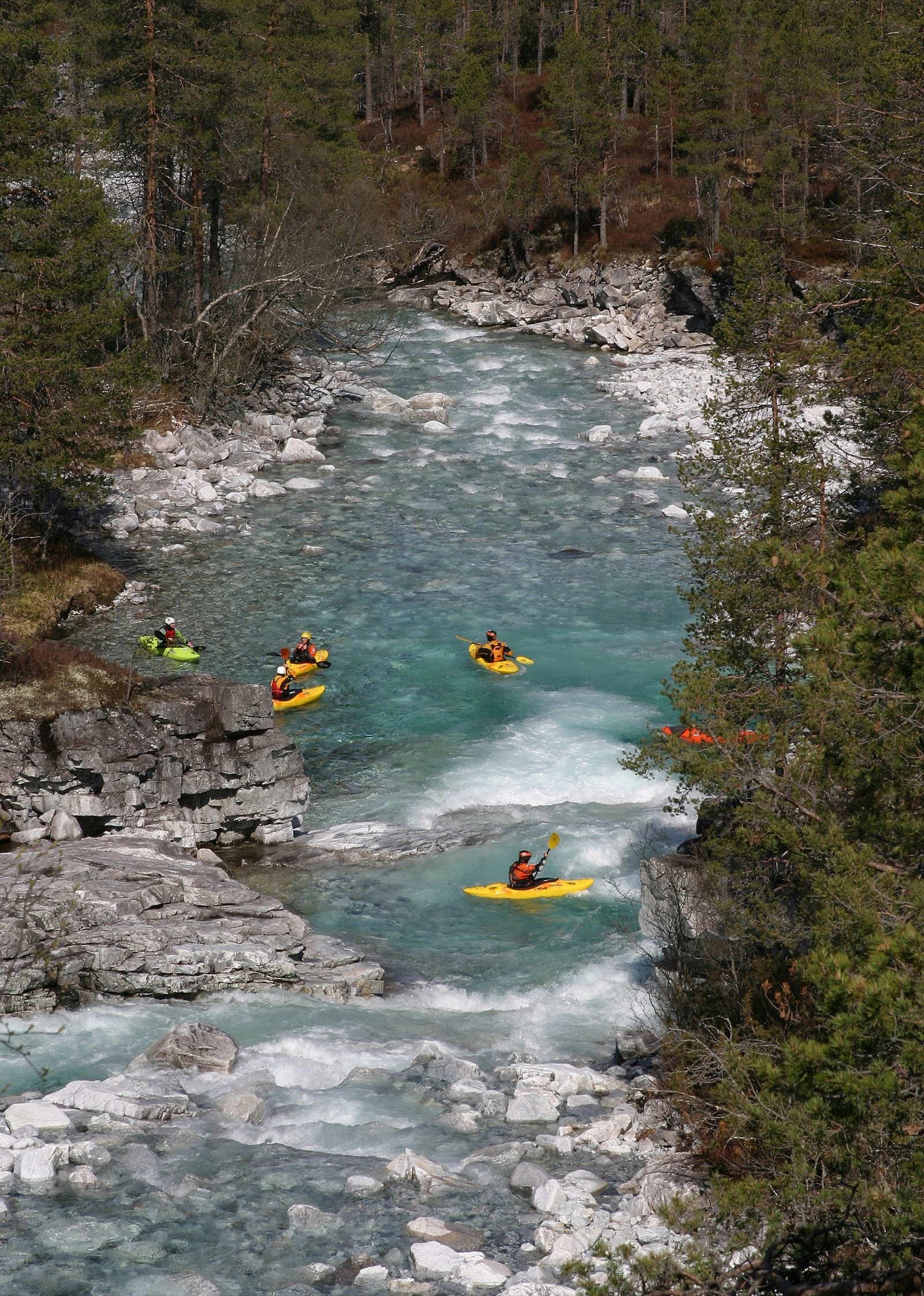
River paddling is kayaking in rapids and current — shorter boats, its own vocabulary, and a risk profile that differs substantially from sea kayaking. In Norway it means the international difficulty grading scale, rolling as a prerequisite, and rivers ranging from beginner-friendly stretches to world-class rapids.
River paddling is kayaking in current and rapids. You sit in a shorter, more rockered boat than at sea, read lines and speeds in the water, and use strokes that differ from the ones you use on flat water. It is a world of its own — its own vocabulary, its own equipment, its own risk profile and its own community.
Norwegian river paddling is modest in scale compared with sea kayaking, but there is a dedicated community around a few classic rivers. People who take up river paddling usually do so through a club or a guide — not as a solo project. It is not an activity you learn on your own.
The international classification system
Rapids are classified on an international six-part scale from Class I to VI. The same system is used across the paddling world, and it is the key to understanding which rivers and stretches are suitable for which level.
Class I is calm river with small waves and little current. Passage is easy, and you can paddle it in most types of kayak or canoe. It is more about getting used to moving water than about learning rapid technique.
Class II has small rapids throughout, small waves and few obstacles. Manageable terrain for beginners who have completed a basic course.
Class III has waves that can reach the chest, possible obstacles in the water, and requires planned route choices. Rolling technique is strongly recommended from here and upwards.
Class IV has waves over a metre, strong current and possible underwater barriers. You will capsize. Requires solid technique and experience.
Class V has extreme force, large drops and little room for error. For experienced paddlers with specific progression.
Class VI is in practice regarded as unrunnable — these are stretches that have been paddled, but where the margins are so small that it cannot be called ordinary river paddling.
Most Norwegian paddlers stay within Class II–III. There is enough challenge, enough of a learning curve and enough variety there to fill many active seasons.
The boats
A river kayak is shorter, wider and more rockered than a sea kayak — typically 2.1 to 2.7 metres long, against 4.5–6 metres at sea. That gives less speed, but better manoeuvring and a more favourable rescue position in current.
Three main types dominate:
River-runners are what most people start with. They are forgiving, stable and can take hitting rocks. A good all-round river kayak for Class II–III.
Creek-boats are higher at the bow, have less deck and are built to handle small drops and narrow sections. For more experienced paddling in Class III–IV.
Play-boats are short and responsive, designed for tricks and surfing on rapids. Fun, but they need good technique to make sense.
For Norwegian beginners you usually start with a river-runner from the club or the rental outfit.
Prerequisites — especially rolling
There is no way around it: rolling technique is all but mandatory for river paddling. You will capsize, and you need to get back up quickly — in current nothing waits for you, and there is rarely time to swim to shore and recover before you have drifted further down. Self-rescue on a river is about rolling yourself up before you leave the kayak, not about swimming to shore.
Unlike sea kayaking, where you can build up rolling over several seasons, a river paddling course usually starts either with you already having a roll, or with you taking a pool course first. It is no great drama, but it is a prerequisite for moving on in the progression.
In addition to rolling comes reading the river — eddy lines, the main current, areas where the water breaks against rocks below the surface, where the view is safe and where it is not. This is a visual skill learned by paddling, ideally with people who are better than you, and by spending time studying stretches from the shore before you set out.
Norwegian rivers
Sjoa, in the municipalities of Sel and Vågå in Innlandet (formerly Oppland), is Norway’s best-known paddling river. The rafting business started in the 1980s, and today there is a whole ecosystem of clubs, guiding companies and course providers. Sjoa has stretches from Class I to V, so there is something for every level within the same river system. Sjoa works at most water levels, and the core community of Norwegian river paddling gathers here every season.
Driva runs through Sunndal municipality in Møre og Romsdal and has sections in Class III–IV. It is a longer river (around 140 km counting its tributaries) with mighty gorges and stretches that are established targets for experienced paddlers.
Otta, a tributary of the Lågen in Gudbrandsdalen, has stretches suited to both training and touring.
Numedalslågen and Glomma have longer, calmer stretches of Class I–II that are good for touring days. Both are also used for longer packraft trips.
Trysilelva is calmer (Class II–III) and is suited to progression after the basic course.
Ulla-Førre and the tributaries of the Sjoa offer demanding Class III–V paddling for those with the experience.
Many of these rivers have strong seasonal variation following the snowmelt. Late May to mid-June is usually the period of high water flow and the most speed. Later in the summer the water level drops, and the rivers become more technical but less powerful.
Safety — a different risk profile from the sea
River paddling has hazards different from sea kayaking. At sea, cold water and distance from shore are the main risk. On a river it is current, underwater barriers (water flowing under an obstacle that holds you fast) and narrow channels — things that can go quickly from manageable to serious. So:
A throw line (a throwable rescue line in a watertight bag) is standard equipment on a river. It sits on the kayak or in the buoyancy aid, ready to use, not something you fetch when needed. More in throw line and tow line.
A helmet is mandatory, not optional. You hit rocks with your head in this discipline.
A suitable buoyancy aid for the river (a white-water PFD) has extra features — typically a plate on the chest, a throw-line attachment, and some have integrated tools.
Våttkort Elv has its own course path with its own content. The Basic River Course covers the study of current, safety routines and reading the river. After the basic course comes the River Safety Course, and then the River Technique Course. More in the Våttkort system.
Rescue in a kayak is different on a river — it is not the T-rescue that dominates, but techniques for getting paddlers out of the current and to a safe bank. Companion rescue on a river is learned as a separate discipline.
Clubs and training
The NPF Basic River Course is the natural way in. Clubs exist in the Sjoa area, around Voss, and at a few other centres — search the website of the Norwegian Canoe Association (Norges Padleforbund) for an up-to-date overview. Commercial operators such as Mad Goats and rafting companies in Sjoa also offer courses, often combined with guided trips.
Many experienced paddlers combine the basic course with a week or two at Sjoa where they can paddle every day and build skill in a close community. It is a fast pace for learning, and a large part of Norwegian river-paddling culture comes from there.
Season
The water flow governs much of the river-paddling season. Late May to mid-June usually brings the highest water level from the snowmelt, and many classic stretches are then at their most spectacular. In July and August the water level drops, and the rivers become more technical but also more forgiving. September can have steady water levels with clear air and good visibility.
The winter season is rarely an option for Norwegian river paddling — frozen rivers, low water levels and short daylight mean most people take a break.
Next steps
If you want to try river paddling: the Basic River Course is the natural way in, either through a club or a commercial operator. Rolling technique is either a prerequisite or something you take a pool course on beforehand.
If you have done the basic course: the River Safety Course and the River Technique Course are the next steps. Paddling at higher grades (IV and upwards) should be built up gradually, ideally with experienced paddlers and over several seasons.
If you want to combine river paddling with other activities: packraft opens up combination trips where you walk in to the river and paddle out, or paddle a stretch before continuing on foot.
General considerations that apply to all paddling — cold water, rescue and when to turn back — are found in rescue in a kayak, cold water and hypothermia and turning back in good time.
Learn more
- Norges Padleforbund — Grunnkurs Elv
- Friflyt — Elvepadling i Sjoa
- Mad Goats — kajakk-kurs i Sjoa
- SNL: padling
Text: Snuitide (2026).