Paddling
Cold water and hypothermia
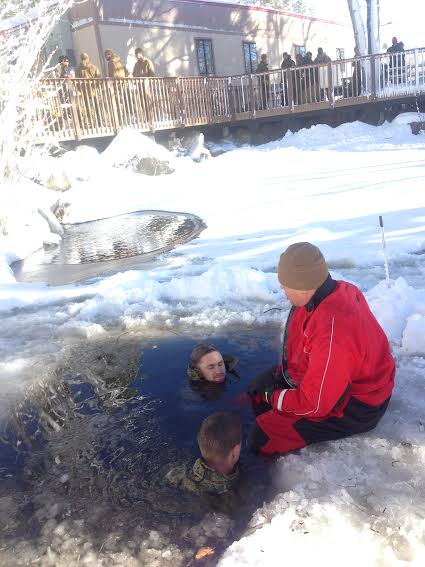
Cold water is the greatest risk in Norwegian paddling. How the body reacts, what you do to prevent it, and how you handle hypothermia when it happens.
The fear of cold water is often worse than the water itself. That is why we go so deep into the physiology here — not to frighten, but to make the knowledge ordinary. When you understand what happens in the body, it is less frightening, and you react better if it happens.
It is cold water that dominates the drowning statistics in Norwegian paddling. The cause is rarely broken legs or a direct counter-current — more often it is that the body does not work the way the paddler expected. That is why it is worth knowing what cold shock, swimming failure and hypothermia actually are, and which phases you can do something about.
What happens — phase by phase
When you end up in cold Norwegian water (6–15 degrees), the body reacts in distinct phases. Each phase has its mechanism, and each mechanism can be handled if you know what to look for.
Phase 1: Cold shock response (kuldesjokk) — 0–3 minutes
The first seconds are the most critical. When the body meets cold by surprise, you draw in your breath involuntarily — a gasp response. It is not something you control; it is a spinal reflex aimed at maximising oxygen uptake. The problem is that your head may be under water when it happens.
Then you hyperventilate. The breathing becomes fast and ragged — you breathe 20, 30, 40 times a minute. The blood circulation withdraws away from the extremities and towards the heart and brain. The muscles stiffen. Fine motor control — which you need to grip the paddle or climb onto the kayak — deteriorates drastically.
This is the phase in which most drownings in cold water actually happen, and it is not because of hypothermia. It is because of hyperventilation, panic and cramp-like movements that reduce your ability to carry out the techniques you have practised. The phase lasts only minutes. If you get out of the water or back up into the kayak within 1–3 minutes, you usually manage the rest — even if you should later develop hypothermia.
What you do: Close your mouth the moment your head goes under. Wait for the breathing to settle — it takes 1–3 minutes. Focus on holding the paddle and the kayak. It is not the time for big actions; it is the time for keeping a clear head and doing the simple things.
Phase 2: Swimming failure — 3–30 minutes
When the cold shock subsides, you enter a phase in which the body works, but with reduced capacity. You can paddle, you can swim, but the strength is less than you thought. Fine motor control in the hands and arms falls quickly. The legs, which lose blood circulation first, become particularly weak if you have to swim.
Gordon Giesbrecht, a Canadian researcher on drowning in cold water (known as “Professor Popsicle”), has documented that people who drown in this phase do not do so because of hypothermia, but because they are unable to carry out the movements needed to get up into the kayak or reach land. They give up, or they become so exhausted that they lose control.
What you do: You have about 10 minutes of meaningful strength. Use them to get up into the kayak or to reach help. Self-rescue or buddy rescue — that is what you have practised, and it should work here. After 10–15 minutes it becomes considerably harder, so speed matters.
Phase 3: Hypothermia — 30 minutes and onwards
After about half an hour the core temperature (the temperature in the heart and brain) begins to fall. That is hypothermia. The stages run from mild (core temperature 32–35°C) to moderate (28–32°C) to severe (below 28°C).
In mild hypothermia you shiver, become restless and lose fine motor control completely. In moderate hypothermia you become sluggish and confused — speech becomes stumbling and attention poor. In severe hypothermia you lose consciousness.
This is the phase that requires external help and that is potentially fatal. But it is also the phase that is easy to avoid: if you get up into the kayak before 30 minutes have passed, or if someone picks you up out of the water, you are not in this phase.
The 1–10–1 rule — a practical rule of thumb
To make it easier to think about this under stress, rescuers use the “1–10–1” rule:
- 1 minute: The cold shock. Focus on your breathing and on keeping your head above water.
- 10 minutes: You have meaningful movement. The rescue must happen within this window of time.
- 1 hour: The approximate limit for how long you can be in cold water before hypothermia becomes severe (approximate; it varies greatly depending on body, clothing and activity level).
These are not precise limits — a person in a drysuit can stay warm considerably longer — but they give a mental framework for how fast things have to go.
Why your choice of clothing is your best tool
Prevention is not seconds to work within, the way rescue is. It is hours.
A drysuit is a membrane between you and the water. Under the drysuit you stay dry. That means your body produces heat as normal, and it is not drawn out of you. A person in a drysuit can be in 6-degree water for several hours before hypothermia becomes critical. The same person without a drysuit may have minutes.
A wetsuit is watertight on the outside, but it lets water through the inner layer. The water is warmed by your body and becomes a layer of insulation. It works far better than no suit, but it is not equivalent to a drysuit.
Layering under a wetsuit or drysuit — merino wool, synthetic materials that retain heat when they are wet — makes a big difference.
The head loses heat quickly. A head covering (a hat or a neoprene hood) under a wetsuit can be the difference between mild hypothermia and severe hypothermia.
This is not about chasing gear — it is about knowing which principles work, so that you can make the right choices. More on choice of clothing and the layering system under clothing.
Prevention number two: Never alone, and never beyond your competence
A person who stays together with others has a far better chance than one who is alone. It is not drama — it is statistics. A partner can call for help, keep track of symptoms you do not notice yourself, and carry out a rescue if something goes wrong.
Paddling in cold water alone is paddling without a safety net. If you capsize, whether you get back up or not depends on your own skills and your body. Many people are good enough for it — but it is not an activity you do without having thought it through carefully.
The other thing is to be realistic about your level of competence. If you are new to paddling, you start on a calm lake or a sheltered fjord area, not on an exposed coast or in strong wind. It is not gatekeeping; it is respect for the fact that the environment changes the conditions in ways that take experience to handle.
First aid for hypothermia
If you rescue someone from cold water, or if someone is brought up onto the shore, it is important to know what not to do.
Do not rub the person. It was in old textbooks. It hurts, it damages skin that is sensitive because of the cold, and it directs blood flow out to the extremities (which are cold) instead of inwards to the heart and brain. It is thoroughly discredited in modern first-aid practice.
Do not immerse the person in warm water. Sudden warming of the extremities can cause “afterdrop” — the cold blood from the arms and legs flows towards the heart before the extremities have warmed up, and the core temperature can in fact fall further.
Do this instead:
- Get the person out of the water — slowly, carefully, no sudden movements.
- Remove wet clothing.
- Wrap the person in dry, insulating material (dry jackets, a sleeping bag, a blanket).
- Lay the person horizontal, not upright.
- Be cautious with increased activity. If the person is conscious, warm drinks (not alcohol, not caffeine) can help internally — but only if the person can swallow safely.
- If the person is unconscious but breathing, place them in the recovery position and call 113. If the person is not breathing, start cardiopulmonary resuscitation (CPR) immediately and continue until medical personnel take over. In a state of hypothermia the breathing can be very slow and weak, so check the breathing for up to one minute before you conclude. Never give up CPR on a hypothermic person before they have been warmed up — cooling protects the brain, and resuscitation can succeed even after a long time.
There is a saying: “You are not dead until you are warm and dead.” People who have been in deep hypothermia over a long time have survived without brain damage because cooling protects the cells. It means that passive warming of a hypothermic person can be the right way, and that active warming (rubbing, warm water, vigorous movement) can be harmful.
Secondary drowning and post-rescue collapse
There are two other phenomena worth knowing about:
Secondary drowning is when a person drowns hours or days after the incident seemed to be over. It happens because water that was drawn into the lungs causes irritation or damage that prevents the lungs from working normally. The symptoms are breathlessness, coughing and a change in mental state. If someone has got water in the lungs, they should be observed closely in the hours that follow, even if they look fine at the scene.
Post-rescue collapse is when a person who was rescued from cold water suddenly becomes unconscious or has a cardiac arrest right after they have come up. It happens partly because the mental relief triggers parasympathetic activation (the rest system), which can lower the blood pressure. If someone who was rescued becomes unconscious shortly afterwards, they should be treated as a cardiac patient until proven otherwise.
Both of these phenomena are unusual, but they underline that a person who was rescued from cold water is not “finished” with the incident just because they were out of the water. They should be observed, and they should often go to hospital even if they say they are fine.
Norwegian figures
Redningsselskapet reported 79 drownings in Norway in 2023 and 95 in 2024 — a clear rise. A significant proportion happen in cold water, and a large share could have been avoided with better use of life jackets, choice of clothing and competence.
The pattern that recurs in the statistics is not that people die of hypothermia, but that they drown in the cold-shock phase — panic, hyperventilation and a lack of rescue technique in the first minutes.
Acclimatisation and the winter-bathing movement
There is a phenomenon of its own in Norwegian friluftsliv: winter bathing. People who bathe regularly in cold water throughout the year report that the body acclimatises over time — the cold shock becomes less powerful, and the tolerance for hypothermia increases. It does not mean they are immune to cold water, but that the response becomes less dramatic.
This is not something you take up alone, but it is worth knowing that the body adapts, and that experienced paddlers who have been in cold water through many seasons have a different response to cold than beginners do.
Practical implications
For you as a paddler:
- Buy or borrow a drysuit or wetsuit before you paddle in cold water. Do not let this be the thing you “are waiting to invest in”.
- Take Grunnkurs Hav or the equivalent, where you learn rescue technique in controlled conditions.
- Paddle with others. It gives a real safety net.
- Learn to read the weather forecast and the conditions — wind, waves, water temperature. “Turn back in good time” is a rule that applies just as much at sea as in the mountains.
- If you are going to paddle far or in an exposed area, take a VHF radio or mobile phone in a waterproof case.
Next steps
If you do not have rescue technique, start with rescue in a kayak.
If you are going to paddle in stronger conditions, learn to read wind, waves and current.
If you are unsure about when to turn back, read turning back in good time.
For more on the Våttkort system and NPF Grunnkurs, see the Våttkort system.
Learn more
- Redningsselskapet — sea-sense rules and drowning statistics
- Norges Røde Kors
- Norges Padleforbund — Våttkort
- Giesbrecht & Steinman, Immersion into Cold Water (chapter in Wilderness Medicine, Auerbach, 7th ed.) — the professional standard on cold water immersion physiology.
Text: Snuitide (2026).