Paddling
SUP
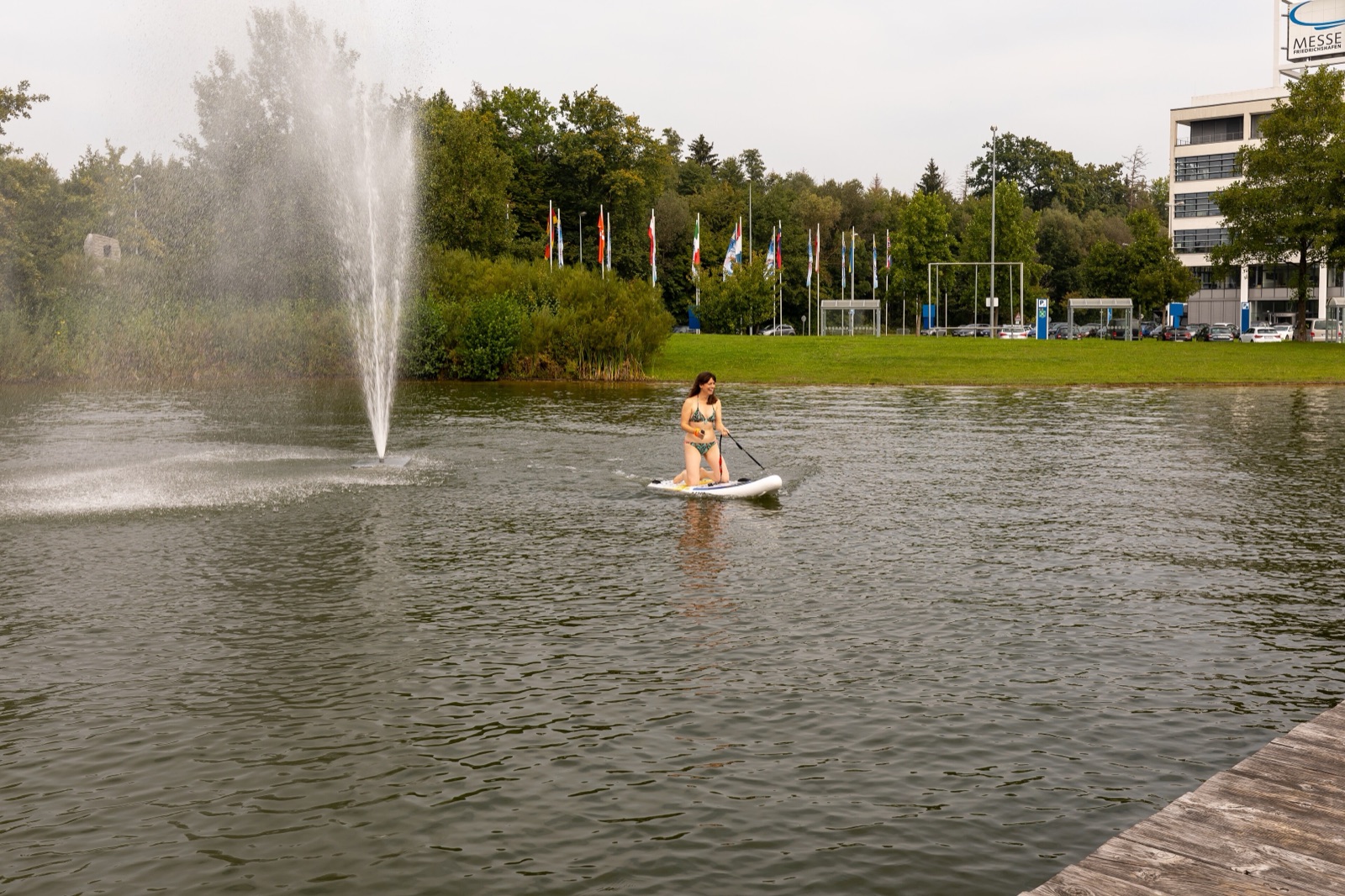
SUP — stand-up paddleboard — is paddling from a standing position on a board. A low-threshold way in, but wind on the water and cold water mean there is more to know than first meets the eye.
SUP stands for stand-up paddleboard — you stand on a board and paddle with a long paddle. It is as simple as it sounds, and it is the reason SUP has gone from niche to mainstream in Norwegian paddling within a few years. Today SUP is probably the most widely practised form of paddling in Norway when you count recreational and social paddling. Low thresholds, light inflatable boards that fit in the boot of a car, and easy hire arrangements have made the activity accessible to almost anyone.
That does not mean SUP is without complexity. It is low-threshold on calm water in fine weather. On the sea in wind, or in a current, it is something else — and cold water in Norway adds a dimension of risk that is often forgotten when the board looks so peaceful.
Where SUP comes from
Stand-up paddleboarding has its roots in Polynesian boat tradition. In its modern form it was reinvented in Hawaii around the year 2000 — surf instructors on Maui began standing up on their surfboards to get a better view of their pupils, and discovered that it was an activity in its own right. From the Pacific, SUP spread to the United States and Europe, and arrived in Norway around 2010.
Here SUP met almost ideal conditions to grow: thousands of lakes, sheltered fjord arms and archipelagos, and an audience that wanted to try paddling without investing in a kayak and courses. Inflatable boards that pack down into a large bag also meant that SUP could be stored on a metre of shelf and carried on the tram — the kayak has never had that flexibility.
Types of board
There are several types of SUP board, and what suits you depends on what you want to use it for:
All-round boards are wide, stable, and made for lakes, sheltered coast and calm fjord. The easiest to start on because it tolerates loss of balance and gives plenty of buoyancy. Most hire boards and first purchases are all-round.
Touring boards are narrower and longer — designed to move more efficiently over longer distances, and to hold a course in light wind and waves. Used by those who paddle longer coastal trips or systematic touring.
Race boards are narrow, long and low in the water. For those who want to paddle fast and know what they are doing.
Surf boards are shorter and more manoeuvrable, built to ride sea waves.
River SUP boards are special boards constructed for rivers and rapids — shorter, with more rocker (an upturned bow and stern), and often with fixed attachments. A discipline of its own with its own skills.
Inflatable vs hard board: Inflatable boards are cheaper, easier to store and transport, and tolerate knocks better. Most people in Norway start on an inflatable because the threshold is lower. Hard plastic boards are more responsive and hold their shape better on long trips, but are more complicated to store and transport.
Why SUP has grown so quickly
Three things make SUP attractive to people who would not otherwise have paddled:
First, it is low-threshold in a formal sense. You do not need a course or certificate to try it. You hire or borrow a board, get a short briefing on the beach, and paddle out. For most people the first half hour on a calm lake goes fine.
Second, it is social in a way that a kayak is not. You stand upright, see the landscape around you, and can talk to your paddling partner while you are out. That opens the activity to groups who would not otherwise have sat in enclosed craft.
Third, the board is flexible. It can be used for touring, training sessions, yoga on the water, fishing from the board, or as a platform for surfing. Few paddling disciplines offer the same breadth of uses.
The risk picture — wind is the big trap
Here comes what is often forgotten: SUP looks peaceful on calm water in fine weather, and so it is. But the SUP board sits high in the water with a large area above the surface, and it catches the wind strongly. A person who paddles out in light wind can suddenly be a long way from shore if the wind picks up — and because the board drifts faster than the paddler can paddle against it, the situation can develop from pleasant to serious within minutes.
This is a known accident category. Redningsselskapet reports that a total of 95 people drowned in Norway in 2024, an increase of 20 per cent on the year before, and an ever-growing share is linked to small boats and boards — particularly people who drift out and do not come back.
The most common mechanism is not that someone capsizes and drowns, but that someone drifts out — an offshore wind takes them with it, they cannot paddle back in, and they end up in open water without a buoyancy aid, sometimes without anyone knowing where they are.
The other risk is cold water. The sea temperature along the Norwegian coast is between 6 and 15 degrees for most of the year. If you fall off the board without a leash and without a buoyancy aid, the situation can become serious quickly. More in cold water and hypothermia.
A buoyancy aid is not optional. In most cases, SUP paddlers who have drowned in Norway in recent years did not have a buoyancy aid. Use one.
Leash — when it helps and when it harms
A leash is a cord that attaches you to the board. It keeps the board with you if you fall off. That sounds like a sensible safety rule, but it is a little more nuanced than that.
On lakes and sheltered coastal water, a leash is good. If you fall off, the board lies right beside you as a flotation object. You can climb back up or rest on it while you wait for help. Use a coiled leash that does not trail and slacken around your legs.
On rivers, a leash can be dangerous. If the board snags on an underwater obstruction or a tree beneath the surface, it drags you down. In a strong current this can become a fatal situation. Many river SUP paddlers use a breakaway leash designed to release quickly under load, or no leash at all — they would rather rely on swimming to shore if they fall off.
In waves and surf a straight leash is often used to keep the board with you, but it is shorter so the board does not snap back at you when a wave takes it.
In short: a leash is not universally safe. What is safe depends on where you paddle. Weigh up the conditions before you put it on.
Uses in Norway
Lake SUP is the most common. Mjøsa, small lakes in eastern Norway, and thousands of other lakes are perfectly suited to peaceful SUP trips on a summer evening.
Coastal SUP works in sheltered areas — the archipelagos of southern Norway, inner fjord arms, island-hopping in smooth water. With experience and attention to the wind, you can paddle longer coastal trips.
Fjord SUP is fine in the inner Hardangerfjord, the inner Sognefjord and similar sheltered fjord stretches when the weather holds.
River SUP exists as a niche, but requires specialised equipment, training and assessment of conditions. Not something to begin with.
SUP yoga and social paddling are established uses. They work fine on still water and are one of the reasons SUP has drawn in audiences beyond classic paddling.
Winter SUP is a thing in milder areas — particularly southern Norway and inner fjords where the water does not freeze. It requires a drysuit and good planning, but offers strange, beautiful experiences.
Season
May has cold water, but it is paddleable with a wetsuit or drysuit.
June to September is the core season. The water is at its warmest — up to 18–20 degrees in the south on the warmest days — and the days are long.
October brings shorter days and colder water, but can be beautiful. It requires a little more planning and better clothing.
November to April is mostly only possible in southern Norway and in sheltered inner fjords where the water does not freeze over. A drysuit and solid competence are a prerequisite.
Safety equipment — the basics
Even though SUP is the easiest form of paddling to start with, it is not equipment-free. Three things should be in place before you set off:
- Buoyancy aid — not optional, not negotiable. For SUP a 50N paddling vest is typically good — it allows movement without hindering your balance on the board.
- A leash matched to where you paddle (coiled for lake/sea, breakaway for river, short for surf)
- Clothing matched to the water temperature, not the air temperature — see clothing
For longer trips or paddling in more exposed areas, a whistle, a waterproof phone case and the ability to read weather conditions come into the picture. More in reading wind, waves and current.
Next steps
If you want to try SUP for the first time: find a hire place by a lake or sheltered beach, hire an all-round board, and start on calm water. Do not paddle out when it is windy, and use a buoyancy aid from the start.
If you have paddled a little and want to go further: learn to read the wind and conditions before you paddle further from land. There is no formal Våttkort progression for SUP of the same kind as for kayak, but the Våttkort system has elements of it, and commercial operators offer SUP-specific courses. A technique course or a SUP trip with an experienced guide gives more than any tutorial video.
If you want to expand: river SUP, SUP surfing, or longer coastal trips are natural next steps, each with its own training need. Or you can build a bridge to other forms of paddling — the skills from SUP transfer in part to the kayak, particularly the feel for wind, water and balance.
General considerations that apply to all paddling — conditions, cold water, and when to turn back — apply on a SUP too. More in cold water and hypothermia and turning back in good time.
Learn more
Text: Snuitide (2026).