Gear
Canoe
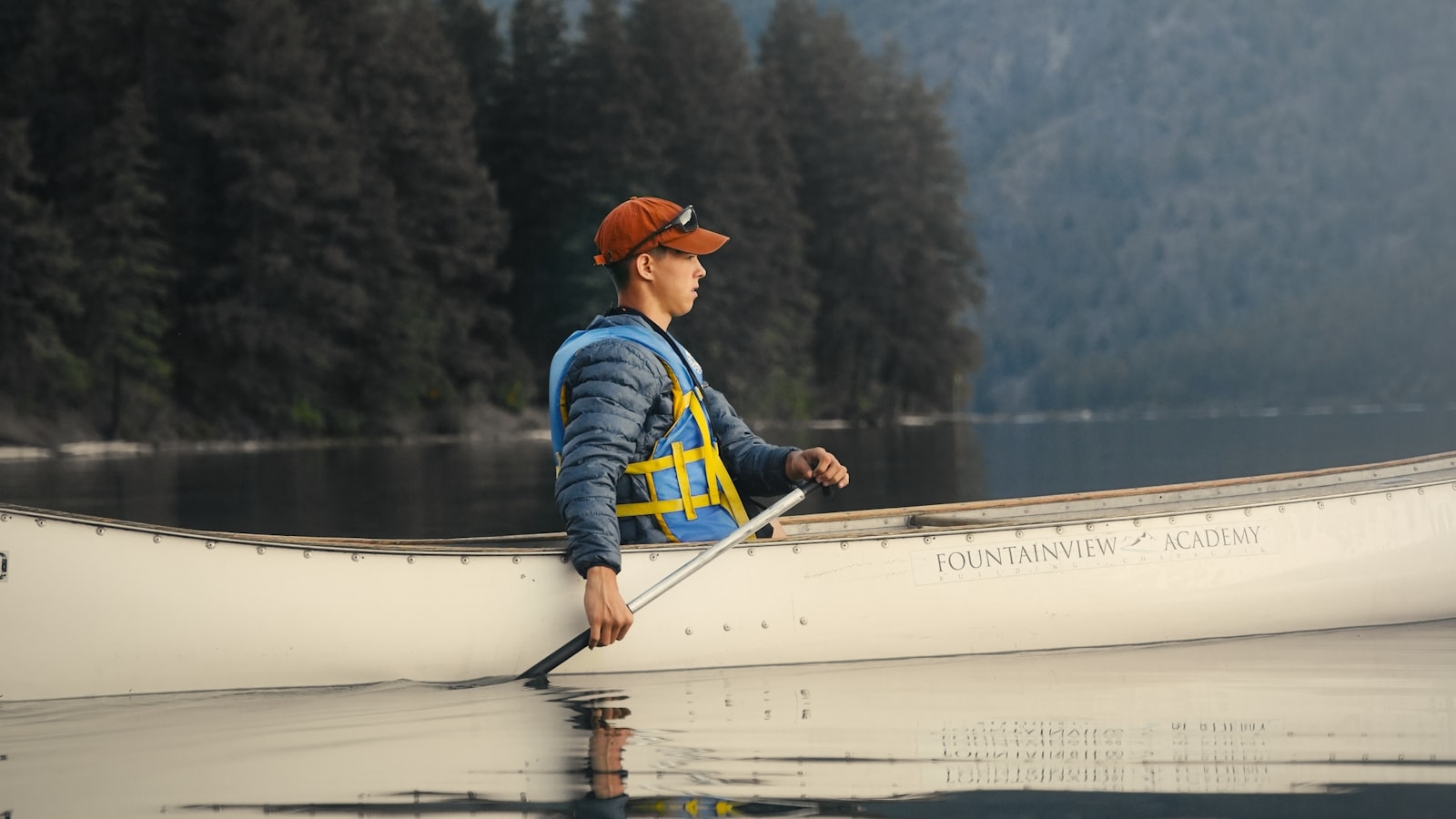
An open craft paddled with a single-blade paddle, where you sit or kneel on top of an open deck. The canoe carries loads and people in a way no kayak does, and is the simplest form of paddling to begin with.
A canoe is an open craft — you sit or kneel on top of an open deck and paddle with a single-blade paddle. It is the opposite of the kayak: where the kayak closes you into a watertight space, the canoe lets you sit freely with your legs stretched out, keep equipment, load and children around you, and look straight out across the water. On a lake and on calm river, the canoe is the flexible solution.
As a craft, “kano” covers a wide range — from short solo canoes to large expedition canoes that can carry two adults, two children and a week’s worth of equipment. This article deals with the canoe as equipment: the types, the materials, and what is worth knowing before you hire or buy one. For the paddling itself — technique, where in Norway, safety — see canoe in the paddling domain.
Roots
The modern canoe — what in Norwegian we tend to call the “kanadakano” (Canadian canoe) — has roots in North American indigenous tradition, particularly among the Algonquin and Iroquois peoples in the great forest and river regions. The original hull was a hollowed-out tree trunk, covered with birch bark, sewn with tree roots and sealed with pitch. The boat was light, hard-wearing, and suited to being carried between lakes (“portage”).
When Europeans came to North America in the 1500s and 1600s, they adopted the canoe for the fur trade and exploration — it was the only craft that worked in the network of rivers and lakes that covers the northern hemisphere. From the late 1800s a sport-canoe tradition developed, particularly in Canada and then in Scandinavia.
Today the canoe is an international paddling discipline with its own clubs, course progressions (the NPF Våttkort has its own Canoe track) and a small but active community in Norway — particularly tied to Femundsmarka and similar large lake and river systems.
The main types
Canoes come in several categories according to use:
Tour canoe (recreation canoe) is the standard choice for most people. Three to four metres long, broad and stable in flat water, designed for lake and calm river. Carries 200–300 kg of load, which covers two adults, one or two children, a tent and equipment for a weekend or week.
Wandering canoe (touring canoe) is a little slimmer and longer, designed for longer trips. More efficient in the water, but also a little less stable — it demands a little more balance from the paddlers.
Expedition canoe is the largest and carries the most load, often over 5 metres long and with a capacity over 300 kg. Used for longer wilderness trips, often in regions such as Femundsmarka, Pasvik or Swedish and Canadian wilderness areas. Less common in Norway than in Canada and Sweden, but they exist.
Solo canoe is shorter (typically 3–4 metres), narrower, and designed for one paddler. Less stable than a two-person canoe, but more responsive and efficient solo. It can be paddled kneeling from the middle or seated on an asymmetric seat.
Slalom canoe is short, light and specialised for rapids and rapid manoeuvring. More for sport than for outdoor use.
For more depth on canoe paddling as a discipline, see canoe in the paddling domain.
The materials
The canoe’s choice of material has its own historical shifts, and there is still an active field of choice between several materials:
Royalex was for a long time the gold standard for tour canoes. A composite plastic type: ABS foam laminated between plastic shells, with a vinyl coating on the outside. Robust, flexible, it stayed afloat even when damaged, and withstood years of wear on shallow rocks. Production was shut down in 2014 when the factory that made Royalex closed. Used Royalex canoes from the 1980s to the early 2010s are still found in many clubs and with private owners — they may well last another 20–30 years if they are not exposed to strong UV.
ABS composite is the modern replacement for Royalex. Layered plastic with a foam core — the same basic principle as Royalex, but with slightly different chemistry. A good balance between weight and strength, often a little heavier than fibreglass but more hard-wearing.
Polyethylene is rotomoulded plastic — the same process as plastic kayaks. Affordable, robust, heavy. Much used in hire, clubs and for canoes that must withstand hard use over years. A polyethylene tour canoe typically weighs 30–35 kg.
Aluminium was common before, less so now. Durable and affordable, but cold against the body, noisy against rock, and less elastic when you hit obstacles (you get dents that do not straighten themselves out). Still used for hire in some countries and areas.
Wood/canvas is the classic way of building. Wood strips — typically cedar or ash — are glued together and covered with fibreglass laminate, or built as traditional rib-and-plank construction with stretched canvas over them. Beautiful, requiring maintenance (varnish or oil every year or every other year), and often handmade or built on a course. Service life can be over 50 years with good care.
Fibreglass composite is lighter than polyethylene and responsive in the water. A good balance between weight, performance and price.
Kevlar and carbon composite is the lightest — a tour canoe under 25 kg is not uncommon. Expensive, and a little less robust against heavy impacts, but the difference is felt when you carry the canoe between lakes.
For family trips and lake-based outdoor life, a used Royalex or ABS canoe from the 1990s or later is a good choice. Such canoes last many decades of use.
Length, breadth, weight and load capacity
Three dimensions govern how the canoe behaves:
Length affects speed and tracking. A longer canoe (4.5–5 metres) glides further per paddle stroke and holds its course better. A shorter canoe (3–3.5 metres) is more manoeuvrable in narrow waters and easier to load onto a car.
Breadth governs stability and capacity. A broader canoe (90–100 cm) is very stable and carries a lot of load; a narrower one (80–85 cm) is faster and more responsive, but demands better balance.
Load capacity is measured in kilos and given in the instruction manual. A tour canoe carries 200–300 kg, an expedition canoe 300–400 kg. That includes both the paddlers and all the load.
Weight ranges from under 25 kg (composite) to 35–40 kg (polyethylene, aluminium). Heavy canoes are a factor for one-person carrying and car transport — it is a real consideration for how much you actually get to use the canoe.
The anatomy — what the parts are called
On a canoe there are some terms it is worth knowing:
Stevn (bow and stern) — the end points at the front and back.
Senterbjelke (yoke) — the cross beam in the middle, often shaped to rest on the shoulders during carrying.
Tofte (thwart) — cross beams that hold the canoe rigid. Tour canoes usually have 2–3 thwarts.
Sete (seat) — a hanging seat or fixed seat for the paddlers. Placed at the front and back, possibly in the middle for a solo canoe.
Karm (gunwale) — the upper edge of the side. It can be wood, plastic or aluminium.
Skrog (hull) — the body of the craft itself.
Kjøl (keel) — the optional centre line on the underside that helps tracking. Many tour canoes have a slight keel; expedition canoes sometimes do not.
Maintenance
Canoes are as a rule more hard-wearing than kayaks, but they need their care:
Polyethylene and composite: Rinse with fresh water after the sea. Store on the side or hanging, not flat on the deck (that deforms the hull and thwarts). UV breaks down the plastic — storage under cover is ideal.
Royalex and ABS composite: The same basic principles. The vinyl coating on Royalex may need extra UV protection; a UV spray for plastic and vinyl once per season extends the service life.
Aluminium: Rinse, dry, store on the side. Dents can be straightened out to a certain degree. Corrosion in contact with steel screws can arise over time.
Wood/canvas: Requires the most maintenance. Varnish or oil every year or every other year, check the canvas for cracks, store dry and frost-free. A well-maintained wood canoe lasts for generations.
Storage indoors or under cover extends the service life considerably. A canoe that lies in the sun all year round loses colour and strength over the course of 5–10 years; one that lies in a shed can be intact after 30 years.
Used vs new
As with the kayak, a used canoe is often a good buy. The market for used canoes is good in Norway — particularly around Femund and in other canoe-active areas. Things to check:
- The hull: deep scratches are cosmetic; cracks that go all the way through are repairable but cost.
- Thwarts and yoke: must be intact and fastened.
- Gunwale: damage to the gunwale can be repaired, but weigh up the cost.
- Seat: can be replaced if it has come loose or is damaged.
A realistic price for a used tour canoe in good condition: 3,000–8,000 kroner for polyethylene or aluminium, 6,000–12,000 for ABS/Royalex, 10,000+ for composite or wood.
Transport and storage
A 4.5-metre canoe is a large piece of equipment. Transport requires a roof rack or trailer; storage requires somewhere it can lie unloaded. Both factors are real considerations before buying.
For storage you need at least 5 metres outdoors or space on a garage or shed wall. The canoe is stored on its side or hanging from two pads — never on the thwarts or on a flat surface that deforms the hull shape over time.
For transport on a car most people use foam pads between the canoe and the roof bars, together with straps at the bow and stern. With two people a 30 kg canoe can be loaded onto a family car in under five minutes.
Who needs what
For family trips on lake and calm river: a tour canoe in Royalex (used) or ABS composite. 4–4.5 metres, 300 kg load capacity. One of the most flexible forms of paddling there is.
For long expeditions with a lot of load: an expedition canoe in composite (light carrying between lakes is a factor on long trips in the wilderness).
For solo paddling: a solo canoe of 3.5–4 metres, or a smaller tour canoe paddled from the middle.
For clubs and hire: a polyethylene tour canoe. Robust, cheap, withstands hard use.
For aesthetics and tradition: a wood canoe, ideally handbuilt. It requires more maintenance but is a craft that lasts for life.
Next steps
- Paddle — the single-blade paddle that drives the canoe; the technique builds on it.
- Buoyancy aid — compulsory flotation equipment, even on a calm lake.
- Drybag (waterproof packing bag) — load on an open deck must be kept dry; the canoe’s advantage is that it takes a lot.
- Canoe — canoe paddling as a discipline: technique, safety and where in Norway.
- Paddling — paddling as an activity, where the canoe is the simplest form to begin with.
Learn more
Text: Snuitide (2026).