Overnight Stays
Tips for winter camping
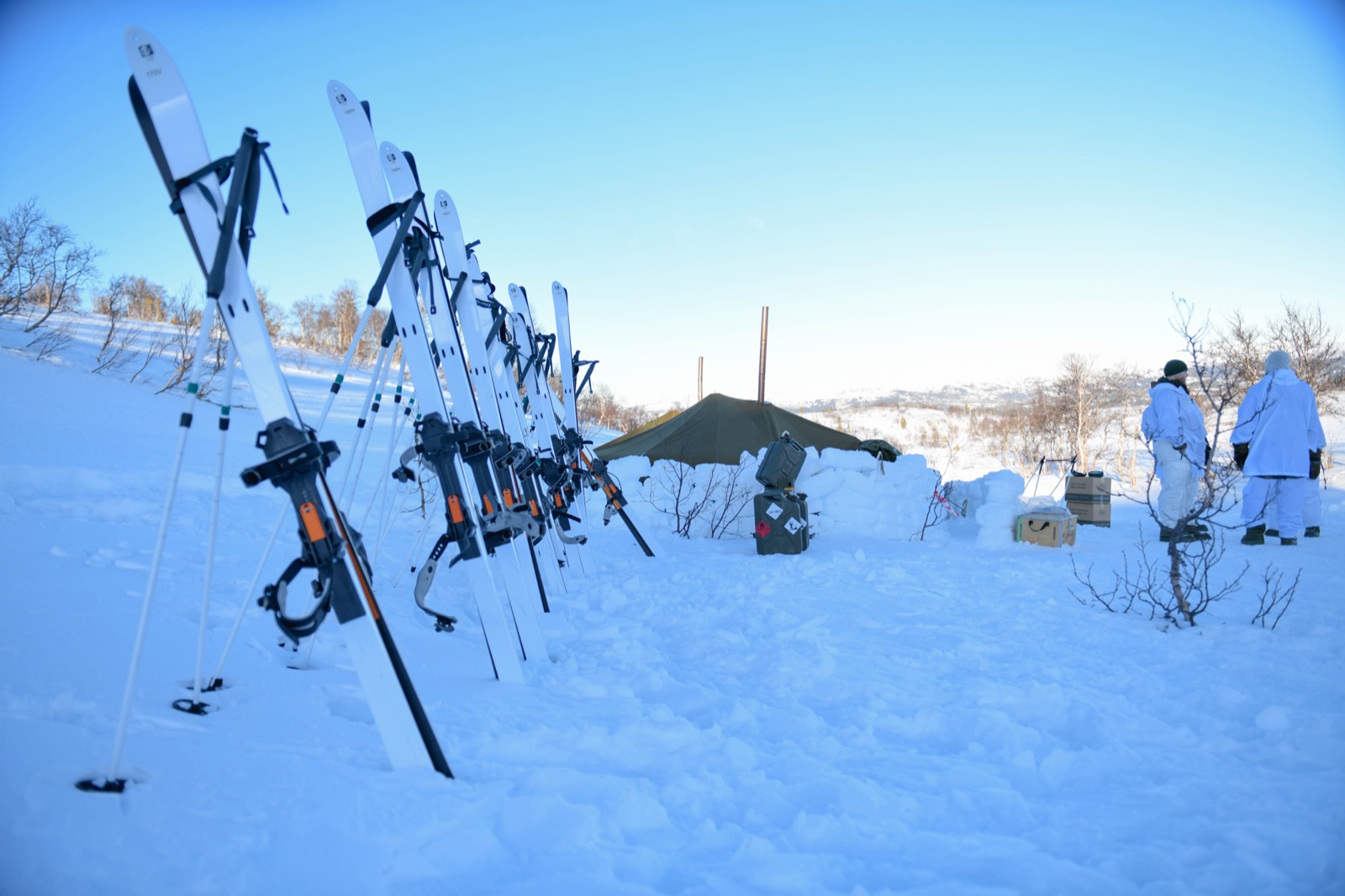
- Test your equipment before you set out on a longer trip in the high mountains.
Contents
- Test your equipment before you set out on a longer trip in the high mountains.
- Keep your equipment tidy in camp, and do not leave equipment lying outside.
- It can get snowed under or blow away.
- Use a tent intended for winter use.
- These withstand more wind and weather and have flaps for laying snow over, which makes the tent stand better.
- Bring a snow brush – a washing-up brush or shoe brush works well.
- Then you can sweep both yourself and the tent free of snow and rime.
- Bring overboots (fotposer) or separate warm shoes to have in camp.
- It will also help if you stand on a sleeping mat rather than directly on the snow.
- Remember that it is not dangerous to be a little cold – but do something about it before you get very cold.
- Bring a warm sleeping bag.
- Or use two sleeping bags one inside the other.
- Feel free to use two sleeping mats.
- That insulates you from the cold of the ground especially well.
- One of them should be a foam mat, as inflatable mats can get holes.
- Reindeer hide or sheepskin is among the warmest things you can sleep on.
- Bring a board to set the burner on.
- Make the food outside.
- In bad weather, you can cook in a well-ventilated porch with a good distance to the tent fabric.
[Tips for sleeping well
Pitching the tent
[Pitching the tent in winter. Film: Marius Dalseg, DNT](Tips%20til%20vinterovernatting/dg8g7zqw8estxkijs79t.webm)
Pitching the tent in winter. Film: Marius Dalseg, DNT
-
Use skis or snowshoes to tramp down the tent site before you pitch the tent.
-
Secure the tent with snow pegs, skis, poles, a pulk, trees or sticks.
-
Lay the tent out flat on the ground where you want to pitch it, with the tent floor down and unfolded to full size.
-
Secure one of the ends with a tent peg so the tent does not blow away.
-
Locate the tent opening, and turn the floor so the tent opening ends up where you want it.
- Remember to place the opening away from the wind.
- A tunnel tent should stand with the short side facing into the wind.
- Remember to place the opening away from the wind.
-
The tent pegs are pressed in at an angle into the ground, with the top of the peg furthest from the tent.
[Tent pegging in winter. Film: Andreas Kjøndal, 2017](https://www.youtube.com/watch?v=fqHFlo_zhwo)
Tent pegging in winter. Film: Andreas Kjøndal, 2017
-
Stretch out the floor of the inner tent and put tent pegs in all corners.
-
Assemble the tent poles – look for colour coding on the pole and the channel in the tent they are to be threaded into.
-
Thread in all the tent poles in the right place.
-
Fix tent pegs in the outer fabric, then continue with the guy lines.
-
When the tent is pitched roughly as it should be, you can start on the fine adjustments!
-
Lay snow on the storm skirts all around the tent except the opening.
-
Dig a cold pit in the porch.
- Then you get more room.
- Avoid digging out right at the side, so that you have a place to cook in the porch.
-
Dig a windbreak wall if a lot of wind is forecast.
- The height should be like the tent.
- Placement about 1.5–2 metres from the tent towards the wind.
[Building a windbreak wall in winter. Film: Andreas Kjøndal, 2017](https://www.youtube.com/watch?v=1xBtebzrUZk)
Building a windbreak wall in winter. Film: Andreas Kjøndal, 2017
Keeping warm in the winter camp
- Use overboots over your shoes, or ideally have wool carders in the overboots and only a wool sock inside.
- A good tip is to cut a sleeping mat to size as an extra insole in the overboots.
- Use roomy outerwear.
- Clothes insulate better when there is room for air between the layers.
- Light a campfire to keep warm.
- Sit in the lee of the wind, build a windbreak wall if it is very windy.
- Wear shoes that are big enough; tight shoes quickly become cold.
- More tips for keeping warm.
Choosing tent pegs in snow
In the snow the ordinary tent pegs do not hold. The snow is often loose, and we need anchors with a larger surface so that they are fixed more firmly.
Snow pegs can be rented or borrowed from BUA or Frilager, and can be bought separately at sports shops.
Cheaper and good alternatives to snow pegs:
- old ski poles
- bamboo poles
- snow stakes.
These are sawn to the desired length; a length of 50–60 cm is usually enough. The alternative pegs are lighter than the snow pegs, but hold a little less well.
Photo: Gina Wigestrand, Use of snow stakes
Photo: Gina Wigestrand, Snow stakes as tent pegs in winter
It is possible to secure the guy lines to sticks that are then dug down into the snow as an anchor. The challenge is that it can be difficult to tighten. The guy lines can also be secured to trees or stones.
Ski poles and skis also work well, but not if the tent is to stand for several days. Set the skis so that the steel edge does not chafe on the guy lines.
Finding water in winter
The first winter camp – in the podcast Uteliv
- with Randulf Valle and Une Cecilie Oksvold
[(Valle, 2021, https://feeds.acast.com/public/shows/podkasten-uteliv, BY-NC-ND) ](Tips%20til%20vinterovernatting/1635408843790-748beea03627e9ec1613480556b93db6.mp3)
(Valle, 2021, https://feeds.acast.com/public/shows/podkasten-uteliv, BY-NC-ND)
Next steps
- Sleeping in the snow — snow cave and snow shelter
- Tent and lavvo — setting up in winter conditions
- Frostbite — preventing and recognising
- Hypothermia — hypothermia response
- Avalanches — camp-site assessment
Learn more
- DNT — cabins — the cabin network and booking
- UT.no — trip suggestions, cabins and places to stay
- Norsk Friluftsliv — sporløs ferdsel — principles for camp and travel
- Varsom — avalanches — camp site and avalanches
Text
Gina Wigestrand, Snuitide (2021)
-
Sources
Glorvigen, S. (2020, 23. desember). Slik får du en vellykket vinternatt ute. Norsk friluftsliv. https://norskfriluftsliv.no/far-vellykket-vinternatt-ute/
Kjøndal, A. (2017, 15. september). Hvordan sove godt i sovepose – noen tips! [Videoklipp]. https://www.youtube.com/watch?v=Ibjh5aXLksI
Kjøndal, A. (2017, 15. september). Teltplugging på vinteren. [Videoklipp]. https://www.youtube.com/watch?v=fqHFlo_zhwo
Kjøndal, A. (2017, 15. september). Å bygge levegg på vinteren. [Videoklipp]. https://www.youtube.com/watch?v=1xBtebzrUZk
Norsk Friluftsliv (2021, 18. juni) Trodde du det var lov å hugge friske trær? Det er det ikke. Hentet fra https://norskfriluftsliv.no/trodde-du-det-var-lov-a-hugge-friske-traer-det-er-det-ikke/
Pettersen, M. N. (2020). Sove ute. Gyldendal
Valle, R. (2021). Den første vinterovernattingen – med Une Cecilie Oksvold. [Lydfil] Podkasten Uteliv. Hentet fra https://feeds.acast.com/public/shows/podkasten-uteliv