Overnight Stays
Camp routines
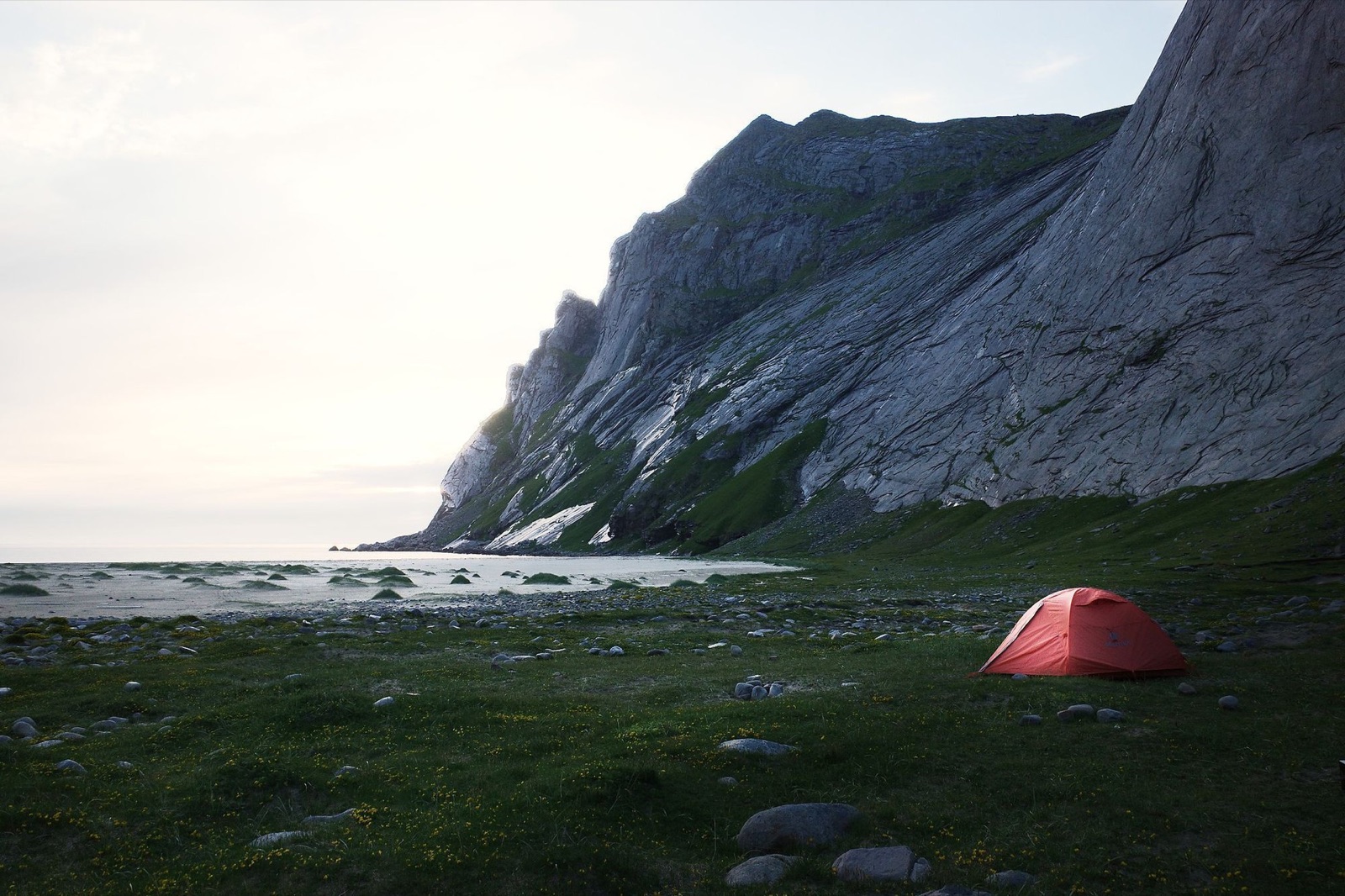
- In camp you are often less active and get cold sooner.
Contents
Stay warm
- Put on warm clothes.
- In camp you are often less active and get cold sooner.
- Change into dry clothing – wet and sweaty clothes make you cold.
- Do not sit completely still for too long, as that makes you cold.
- Eat, drink and go to the toilet.
- Food raises your metabolism, and then we keep warm better.
- We also need extra energy when we are active.
- Warm food and drink make us warm.
- If you go to the toilet regularly, your body is spared from using unnecessarily much energy keeping warm the waste matter that is going to come out anyway. You may also risk becoming constipated if you are unlucky.
- Be warm when you go to bed.
- Take a little jog, walk briskly up a small slope or do some squats and frog jumps before you get into your bag.
- Then you will sleep better through the night.
- Using a gas burner/multifuel stove to heat the tent is possible, but it is risky
- The consequences are great; the tent can catch fire. Therefore:
More tips on using a stove.
Keep things in order
Leave as little as possible lying outside. It gets wet when it rains, or it can blow away. Remember to bring in your shoes and rucksack. If there are several of you in the tent, give each person their own place for their own gear. Gather your gear in a bag, do not leave everything lying loose in the tent.
Have a fixed place where you cook, and wash up pots and plates as soon as you have finished. Bring a bag where all rubbish is collected, and put it somewhere it will not blow away. Tie it to a tree if you like, keep it in your rucksack or put it in the tent.
Drying clothes
Dry your clothes on your body while you are active if you like, but change as soon as you are going to sit still, to avoid getting cold. One tip is to put a dry wool jumper under the wet one so that you do not get cold so quickly while drying clothes on your body.
Clothes that are wet can also be dried in the sleeping bag, but remember:
- Do not dry too much at once – a couple of garments such as long johns, a pair of socks or a wool top is enough.
- Wring out the clothes first if they are very wet.
Bring a bit of cord and make a washing line in the tent. The clothes dry during the day when the sun warms the tent. If it is dry and windy, you can hang clothes out to dry on a line outside. Remember to tie the clothes on so they do not blow off. Use the cords, zips or hook-and-loop fasteners on the clothes to fasten them to the line.
Sleep well
- Make sure the ground is even, relatively flat and reasonably soft.
- Remove cones and sharp stones, they are uncomfortable to lie on.
- If the ground is very uneven, you risk sliding or rolling off the surface.
- Moss and heather on the ground are soft to sleep on. You can also add spruce boughs.
- Use a good sleeping mat.
- Inflatable mats have poor insulation and can get holes.
- When using an inflatable sleeping mat, a foam mat or a sheepskin on top is recommended.
- Use a warm sleeping bag.
- Check that the sleeping bag is rated for the temperature you are going to sleep out in.
- Use two sleeping bags inside each other if you do not have a warm enough sleeping bag.
- Be good and warm when you go to bed and go to the toilet before you crawl into the sleeping bag.
- Sleep with your hat on, so you keep warm better.
- Avoid cold feet.
- Wear loose wool socks that do not tighten around the calves.
- Put a jacket over the foot end of the sleeping bag or stuff your feet and the sleeping bag into an empty rucksack.
- Put clothes under the foot end for extra insulation against the cold from the ground.
- Make a hot-water bottle to put at the foot end of the bag. Remember to check that the bottle is completely watertight and can withstand hot water.
- Wear dry wool clothing.
- One set of wool underwear, socks, a neck warmer and a hat is usually enough.
- Do not put on so much that it gets cramped in the bag.
- The down jacket can be used as a pillow or a blanket on top of the bag.
- Do not try to dry too many wet clothes in the sleeping bag at night.
- Pull the sleeping bag tight around your head.
- Remember to air the sleeping bag after each night.
- Then you dry out the moisture that evaporates from your body during the night.
Storing food
Pack the food well to keep out unwanted guests such as animals and insects. It is also possible to hoist the food up into a tree. Store the food in the shade. Fresh food that normally lives in the fridge, such as meat, fish, dairy products and sandwich fillings, should be kept cold. Look for a stream or a bog, or dig a hole in the ground and put the food down in it. Remember to pack the food well first.
If you have snow available near camp, bury the food in the snow.
Hygiene
When there are several of us in a camp, it is wise to establish good routines. Check that the water is of good quality: we want clear, running and odour-free water. Still water, or water near farms and buildings, may contain bacteria and should be boiled before use (Ekker, Bolle & Slapgaard, 2019).
Among other things, we set up a clean zone and a dirty zone, so that we know where we can fetch water. The clean zone is always upstream of the dirty zone (higher in the terrain), since water, as we know, runs downhill. In the dirty zone we can wash up and wash our hands. Note that you should wash up with hot water, otherwise you do not get rid of bacteria. Be especially aware when it comes to rice and pasta, as this food has a fair amount of bacteria even after it has been boiled (Granum, 2012).
It is also wise to establish a group toilet pit (latrine), so that people do not go to the toilet everywhere.
How to go to the toilet outdoors
More on hygiene on a tur here:
Hygiene on a tur
Weather and wind in camp
Think about how weather and wind affect you in your camp. Here are some tips:
- Find a place with a bit of shelter, then it is more pleasant to sit outside.
- Set up the tents that can take the most wind facing the wind.
- Set up tents and tarpaulins so that the opening is sheltered from the wind.
- Guy your tent and tarp well.
- Use all the guy lines on the tent/tarp, it is better to use too many than too few.
- Whittle extra pegs if needed.
- Put stones on top of the storm flaps for extra security.
- Make sure the stones are not sharp, so that they do not cut holes in the fabric.
Consider nature
As long as we are in nature, we must consider nature, the animals and the people around us. This applies of course also when we make camp. The Outdoor Recreation Act gives us many benefits, such as free movement in utmark, as long as we also behave considerately. The Outdoor Recreation Act and allemannsretten give you several rights and duties: [
Rubbish
Be prepared, bring a bag for the rubbish. Everything you have brought out with you, you must bring home again. That also applies to food waste, such as banana peel and the like, which takes a long time to break down in nature (Norsk Friluftsliv, 2021).
Open fires
Remember the open-fire ban from 15 April to 15 September, and choose your fire site with care. During the general fire ban it is nevertheless permitted to light a fire in cases where it obviously does not pose a fire risk. That may for example be after a lot of snow or rainfall. Place the fire where it does not damage nature. Is there an existing fire site? Use it (Norsk Friluftsliv, 2021).
If you make a fire pit, clear the stones back into place after use, and remove any remains of wood that have not been burned up. Remember to put the fire out properly. Stones, logs or the like that you have used are put back where you found them. It should ideally not be possible to see that there has been a camp where we slept.
Do not cut down healthy trees to get firewood. It is also not permitted to damage healthy trees and break off branches. So bring firewood from home, unless you know you will find dead branches and twigs.
Read more about Lighting fires
Hammock
If you sleep in a hammock, make sure you have straps that do not chafe into the bark of the tree. Flat straps are best.
Lean-to shelter
A lean-to shelter can be made from a tarpaulin and cord, from trees, or a combination of tarpaulin and timber poles. Using a tarpaulin is quicker and requires fewer trees and spruce boughs. Do not use healthy trees, as you would then need the landowner’s consent, in accordance with the Outdoor Recreation Act. Trees that are broken or dead trees are permitted to use. Remember leave-no-trace travel and put everything back after use. No lean-to shelters should be left behind in nature, unless an agreement about this has been made with the landowner.
Tips and tricks for sleeping out
Randulf Valle and Marius Nergård Pettersen give tips and tricks for sleeping outdoors in the podcast Uteliv:
[(Valle, 2021, https://feeds.acast.com/public/shows/podkasten-uteliv, BY-NC-ND) ](Rutiner%20i%20leir/5f58f047ab1d990eb4c53612.mp3)
(Valle, 2021, https://feeds.acast.com/public/shows/podkasten-uteliv, BY-NC-ND)
Next steps
- Tents and lavvo — where the routines happen
- Sleeping in the snow — special routines in snow
- Tips for winter camping — winter adaptations
- Camping on a tur — the hub
Learn more
- DNT — cabins — the hut network and booking
- UT.no — trip suggestions, cabins and places to stay
- Norsk Friluftsliv — leave-no-trace travel — principles for camp and movement