Overnight Stays
Tarp (presenning)
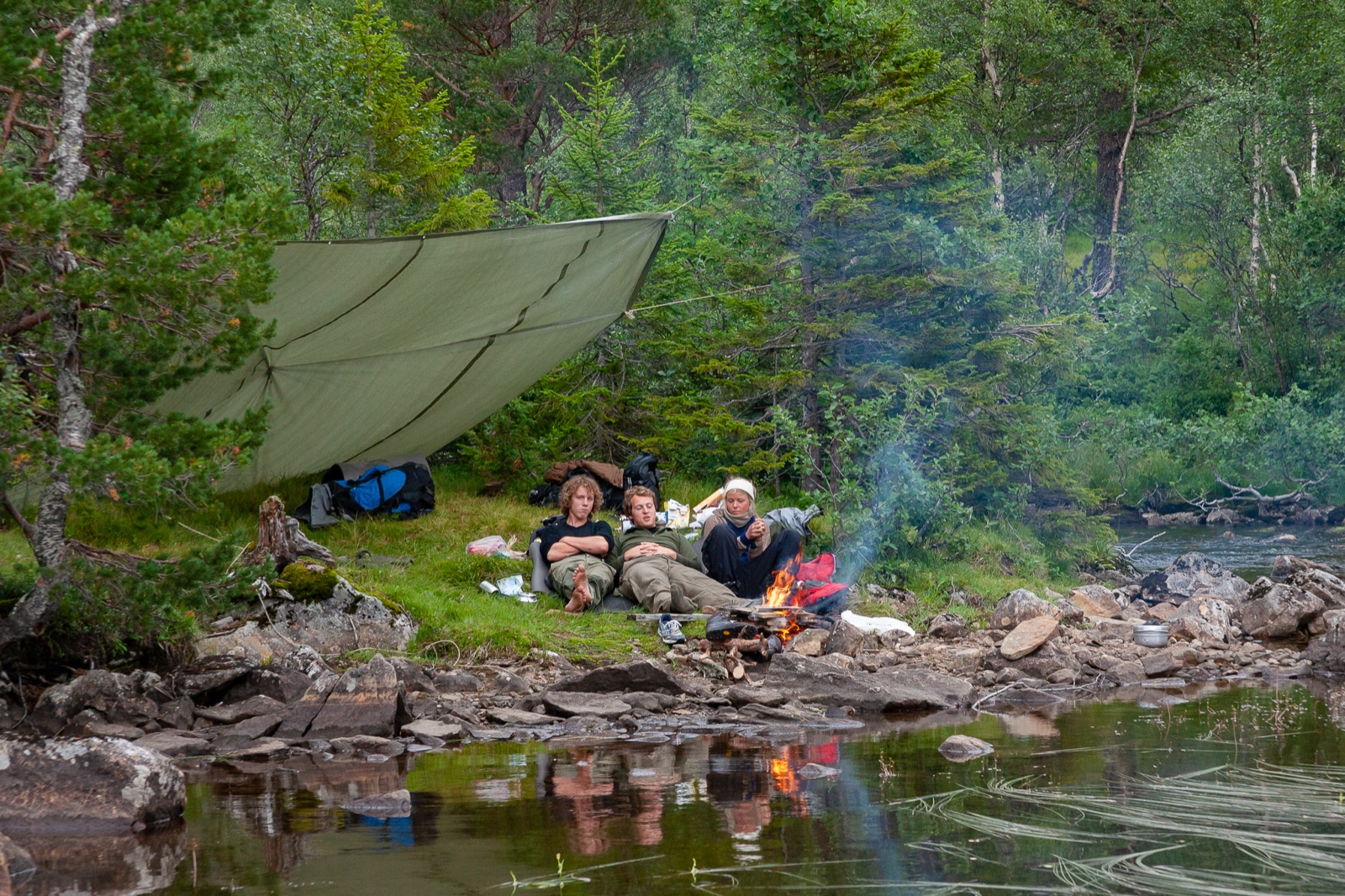
With a tarp we can make our own tent. Many people use the term tarp, which is the English word for presenning. It is easiest to camp in a forest or somewhere with…
Contents
With a tarp we can make our own tent. Many people use the term tarp, which is the English word for presenning. It is easiest to camp in a forest or somewhere with trees, but it is also possible to use walking poles as tent poles (see photo).
Both lightweight and heavier tarps work equally well. A plastic tarp bought, for example, at Biltema is cheaper than the thin tarps sold under the name ‘tarp’. The plastic tarps are often heavier and take up more space than thin fabric tarps. Both are durable, as long as they are guyed out well.
Some bothy bags (vindsekk) and the Jerven sheet (jervenduk) can also be rigged as a tarp.
/IMG_2923.jpg)
A tarp pitched as a tent, using walking poles. Photo: Gina Wigestrand
You need: a tarp or presenning, rope or guylines, tent pegs, a sleeping mat and a sleeping bag.
How to sleep under a tarp
Norges speiderforbund, 2016, https://www.youtube.com/watch?v=Uu4cOAYyCbU&list=PL6ksnt69zt7NW6DMeDwX_EiB9ArlFWKJ9&index=3
/IMG_1429.jpg)
A tarp pitched as a ridge roof. Photo: Gina Wigestrand
The simplest tarp setup is to make a roof that slopes down on both sides. Pull the tarp taut along the middle and tie a rope or guyline to the tarp on each side. Then fix the ropes to a tree. After that, stretch out the four corners. Remember to have ropes at the corners too, before the ropes are fixed to the ground with tent pegs, sticks or roots on the ground.
It is also possible to make a simple lean-to from just a tarp, or, as here, an unfolded Jerven sheet. The sheet is fixed to the trees at the upper corners and to the ground at the lower corners. Remember to place the opening sheltered from wind and rain. Be aware too of a large wind-catching surface; a setup like this will not stand up to strong wind.
/IMG_9725.jpg)
A Jerven sheet used as a lean-to. Photo: Gina Wigestrand
Lean-to (gapahuk)
The lean-to is a traditional way of spending the night in nature. It got its name because the opening forms a gap — out towards the fire (Miljøagentene, n.d.). The lean-to typically consists only of a sloping roof you can lie under, made either of boughs and twigs — or, best of all, a pitched tarp. Traditionally, lean-tos were built with logs and woven spruce boughs. This is hard to make watertight and not very environmentally friendly, so today we mostly use a tarp. In front of the lean-to there is usually a campfire.
The lean-to is pitched between two trees, or other high points you can fix to, and stretched at a slant back towards the ground so that you get a sloping roof to lie under. You should bear in mind that there must be room under the roof for everyone in the party and their luggage. The ground should be relatively flat for sleeping comfort.
If you are going to have a campfire in front of the lean-to, it works best at around 45 degrees of slope. This helps the warmth reach into the lean-to, and the lean-to acts as a reflector where the warmth is thrown back against your back.
/IMG_3512.jpg)
A simple lean-to, made from a tarp. Photo: Gina Wigestrand
When we build the lean-to, it is wise to build it facing a reflector (a large rock, rock face or the like that the fire can be built against), and preferably with the prevailing wind direction at your back.
The reflector helps throw warmth into the lean-to, instead of it disappearing into nothing. If you lack a reflector, one can be built from logs.
/varmerefleksjon.png)
Illustration of a lean-to with a reflector. Illustration: Bjørn Henrik Stavdal Johansen
/Gapahuk.jpg)
A lean-to can also be built very simply, by pitching a tarp between the trees. Photo: Espen Mills.
To build a lean-to you need
- a tarp 4x5 metres (or spruce boughs)
- logs
- axe/saw/knife
- rope (200 m)
- spruce boughs for side walls, if needed.
Recipe for building a simple lean-to
-
Find two trees or two logs that are solid. These should stand a couple of metres apart (the distance varies with how many people the lean-to is to hold).
/gapahukfig1.png)
Fig.1: Find two trees or two logs that can serve as uprights. These will carry much of the weight of the lean-to and must be strong. Illustration: Bjørn Henrik Stavdal Johansen
-
Lash a sturdy log firmly between the trees. This log becomes the crossbar. The log is fixed about a metre above the ground (Miljøagentene, n.d.).
- Videos showing lashings.
/gapahukfig2.png)
Fig.2: Tie a crossbeam to the uprights. It must take some weight, since part of the load will rest in the middle of it. Illustration: Bjørn Henrik Stavdal Johansen
-
After that, long logs are laid from the crossbar down to the ground so that they form a sloping roof. Lash these firmly to the crossbar.
/gapahukfig3.png)
Fig.3: The roof beams are lashed to the crossbeam. The beams at the sides should also be lashed to the uprights to take weight off the crossbeam. Illustration: Bjørn Henrik Stavdal Johansen
/gapahukfig3.2.png)
This is when you make the angle of the lean-to. Remember that it gives the best effect at around 45 degrees of slope. Illustration: Bjørn Henrik Stavdal Johansen
- Lash the tarp over the roof. The walls are closed off with spruce boughs and spruce twigs that you weave in between the logs.
Recipe for building a lean-to with spruce boughs
Follow steps 1–4 of ‘building a simple lean-to’.
- Lay thin twigs crosswise over the logs that run down towards the ground. Weave these firmly between the logs.
/gapahukfig4.png)
Fig.4: Wind long, thin poles between the roof beams. The more the better. These are to carry the roof. Young goat willow and birch are best. Illustration: Bjørn Henrik Stavdal Johansen
- Seal the roof with spruce boughs or, if needed, leafy branches from other trees. It must be laid very densely.
Start by laying the bottom across the full width, before you work your way up with good overlap step by step. Think of it as letting water run all the way from the top down to the ground.
/gapahukfig5.png)
Fig.5: The roof is made of boughs or brushwood. Spruce boughs give the most watertight result. Illustration: Bjørn Henrik Stavdal Johansen
If you do not have a reflector, one can be built in front of the lean-to. It can also be wise to make a bed of boughs or brushwood on the sleeping spot. This gets you up off the ground, and helps you keep warm. If you are alone, you lie sideways in the lean-to. If there are several of you, you lie with your feet inwards and your head towards the warmth.
/gapahukfig6.png)
Illustration: Bjørn Henrik Stavdal Johansen
Next steps
- Tents and lavvo — comparison with more enclosed shelter
- Hammock and tree tent — a related lightweight solution
- Camp routines — what you do around the sleeping spot
- Other types of outdoor overnight stay — the alternatives
Learn more
- DNT — cabins — the hut network and booking
- UT.no — trip suggestions, cabins and places to stay
- Norsk Friluftsliv — sporløs ferdsel — principles for camp and travel
Text
Bjørn Henrik Stavdal Johansen and Gina Wigestrand, Snuitide (2022)
-
Sources
Miljøagentene (u.å.) Sove ute? https://miljoagentene.no/aktiviteter/sove-ute-article1684-124.html Norges speiderforbund (2016, 14. april) Enkelt friluftsliv – Ly og leir. (Videoklipp) Hentet fra https://www.youtube.com/watch?v=Uu4cOAYyCbU&list=PL6ksnt69zt7NW6DMeDwX_EiB9ArlFWKJ9&index=2