Overnight Stays
Tents and lavvu
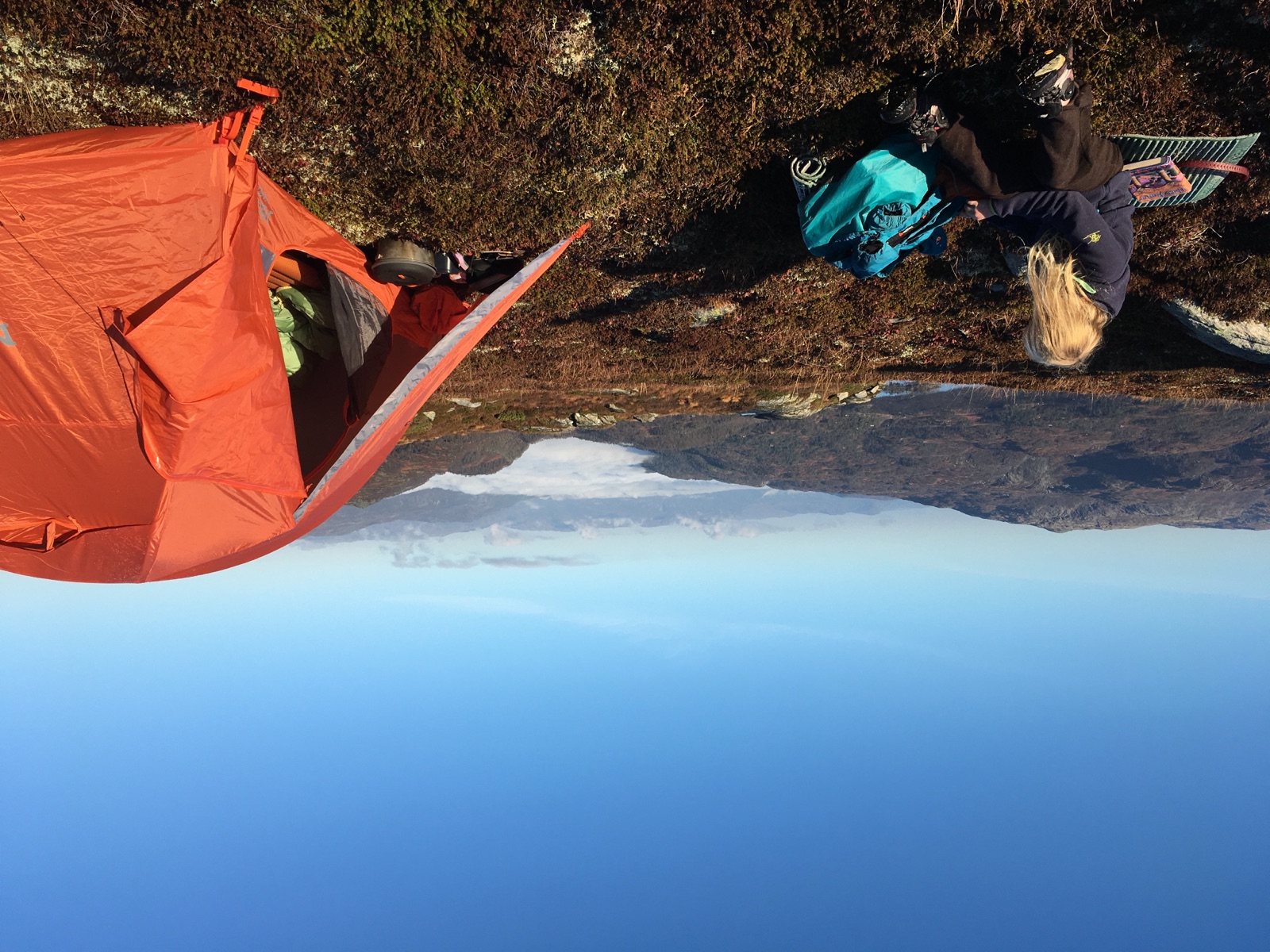
Pitch your tent at home before you set off, so you know how it goes up and are sure you have all the parts.
Contents
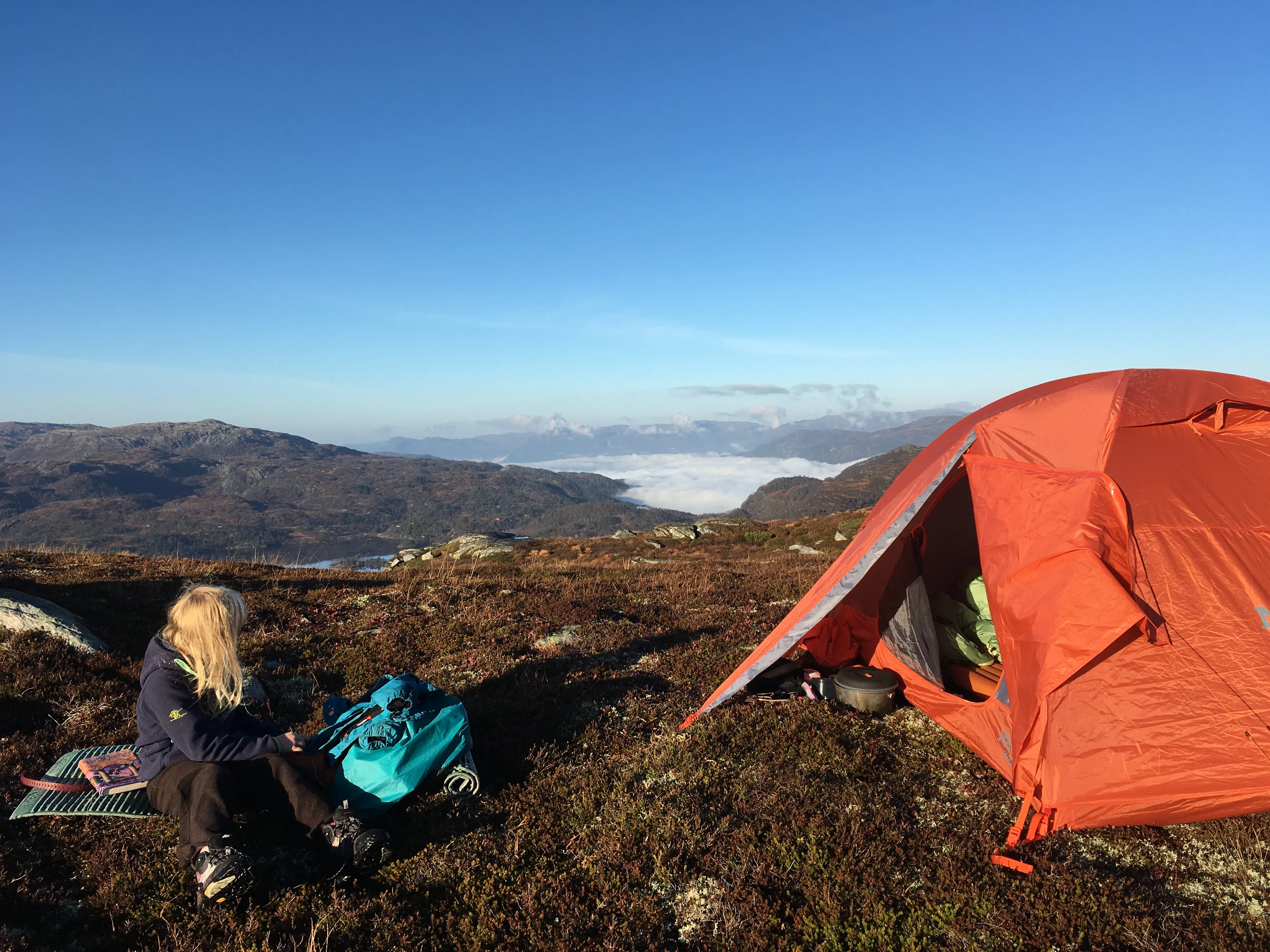
Photo: Gina Wigestrand
You need: a tent, a sleeping mat and a sleeping bag.
With a tent and a lavvu you can spend the night almost anywhere, all year round. There is something special about carrying your home with you and settling down exactly where you want to. Allemannsretten gives us the right to camp 150 metres from an inhabited house or cabin for a maximum of two 24-hour periods.
Choose a tent that suits the season and the use: camping in winter and in the high mountains calls for sturdy tents that can take a lot of wind. In the lowlands and in the forest, an ordinary camping tent is often enough.
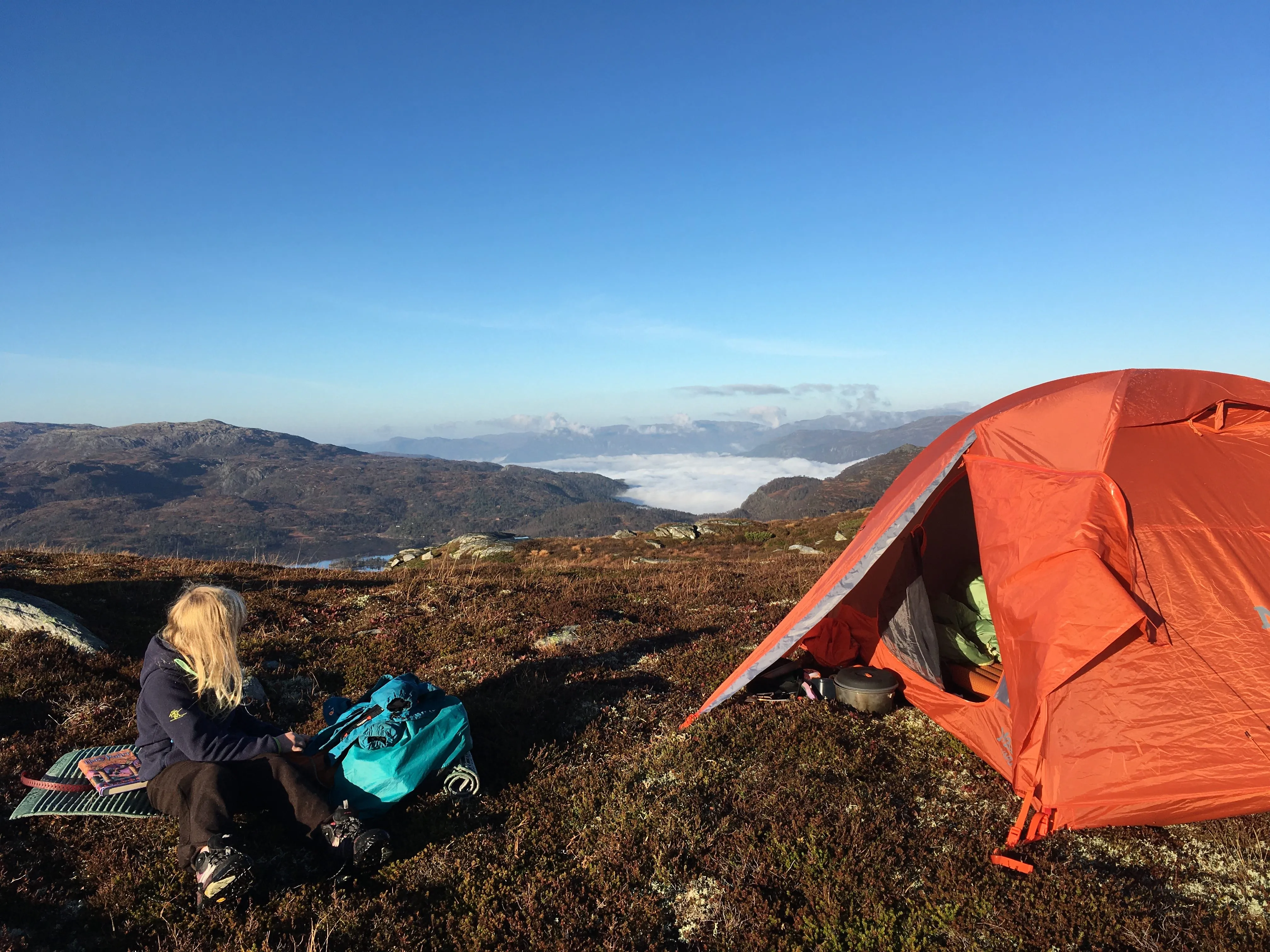
How to sleep in a tent
Pitching a tent
How you pitch the tent depends on which type of tent you have. Even so, a number of points are general and can be used as a guide:
-
Clear away branches, cones or anything else in the way where the tent is to stand.
-
Spread the tent out on the ground where you want to pitch it, with the groundsheet down and unfolded to full size.
-
Fix one of the ends with a tent peg so the tent does not blow away.
-
Locate the entrance of the tent, and turn the base so the entrance ends up where you want it.
- Remember to place the entrance away from the wind.
- A tunnel tent should stand with the short side at the back toward the wind.
- Remember to place the entrance away from the wind.
-
Push the tent pegs into the ground at an angle, with the top of the peg furthest from the tent.
[Pegging out a tent in winter. Film: Andreas Kjøndal, 2017](https://www.youtube.com/watch?v=fqHFlo_zhwo)
Pegging out a tent in winter. Film: Andreas Kjøndal, 2017
-
Stretch out the base of the inner tent and put tent pegs in all the corners.
-
Assemble the tent poles – look for colour coding on the pole and on the sleeve in the tent they are to be threaded into.
-
Thread all the tent poles into their correct place.
-
Fix the tent pegs in the flysheet, then carry on with the guy lines.
-
Once the tent is pitched more or less as it should be, you can start fine-tuning!
Different types of tent
You can use a tent all year round, on bare ground and in snow. In forest, high mountains and by the sea. All the extra kit you need is a sleeping bag, a sleeping mat and, of course, the tent itself.
There are countless variants of tent, and they suit different trips and conditions. The most common types of tent are listed below.
Lavvu
This is mostly made for many people, and has a centre pole that holds the tent up. The tent has good height, and therefore catches a fair amount of wind. Lavvus weigh more than tents, but spread across the number of people who can live in a lavvu the weight is often less (Pettersen, 2020).
Tunnel tent
Among the tunnel tents we find the lightest tents. The tent poles arc over or through the tent fabric and make the tent quite easy to pitch. Often there is also a good porch. The drawback is that the tent is more vulnerable to side wind and snowfall than a dome tent. The tent should have storm flaps if it is to be used in winter, so you can dig snow over the flaps and get a steadier tent.
Dome tent
These are sturdy tents when it comes to wind and snow, and they usually have better headroom than tunnel tents. The tent poles cross each other so the tent’s skeleton forms an x. The drawback is a little more fuss to pitch, and a smaller porch. On many of these tents the flysheet is separate and has to be pulled over the tent after it is pitched. This is a drawback in heavy rain. Note that dome tents often have no storm flaps.
How to pitch a dome tent.
Tunnel and dome tent
There are combinations of tunnel and dome tent. These are often sturdy winter tents where you get the best of both variants: a good porch, the ability to take a lot of wind and better headroom. The drawback is that the tents are heavy.
Packing a tent
- In heavy precipitation and wind: pack as much as possible inside the tent before you take it down.
- Untie all guy-line cords so they do not tangle together.
- A dry inner tent is packed in its own stuff sack and put inside the rucksack.
- The flysheet, if it is wet, should be fixed to the outside of the rucksack.
- Always pack the side of the tent that is to face the wind at the top of the stuff sack.
- On dry days and in places without many insects, the inner tent can stay at home.
- Always pack repair kit for the tent.
- a splice joint for a tent pole
- duct tape
- a sewing kit.
Tips for choosing a tent
Try different tents and work out what suits your needs and what you prefer.
- Borrow or hire a tent rather than buying; good tents are expensive.
- If you are going to spend a lot of nights in a tent and want to buy, buy a used one.
- Where and when will the tent be used?
- Check that the tent is solid enough for your use.
- Which seasons and which terrain you will camp in matters for the choice of tent.
- A winter trip on the plateau calls for a proper winter tent, but if you are heading to the lowlands or onto bare ground, the tent need not be as solid.
- Size
- How many will sleep in the tent?
- Is there actually room for the number of people stated for the tent?
- It is usually more comfortable to be one person fewer than the tent manufacturer states the tent is made for.
- You can reckon on 0.65 by 2 metres as sleeping space for each individual occupant of the tent (Ekker, Bolle & Slapgaard, 2019).
- Weight
- How far will the tent be carried? For short distances, weight is not as important.
- Is weight more important than comfort?
- Personal preferences
- Is it important that the tent has standing height?
- What ventilation options should the tent have (not as important in winter as in summer)?
- How big a porch do you want?
- Should the tent be possible to pitch in one go, without having to put on the inner or outer fabric afterwards?
Next steps
- Tarpaulin and tarp — a lighter alternative
- Hammock and tree tent — off the ground
- Sleeping in the snow — adapting for winter
- Accessible cabins in Norway — when a tent is not needed
- Reindeer husbandry and Sámi culture — the lavvu as a cultural tradition
Learn more
- DNT — cabins — the cabin network and booking
- UT.no — trip suggestions, cabins and places to stay
- Norsk Friluftsliv — leave-no-trace travel — principles for camp and travel
- Norske Samers Riksforbund (NSR) — on the lavvu and Sámi culture