Gear
Greenland paddle
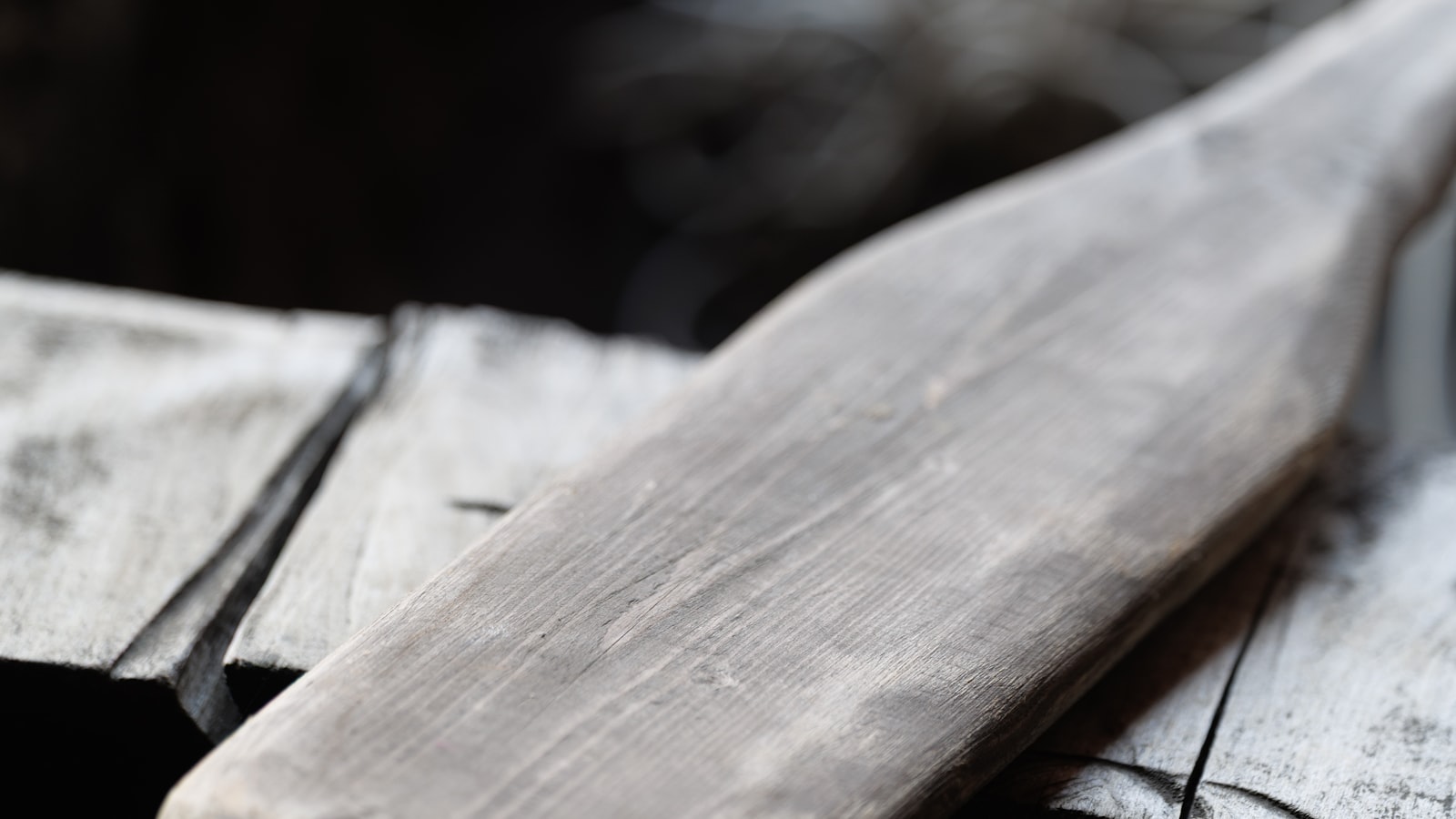
The Inuit paddle — slim blades, a shorter loom, no feather, often made of wood. A tradition of its own within sea-kayaking, with its own vocabulary, its own technique, and a loyal community that will not go back to the modern paddle.
The Greenland paddle is the Inuit answer to the problem of paddling the sea in extreme conditions over thousands of years. It looks simple at first glance — slim wooden blades, no feather, a shorter loom than a modern kayak paddle — but every detail has a functional reason for Arctic sea paddling. The reaction among those who try it for the first time is often twofold: some find it is better than it looks and stay with it, others go back to the modern paddle.
For Norwegian paddlers the Greenland paddle is a field of its own within sea-kayaking. There is a small but dedicated community — people who paddle only with a Greenland paddle, often in self-built kayaks, and who have their own club culture and their own courses. If you have paddled a sea kayak for a season or two and find yourself wondering “what is it with that odd wooden paddle?”, this article is for you.
What makes it its own thing
A classic modern kayak paddle has asymmetric blades in carbon or glass fibre, a feather of 45–60 degrees between the two blades, and a round shaft. It is built to give maximum power per stroke.
The Greenland paddle is the opposite on almost every axis:
- The blades are long, slim and symmetric — typically 7–9 cm wide and 70–90 cm long.
- There is no feather — the blades lie in the same plane, parallel.
- The shaft (called the loom) is shorter than on a modern paddle — only 45–58 cm — and oval, not round.
- The material is traditionally wood — spruce or cedar, often laminated in thin strips.
- The total length is greater than a modern paddle — typically 2.1–2.3 metres — because you take your grip further out.
It is not an imperfect version of the modern paddle. It is an entirely different technology for the same problem.
The roots
The Greenland paddle was developed by the Inuit over thousands of years. Driftwood was the only source of wood along the Greenland coast, and the paddle was made from what washed ashore — often in pieces, glued with animal bone and sinew. The blades were shaped to be efficient at low speed over distance, not for sprint power. The shaft was kept short and light because the paddler had to be able to paddle all day without the arms tiring.
It was also a hunting paddle. It had to be quiet in the water in order to approach a seal, have low wind resistance in a storm along the coast, and be usable for rolling — because a capsize happens in cold conditions where there is no help. It is these conditions that have shaped every single detail of today’s Greenland paddle.
In Norway there has for several decades been a small but dedicated community that builds kayaks and paddles in the Inuit tradition, and that runs building courses where the craft is passed on from person to person. The community still looks like this: small-scale, dedicated, and with strong ties to the original tradition.
Why it looks the way it does
Each of the design choices makes sense when you paddle it:
Slim, long blades give low resistance per stroke. You draw less power from each movement, but paddle at a higher frequency and tire less over distance. It is like the difference between walking in long strides and short strides — shorter strides are less tiring over a long day.
No feather means the paddle lies in the same plane at both ends. It removes all “feathering” mechanics and makes the paddle behave the same on both sides. You do not rotate your wrist between strokes, and you have the same grip in both hands.
A shorter shaft (loom) keeps the hands close together at the middle of the paddle. It reduces the moment the arms need to move the paddle, and lets you paddle with lower shoulders and less rotation. It is part of the reason Greenland paddles are less tiring on long days.
An oval shaft lets the palm feel which way the blade is facing without your having to look. It is a tactile signal that puts the technique in the body and not in the head.
The paddling technique is different
You are not meant to paddle a Greenland paddle the way you paddle a modern paddle. The technique differs in several ways:
The gliding stroke (canted stroke). The blade is not drawn vertically through the water. It is tilted slightly forward at the top, so that the blade “glides” through the water and produces both forward drive and lift. It sounds complicated, but it is comfortable once the body has learnt it.
A wide grip. You hold your hands further out towards the blades than you would on a modern paddle. This is because the short loom gives less room in the middle, and because rolling and brace strokes call for a longer arm.
A sliding grip. One of the things that surprises new Greenland-paddle paddlers is that the grip is not fixed — it slides through the hand during some strokes, particularly during a brace and rolling. The hand guides more than it clamps.
Lower cadence, lower power. You paddle a Greenland paddle more slowly and softly than a modern paddle. It is not because you lack strength — it is because the paddle is built for it. If you try to give it power, it becomes inefficient.
People who paddle a Greenland paddle often say it “forces good technique”. That holds true to a large extent: a fast sprint with poor technique works worse on a Greenland paddle than on a modern paddle. But a long day with good technique is less tiring.
Rolling — where it has its greatest advantage
The one thing everyone agrees on is that the Greenland paddle is the best paddle for rolling. That is what it is built for. Rolling is what Greenlandic kayak culture has practised most — because survival in cold Arctic water required that you could come back up after a capsize, every single time.
The Greenland paddle gives several advantages in rolling:
- A longer paddle = a longer moment. When you roll, you draw the paddle through the water in an arc. A longer paddle gives a longer arm and therefore more lifting force per effort.
- The sliding grip makes fine adjustment easy. You can move your hands in real time while you are under water.
- Symmetry and the absence of feather mean you do not need to know which side is “up” — the blade works the same from both directions.
- Low forces are enough. You do not roll by climbing up out of the water with maximum force, but by rising steadily and under control through a hip flick and paddle support.
Within the community there are whole collections of rolling techniques named after Greenlandic words — different ways of rolling, different grips, different positions. Qajaq USA and similar organisations catalogue them and pass them on, and they are a core part of the tradition.
As a storm paddle
In strong wind the Greenland paddle has a concrete practical advantage: low wind resistance. The slim blades catch little wind when you lift the paddle over the water between strokes, whereas a large modern blade is pulled backwards by the wind and costs you energy.
Paddlers who are often out in rough conditions report that the Greenland paddle in 10–12 m/s wind is less tiring than a modern paddle. It is one of the reasons it is still used seriously in the Norwegian sea-kayaking community — not out of nostalgia, but as a functional storm paddle.
Length — measured by the body, not by height
A Greenland paddle is traditionally fitted to the paddler’s body, not bought ready-made in a standard size. Two measurements are used:
Total length. Often measured as the paddler’s outstretched arm span plus a cubit (the distance from elbow to fingertip). For most adults it ends up at 210–230 cm.
Loom width. Stand with your elbows against your body and your forearms straight out. Make an “OK” sign with both hands. The distance between the index fingers, outside to outside, is your loom width — typically 45–58 cm.
There are factors that can vary these measurements: a wider kayak calls for a slightly longer paddle, a longer chest gives a shorter loom. Experienced paddle-makers will measure you, perhaps test on the water, and adjust.
Wood and building
Traditionally Greenland paddles are made of wood. Norwegian specialist workshops generally use Norwegian spruce from Hadeland or cedar, laminated in several thin strips for stability. A glue-laminated paddle is stronger and less prone to warping than a paddle cut from a single piece of wood.
The treatment is usually oil (linseed oil, tung oil) rather than varnish, because oil lets the wood “breathe” and is easier to renew after use. An oil-treated paddle has to be maintained once a season; a varnished paddle every second or third year.
Carbon-fibre versions of the Greenland paddle also exist — lighter and entirely maintenance-free — but many purists hold that the vibration damping and the feel of wood are part of the experience. It is a matter of taste.
In Norway it is also popular to build your own Greenland paddle. Courses at specialist workshops teach you to make a paddle that fits your body over the course of 2–3 days.
Who needs a Greenland paddle
It is not a paddle everyone should have. It suits certain situations best:
If you paddle a sea kayak on long trips: low wear per stroke makes it comfortable over several hours. Many Greenland-paddle paddlers find that they do not get sore shoulders or elbows in the way they do with a modern paddle.
If you do rolling or surf paddling: it is better than a modern paddle for both.
If you paddle in strong wind: lower wind resistance makes the Greenland paddle a good storm paddle.
If you have a classic Eskimo-inspired kayak: narrow, low-decked, designed for the Inuit paddling style — that is where the Greenland paddle naturally belongs.
If you want to paddle fast in racing style: no. The Greenland paddle has no top speed, and fast paddling with great power does not work.
If you paddle a wide recreational kayak: the Greenland paddle is less efficient here, because you have to reach further out to meet the water.
If you paddle rivers: no. The Greenland paddle is not made for rapids or quick corrections.
The relationship to the modern classic paddle
It is not an either-or. Many experienced sea paddlers have both: a modern classic paddle for short fast trips or when someone else borrows the kayak, and a Greenland paddle for long days, wind and rolling sessions.
It is a widespread observation that people who first take up a Greenland paddle usually paddle their way deeper into the tradition — there is something about the mechanics and the aesthetics that draws you in. Many end up building their own, buying a classic Eskimo-inspired kayak, and becoming part of the small but intense Norwegian Greenland-kayak community.
It is a good demonstration that “better” and “different” are separate questions. The modern paddle is better at what it is built for. The Greenland paddle is built for something else, and better at that.
Next steps
- Kayak paddle — the modern paddle the Greenland paddle is set against
- Sea kayak — the kayak the Greenland paddle naturally belongs in
- Life jacket — a constant companion when you are out with a paddle in hand
- Paddling — the activity where the paddle is actually used
- Rescue in a kayak — rolling is where the Greenland paddle has its greatest advantage
Learn more
- Kajakkspesialisten — om grønlandske og arktiske padleårer
- SNL: grønlandsrulle
- SNL: havkajakk
- Qajaq USA — Greenland-tradisjon, fellesskap og rolling-bibliotek
Text: Snuitide (2026).