Trip Planning
Fjellvettreglene
1. Plan your trip and tell someone where you are going.
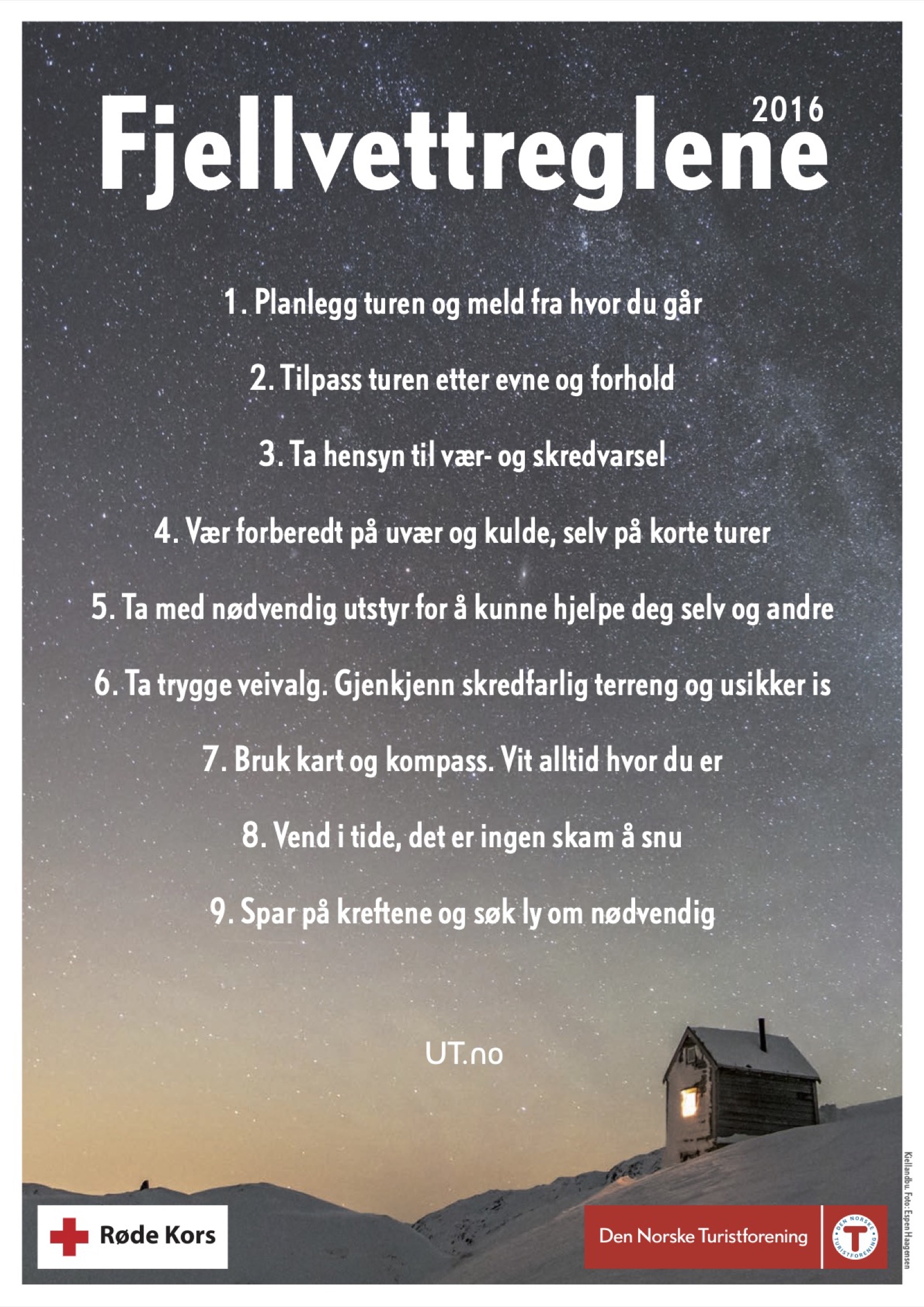
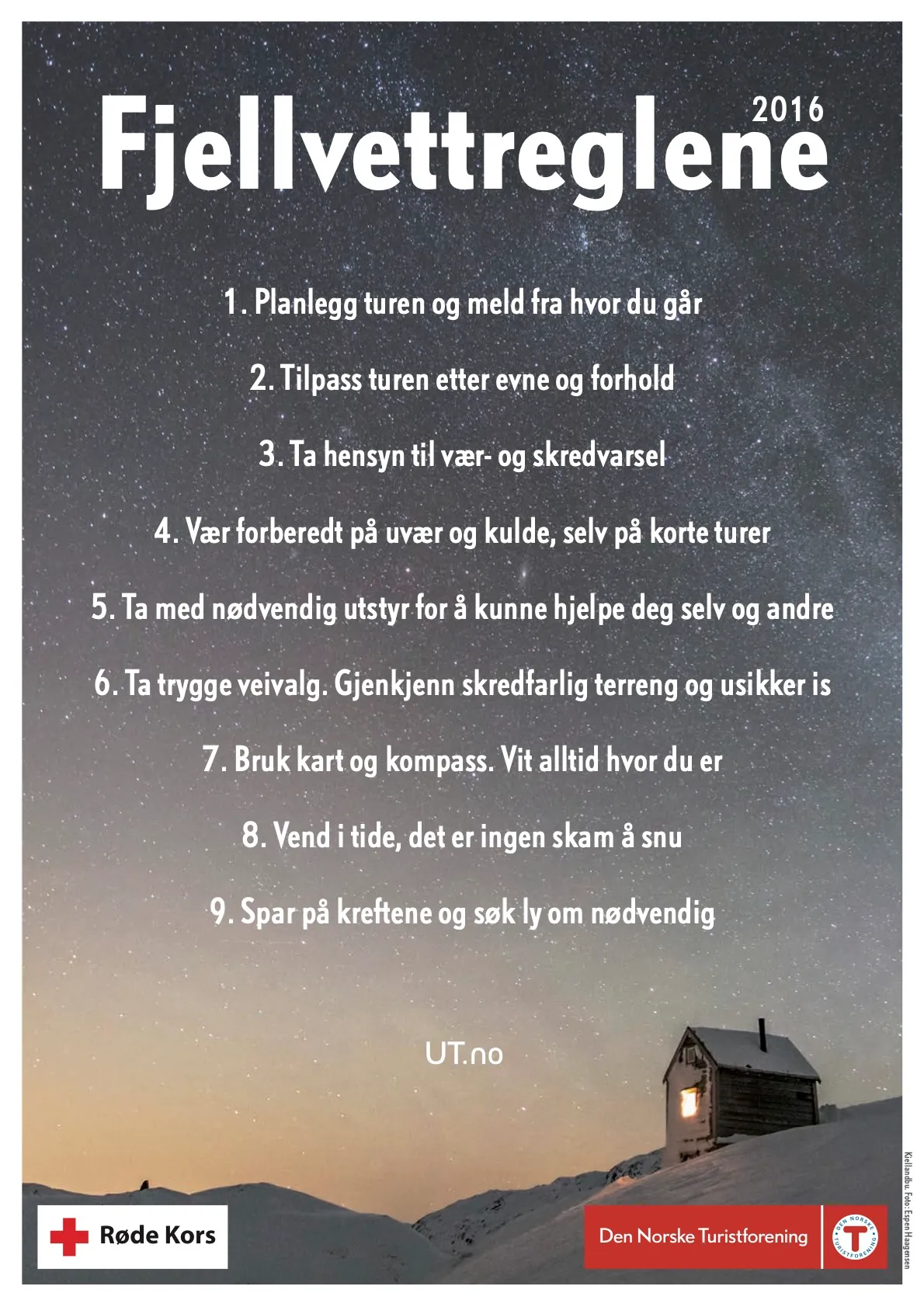
- Plan your trip and tell someone where you are going.
- Adapt the trip to your ability and the conditions.
- Take account of the weather and avalanche forecasts.
- Be prepared for bad weather and cold, even on short trips.
- Bring the equipment you need to be able to help yourself and others.
- Make safe route choices. Recognise avalanche-prone terrain and unsafe ice.
- Use a map and compass. Always know where you are.
- Turn back in good time; there is no shame in turning around.
- Conserve your strength and seek shelter if necessary.
About Fjellvettreglene
Fjellvettreglene, which were first called «Fjellreglene», were introduced after a series of accidents and deaths during Easter 1950. After yet another fatal Easter in 1967, the Norwegian Trekking Association (DNT) and the Red Cross launched the campaign «Velkommen til fjells, men ta ansvaret selv». Fjellvettreglene have since become part of Norway’s cultural heritage. Much has changed since the fifties. We go on different trips, we have different equipment, and the knowledge in the population has changed. For that reason, the Red Cross and DNT have now revised fjellvettreglene. The updated fjellvettreglene are adapted to all seasons, and are a good guide both in planning and carrying out short and long trips. Good fjellvett is not only about what you should and should not do, but about having a conscious relationship with nature, the choices you make and the actions you take. That is why today’s fjellvettregler are arranged as a learning circle: from planning, to meeting the trip group and the conditions of the day outside. Then adjusting the plans according to what we meet on the trip itself. Good fjellvett is about reflection.
1. Plan your trip and tell someone where you are going.
- Plan the trip according to the group’s abilities, and always have several alternatives.
- Make sure you have information about the area and the conditions you are heading into. Listen to experienced mountain people.
- Make sure you have the knowledge and skills required for the trip in question.
- Take account of nature. With good planning you leave no trace behind you.
- Make arrangements that do not depend on mobile coverage or precise times.
2. Adapt the trip to your ability and the conditions.
- Make ongoing assessments of the conditions, and adapt your plans accordingly.
- Show respect for the weather!
- Being on a trip together with others gives greater safety, and someone to share the experiences with. If you are on a trip alone, be extra careful.
- Do not set out on a long trip without experience; you must be able to take care of yourself and the others in the group.
- Show consideration for other walkers.
- Know allemannsrettene and the duties that come with them. Make sure the trip group has a culture of open and direct communication.
3. Take account of the weather and avalanche forecasts.
- Always use the weather and avalanche forecasts, and familiarise yourself with what they mean for you in the area you are going to travel in.
- Make use of the advice tied to the particular forecast, and choose easy terrain when conditions are demanding.
- The trip forecasts are found here: yr.no, storm.no and varsom.no.
4. Be prepared for bad weather and cold, even on short trips.
- Dress for the weather and the conditions. Remember that the weather changes quickly in the mountains.
- Bring both extra clothing and the equipment that the trip and the terrain require.
- Extra food and drink can help both you and others, if you take longer than planned or have to wait for help.
5. Bring the equipment you need to be able to help yourself and others.
- On a winter trip you need a bothy bag, a sleeping mat, a sleeping bag and a spade to manage a night out. A bothy bag can save lives.
- Bring something, for example a reflective vest or a head torch, that makes it easier to find you if an accident happens.
- Carry first-aid equipment. It means you can help both yourself and others.
- Always use an avalanche transceiver, and bring a probe and a spade if you are going to travel in avalanche-prone terrain.
- Pack smart! You will find packing lists for different trips at dnt.no.
- A mobile phone can be a useful aid, but remember that you cannot rely on it in every situation or area.
- If an accident happens, alert the police on 112, go for help or try to raise the alarm in another way.
6. Make safe route choices. Recognise avalanche-prone terrain and unsafe ice.
- Conscious and good route choices are the most important thing for avoiding avalanches.
- Know that avalanches can release on slopes higher than five metres and steeper than 30 degrees.
- Even if it is flat where you are walking, you can trigger an avalanche on the mountainside above you.
- An avalanche can run three times as far as the height of the slope it releases from.
- Avoid terrain traps, such as narrow stream gullies. Think about what happens if an avalanche occurs.
- Be aware of the danger of cornice collapse when you walk along a mountain ridge.
- Be aware of the ice conditions when you walk on regulated lakes, and in inlet and outlet areas.
7. Use a map and compass. Always know where you are.
- Use a map and compass; they always work.
- Keep track of the map even when you are walking on a marked route.
- The trip experience becomes richer if you follow the map along the way.
- GPS and other electronic aids are useful, but remember to bring an extra power source.
8. Turn back in good time; there is no shame in turning around.
- Reassess the plan continuously, and choose plan B long before you become exhausted.
- Have the conditions changed? Should you turn back?
- Is anyone in the party having trouble completing the trip? Should the group turn back?
9. Conserve your strength and seek shelter if necessary.
- Set the pace to suit the weakest in the party, and make sure everyone in the trip party keeps up.
- Remember to eat and drink often. When you exert yourself, the body needs more fluid than you feel the need for.
- Do not wait until you are exhausted to seek shelter.
- Strong wind makes you more tired. Use the bothy bag, or dig yourself down into the snow in good time.
Next steps
- Turning back in good time — rule 8 explained
- Trip plan and risk assessment — planning
- Route choice and SARTto — route and terrain
- Trip planning — the hub
Learn more
- DNT — fjellvettreglene — nine rules to remember
- Varsom — hazard warnings for avalanches, floods and landslides
- UT.no — routes, cabins, warning data
- Yr.no — weather forecast