Gear
Trekking poles
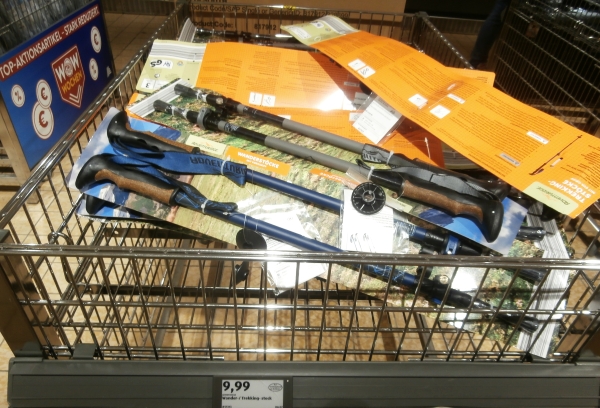
When poles help and when they get in the way, folding vs telescopic, choice of material, and why the length should be adjusted to the terrain — not to what the manufacturer writes.
Poles for hiking (also called trekking poles or simply walking poles) take load off the knees and lower legs on steep descents, give extra balance on uneven terrain, and can be used for everything from measuring water depth in a stream to pitching a tarp. They are not necessary for an ordinary trail walk — but they are useful for long-distance trips, steep terrain, and for anyone with trouble in the knees or ankles.
When poles actually help
Research from the Journal of Sports Medicine and the NIH among others shows that poles can reduce the load on the knee joint by 12–25% on steep descents. The effect is greatest when you:
- Carry a heavy pack (15+ kg)
- Walk in steep terrain over a long period
- Have existing knee or hip trouble
- Move over uneven ground (boulders, roots, snow)
The effect is smallest when you:
- Walk on a flat trail
- Carry little (a day hike)
- Move over obstacles (stone walls, rational climbing)
On a flat mountain trail, poles are first and foremost a marching-rhythm keeper. On an even lowland trail they are often more in the way than useful.
Construction — two main types
Telescopic poles (3 sections that slide into one another, locked with an external clamp or a screw) are the most common. Adjustable length, robust, packing down to ~60 cm. They work for most trips. Classic manufacturers: Black Diamond, Leki, Helinox.
Folding poles (3 sections with a cord inside, snapped together like tent poles) pack down smaller (~35 cm) and are lighter — but usually have a fixed length or only small adjustment options. Best for running use or fixed-length use. The Black Diamond Distance series is the classic here.
For ordinary Norwegian trail use, telescopic poles with an external clamp are the robust choice. Screw locking is easily affected by sand and water, and can slip under load. An external clamp is more reliable over time.
Materials
Aluminium (typically 7075 aluminium) is the most common. Light, durable, it bends under a hard knock rather than breaking. 200–300 grams per pole. Price: NOK 600–1,500 per pair.
Carbon fibre is lighter (150–220 g per pole) and more shock-absorbing, but breaks more abruptly under sideways load. Best for running or for those who prioritise the least weight. Price: NOK 1,200–2,500 per pair.
For trail use, aluminium is the safe choice — it tolerates being wedged in a crack in the rock and bent a little without losing its function. Carbon in the same situation can snap in two.
Length
Rule of thumb: when you stand with the pole planted straight down, your elbow should form a 90-degree angle. On flat ground this is the starting point.
In terrain you adjust:
- Steep descent — lengthen the pole 5–10 cm so that you do not have to lean forward to reach down
- Steep ascent — shorten 5–10 cm so that the pole takes the load while your shoulders stay raised
- Side traverse — pole on the uphill side shorter, pole on the downhill side longer
A habit worth forming: learn to adjust the length while you walk. On a long trip it saves considerable knee load.
Baskets, tips and straps
The tip is typically tungsten carbide — hard-wearing, with good purchase on rock. Protective caps (rubber caps) are used on tarmac and in cabin rooms to spare the floor and reduce clicking.
The basket (the ring above the tip) keeps the pole from sinking through a soft surface. The summer basket is small — for the trail and ordinary terrain. The winter basket is large — for snow. The summer basket is often fitted permanently; the winter basket is swapped on as needed.
The hand strap is often misunderstood: it is meant to support the wrist, not to hold the pole. The correct use is to bring your hand up through the strap from below, so that the strap takes the load while your fingers only grip loosely around the handle. That way you can walk with a looser grip and spare the hand muscles over time.
Maintenance
After wet trips: separate the sections from one another and let them dry open for 24 hours. Salt and sand in the mechanism are the main reason poles slip. Rinse in fresh water after exposure to the sea.
Replace a worn hand strap and a worn tip when necessary — both are inexpensive spare parts at the classic manufacturers. Do not throw away the whole pole for one worn component.
Text: Snuitide (2026).