Clothing
How to dress for the cold from top to toe
SINTEF researchers Julie Renberg and Øystein Wiggen both work in work physiology, with clothing and activity in the cold as their special field.
SINTEF researchers Julie Renberg and Øystein Wiggen both work in work physiology, with clothing and activity in the cold as their special field.
They have already gone deep into a range of projects on how the cold affects us: everything from developing survival suits and work clothing for activities in the Barents Sea, to how the cold affects both cross-country skiers and those who work outdoors in the cold.
“The cold has a considerable effect on us humans, and here at SINTEF we have worked for several decades on how we can function as well as possible in extreme surroundings,” says Øystein Wiggen.
One thing they are both keen on is that the cold affects children and adults differently.
“Because children have a larger surface area relative to body mass than we adults do, they can get cold more quickly. That is important to keep in mind now, when the little ones are outdoors for long days at nursery, out on a tur and perhaps also eating their packed lunch outside,” says researcher Julie Renberg.
Small fingers and toes get cold more quickly, and because children do not have the experience we adults have in handling the cold, they may readily take off their mittens or sit still too long, even though they are mostly very good at keeping active. It takes a little extra attention from the adults around them.
Out with synthetics and in with wool
One trick that researcher and mother of three Julie wants to share is to remove the insoles that come with children’s winter boots and swap them for proper wool insoles. And make sure there is enough room in the boots for extra wool socks.
“That is also a good tip, incidentally, for all the adults who are going to be sitting still outdoors,” says Renberg. For children who are outdoors for much of the day, a good sitting mat for the lunch break is very important. When we are still we naturally get colder, and the cold from the ground cools us down further, especially in the legs.
“Also keep an extra close eye on children’s cheeks when it is very cold, and especially when there is wind as well. Exposed skin can easily get frostbite in these surroundings, and children are not so good at speaking up,” the researcher adds.
 *
*
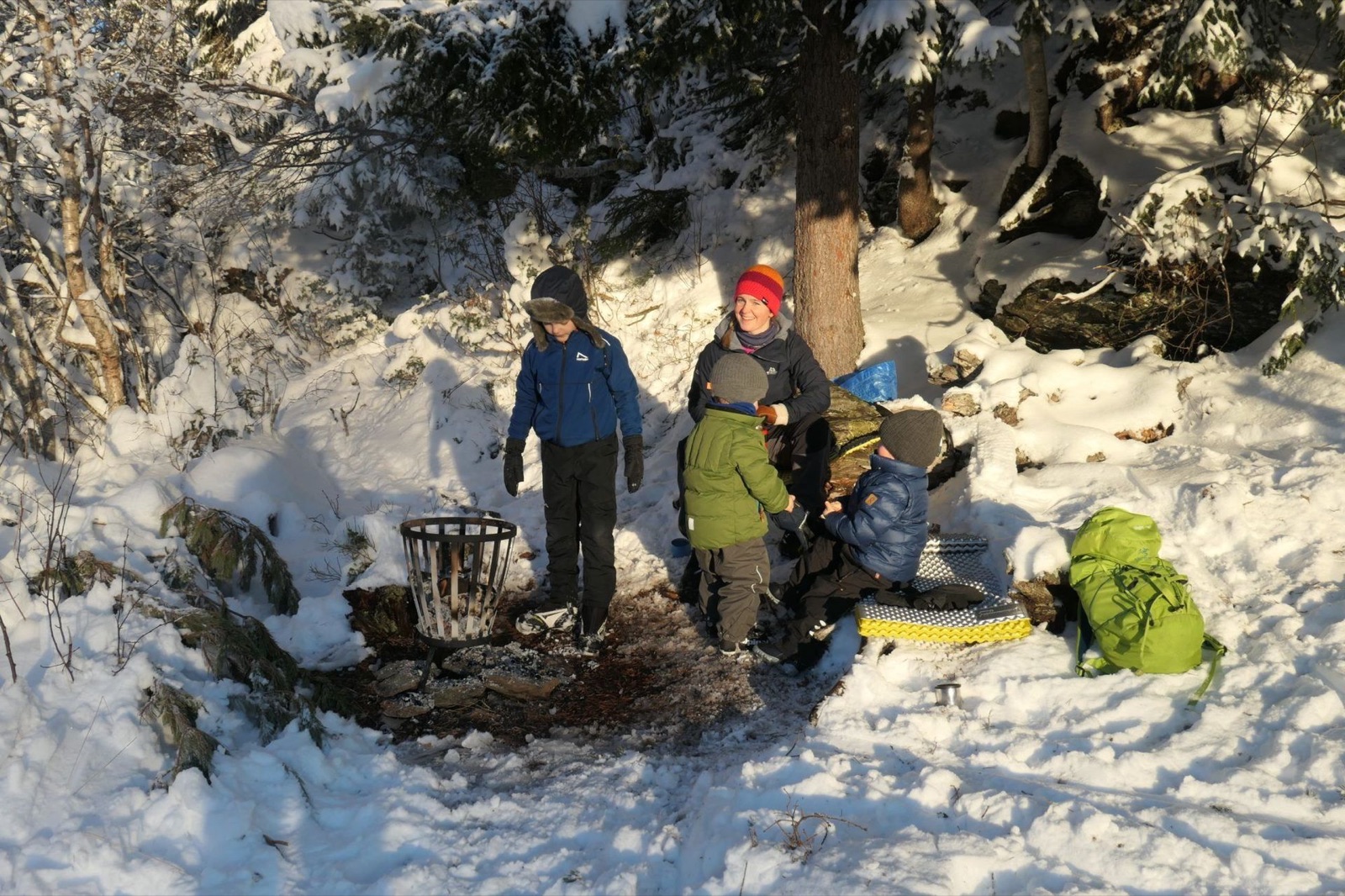
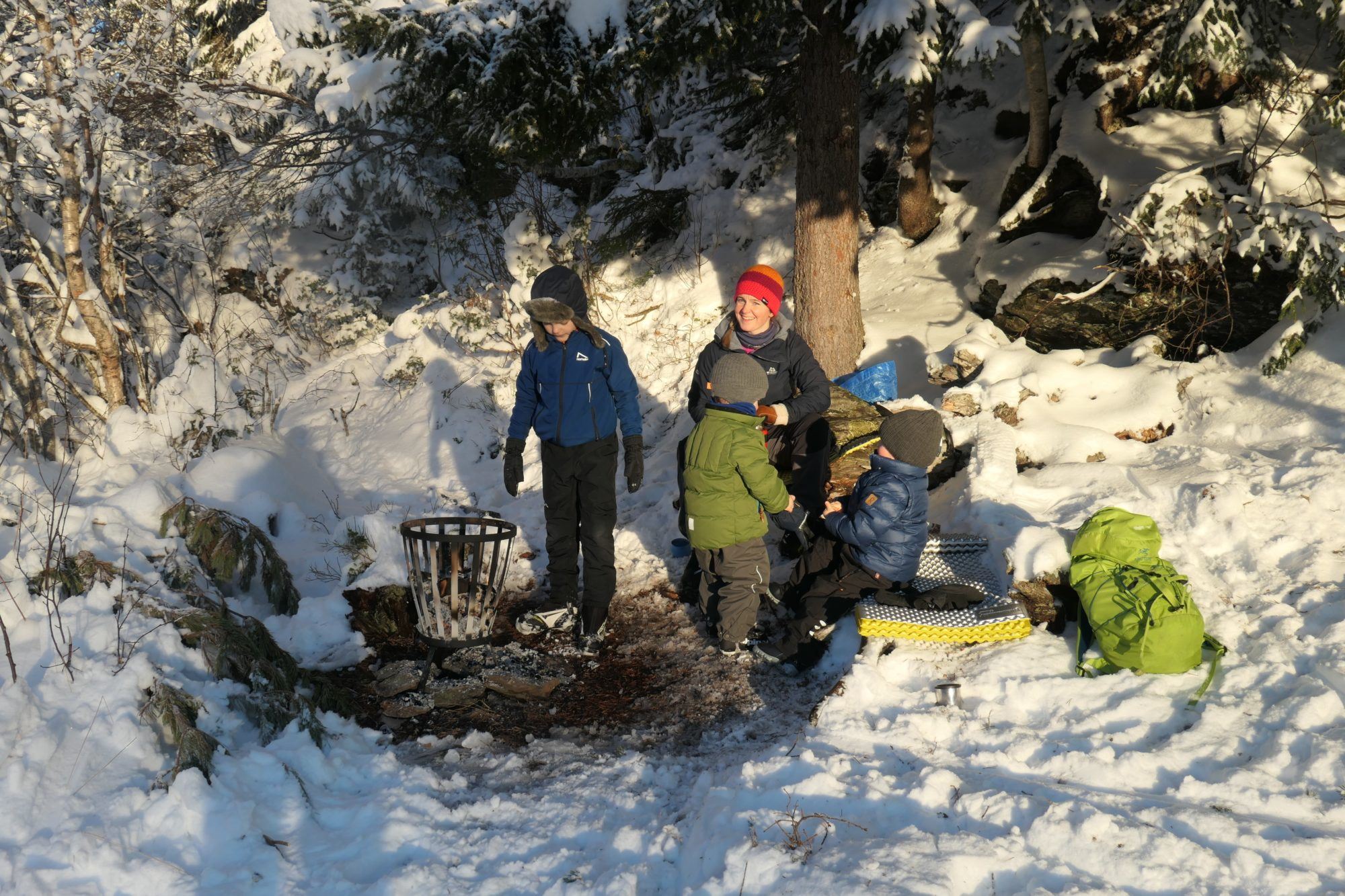
Out on a tur, never in a bad mood. Cold researcher Julie Renberg at SINTEF swaps the factory insoles in her boots for wool insoles and always makes sure she has an extra good sitting mat on a tur. Here from bålkos in the forest in January. Photo: Private (BY-NC-ND)
Dress with your head
But what really is the perfect clothing in the cold?
The researchers’ answer is not clear-cut. There is great individual variation in what feels cold, and not least it depends on what you intend to do in the cold. Planning your clothing around the activity is the key to a good experience outdoors, the experts believe. The basic rule is to think in terms of layered clothing and the ability to regulate the number of layers and thereby the amount of insulation.
“It is smart to plan well, and to make sure the various layers work well together. Is the warm jacket big enough simply to be put on over everything? Are the zips long enough on the trouser legs so that you can get your insulated trousers on even with big winter boots? A large, thick gilet can be a good option as an insulating outer layer,” says Øystein Wiggen.
“String mesh has the wonderful property of insulating because of the air layers the mesh creates, but also of being cooling because it exposes the skin and lets the sweat evaporate. Granddad was not wrong!”
Watch out for frostbite in cold and wind
It is important to be aware that frostbite can occur when the temperature creeps down to double-digit temperatures below zero with wind. The face, hands and feet in particular can be exposed to frostbite. The skin here cools down very quickly, and frostbite can occur within seconds.
“Worst of all is direct skin contact with cold metal surfaces. We quickly notice when we are starting to get cold, and in time it will also start to hurt. If the skin temperature falls below 10°C we will gradually go numb and lose sensation, and then we do not feel that it is getting even colder. That is when there is danger afoot,” says Julie Renberg.
Do not keep your head cool in the cold
If we start at the top of the body, surely everyone has heard that the hat is most important in the cold, because heat loss is greatest at the top of the head. The researchers do not quite agree:
They believe the hat is important, but you should also think about the face and ears, where the cold gets at the skin directly. Here it is the wind, or speed, that matters most: when we are skiing or cycling, we are in fact exposed to possible frostbite. A face mask of neoprene or similar is not a bad idea.
“If you are active you can feel nice and warm because your core body temperature is high. There is then a danger that you do not perceive the cold, which can actually damage exposed skin,” says researcher Øystein Wiggen. The hat should be pulled well down over the ears when it is cold, and pull it up when it gets warmer or you yourself have warmed up. And do not forget to use the hood on your tur jacket!
Read also this piece (from the archive) on how the cold affects us during activity.
 *
*
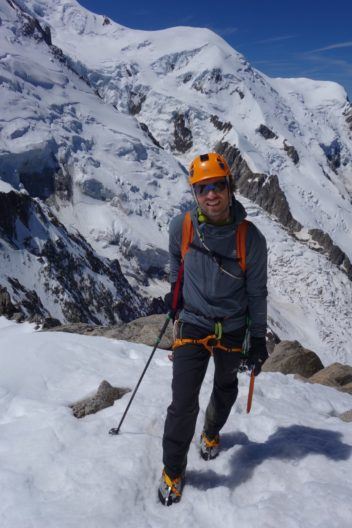
SINTEF researcher Øystein Wiggen has more days outdoors than most, and has researched cold and performance for several years. Here from a trip to Chamonix in 2016. Photo: Private (BY-NC-ND)
If we move down to the arms and hands, the researchers’ rule is to go for mittens rather than gloves when it is really cold. Again it comes down to surface area: mittens have less surface area than gloves, and so heat loss is smaller.
“Remember that it is easier to stay warm than to get the warmth back once you have got cold. If the mittens get too warm after a while — switch to gloves. To get the good tur experience in the cold, the secret is to regulate your insulation according to activity and weather conditions, so it is wise to carry a little clothing in your rucksack,” the SINTEF researcher emphasises.
Let the body distribute surplus heat itself
Many people have surely experienced being nice and warm in the body but ice cold on the fingers. This is typical on a ski tur.
A recent SINTEF study shows that our heat production becomes almost eight times as high when we walk up a proper hill in winter clothing, compared with when we are still.
“A tip can then be to stop for a bit once you have got warm. The body will then redistribute the blood from the working muscles and send warm blood out to the fingers to get rid of surplus heat. If you want to speed the process up a little, you can put in a real effort and swing your arms around, which will force warm blood right out to the fingertip,” says Wiggen.
On the upper body, layered clothing is the key to a good experience outdoors. According to the researchers, layer upon layer is always smart. Several thin layers are more functional, and can also give more insulation, than few and thick ones. It also gives you the chance to adjust the number of layers as needed.
“Good outdoor clothes have zips, for example under the arms and on the sides of the trousers, so you can vent when needed. And make sure the innermost layer can transport moisture away from the skin, or use wool, because wool insulates very well even after it has got wet. When we sweat and the moisture moves out into our clothes, we can reduce the actual insulation from the clothing by up to 25 per cent. That is why it is wise to carry some dry clothing in your rucksack that you can change into during the break. It is a bit unpleasant just as you change, but it is absolutely worth it,” says Julie Renberg.
The researcher also makes the case for the good old string-mesh vest:
“String mesh has the wonderful property of insulating because of the air layers the mesh creates, but also of being cooling because it exposes the skin and lets the sweat evaporate. Granddad was not wrong!”
Watch out for the large muscle groups
But what about the legs? This is where we have our largest muscle groups and it is also here that heat production is greatest when we are active. A recent SINTEF study shows that our heat production becomes almost eight times as high when we walk up a proper hill in winter clothing, compared with when we are still. Admittedly, when we keep up a bit of a pace.
At the same time we have fewer cold sensors in the legs, compared with the upper body. This means we do not feel the cold as much here, which is fine when we are working, but not when we are still, or if we are exposed to wind or high speed. During the break the thing to do is to get insulation on:
“I will always recommend either insulated trousers, down shorts or a down skirt during the break,” says Øystein Wiggen. And make sure there is enough room in the clothes, since air is good insulation. Tight-fitting, narrow clothes insulate poorly, and you do not get the full effect of the layer-upon-layer principle, where there is an insulating layer of air between each garment.
Most of us have probably got cold on the toes and felt the neglesprett afterwards. And the toes are, like the fingers and face, the part of the body that is most exposed.
“It is in the hands and feet that the blood flow is reduced first, and that helps to make these areas cold. In addition, the toes are nearest of all to the cold ground. It is not as easy to put cold feet against warm skin, as we can do with the fingers,” says Julie Renberg.
The researchers’ advice is therefore to have winter boots that are big enough. Ideally with plenty of room for two pairs of socks and wool insoles. And again it comes down to planning: if you are going to sit in a warm car on the way to a tur — skip the winter boots and use a good hiking boot instead. And change into warmer boots when you arrive. If you get sweaty on the legs already on the way to the tur, you have already given yourself a cold problem before the tur begins. It can also be a trick to use heat packs to warm up cold boots before you put them on.
Finally, the researchers have a couple of good pieces of advice: if you are going on a tur and being physically active, the rule is that you should feel a little cool when the tur starts. As we walk, the body’s heat production will increase considerably, and after a few minutes the temperature will feel perfect. Going on a tur with too many clothes only makes us sweat unnecessarily, use too much energy, get wet innermost — and therefore cold even with plenty of clothing. It is also wise to carry a dry change in your rucksack, because moisture is our enemy in the cold. Besides: something warm to drink in the flask is never wrong.
Text Christina Benjaminsen (2021) BY-NC-ND
-
Source
Benjaminsen, C (2021, 17. februar). Slik kler du deg i kulde – fra topp til tå. Sintef. Hentet fra: https://www.sintef.no/siste-nytt/2021/slik-kler-du-deg-i-kulda-fra-topp-til-ta