Avalanches
The weather
Precipitation, temperature and wind are important factors when we assess the weather and the avalanche danger. The weather can increase or reduce the avalanche danger in the winter mountains.
Contents
Precipitation, temperature and wind are important factors when we assess the weather and the avalanche danger. The weather can increase or reduce the avalanche danger in the winter mountains. We will look at which weather factors should be assessed before and during a trip, and we will look at weather situations that worsen the avalanche danger.
Wind
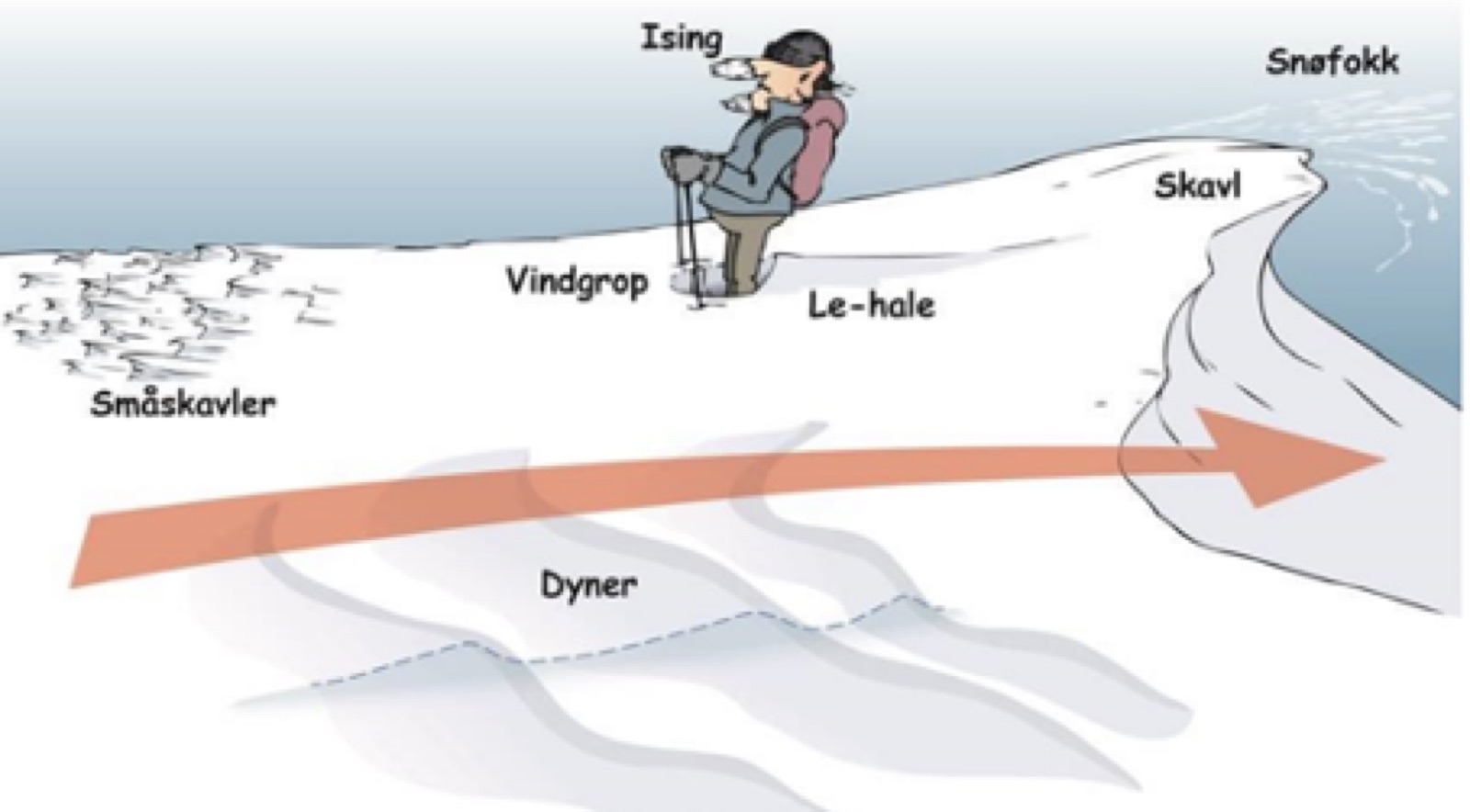
Wind is often described as the architect of the avalanche. The wind can transport snow and worsen the avalanche danger. When the snow is transported, bonds form within the snow. It is important to follow the weather forecast and see how much it is blowing, and which compass direction the wind is blowing from in the days before the trip. On the trip we check whether the forecast holds true: how much is it blowing compared with what was forecast, and is the wind coming from the same compass direction as in the forecast? In the picture below we see that the wind has come from the left-hand side of the picture.
Picture 28: By looking at wind signs in the snow we can estimate the most recent dominant wind direction. Illustration: Georg Sojer, NVE
Areas where the wind has deposited the snow we call lee areas (beneath the cornice on the right of the picture), and areas where the wind has carried the snow away we call windward areas. In the lee areas there can be a lot of snow, and this snow can lie in different layers down through the snowpack. How much snow is carried depends on whether there is snow available for the wind to transport — if it has snowed a lot before and/or after the wind began, a lot of snow can be carried to the lee areas. How light or heavy the snow is matters for how much snow is carried. We need stronger wind to move heavy snow than lighter snow.
Varsom.no - Hva menes med bundet snø? Film, NVE
Precipitation
Broadly speaking, precipitation comes in the form of snow or rain. Both types of precipitation place an increased load on the snowpack. If it snows in combination with wind, the snow will be carried from the windward area to the lee area. This means that the load on the lee area can increase sharply, even if it is not snowing very much.
Temperature
The temperature is decisive for what happens to the snow and to the layering within the snow. In general, low temperatures — colder than -8° — over longer periods will form weak layers in the snowpack and create the avalanche problem we call persistent weak layers. The colder it is, the faster this process goes. Milder temperatures, around 0° to -4°, mean that the snow can form a slab at the surface without the wind having moved the snow.
Weather situations that increase the avalanche danger
- A lot of snow in a short time increases the load on the snowpack
- The wind moves a lot of snow onto lee slopes
Next steps
- Avalanches — the hub
- The snowpack — what the weather shapes
- Terrain — the foundation
- The wind moves a lot of snow onto lee slopes — a specific weather situation
Learn more
- Varsom — avalanche forecast — regional avalanche warnings and the avalanche school
- NVE slope-angle map — slope angle ≥30°
- NGI — avalanches — research
- Norsk Fjellsportforum — course standard
Text
- Linda Hallandvik, Snuitide (2022)
- Where not otherwise stated, all pictures and films come from the website of Varsom.no.