Avalanches
Wind moves a great deal of snow onto lee slopes
Wind moves snow and builds up lee areas with a great deal of snow.
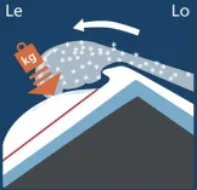
Wind moves snow and builds up lee areas with a great deal of snow. Illustration: NVE
Precipitation often comes in combination with wind, and from that we understand that it will take less than 30 cm of fresh snow per 24-hour period to increase the avalanche danger. So it is important to check both the amount of fresh snow and whether it has come in combination with wind. If so, which compass direction has it blown from? If we look more closely at the next picture, we understand that wind in combination with precipitation leads us on to the next avalanche situation, which contributes to worsening the avalanche danger.
Loose, light fresh snow begins to be transported at a wind speed of about 5 m/s. The lighter the snow, the easier it will be to transport. At a wind speed of about 17 m/s, snow transport will be at its greatest. If it blows more than this, the snow will often be whirled up into the air and part of it will evaporate in the air. This is the reason we say that optimal snow transport stops at a wind speed of about 17 m/s.
Next steps
- The weather — context — wind as a factor
- The snowpack — wind slab and the layers
- Terrain — where the lee slopes lie
- Avalanches — the hub
Learn more
- Varsom — avalanche forecast — regional avalanche forecasting and the avalanche school
- NVE slope-steepness map — steepness ≥30°
- NGI — avalanches — research
- Norsk Fjellsportforum — course standard