Classic tours
Mjøsa, Tyrifjorden, Femund, Hardangervidda — the Norwegian tour-skating classics. What the conditions are like, how long a tour is realistic, and which areas suit what.
6 articles
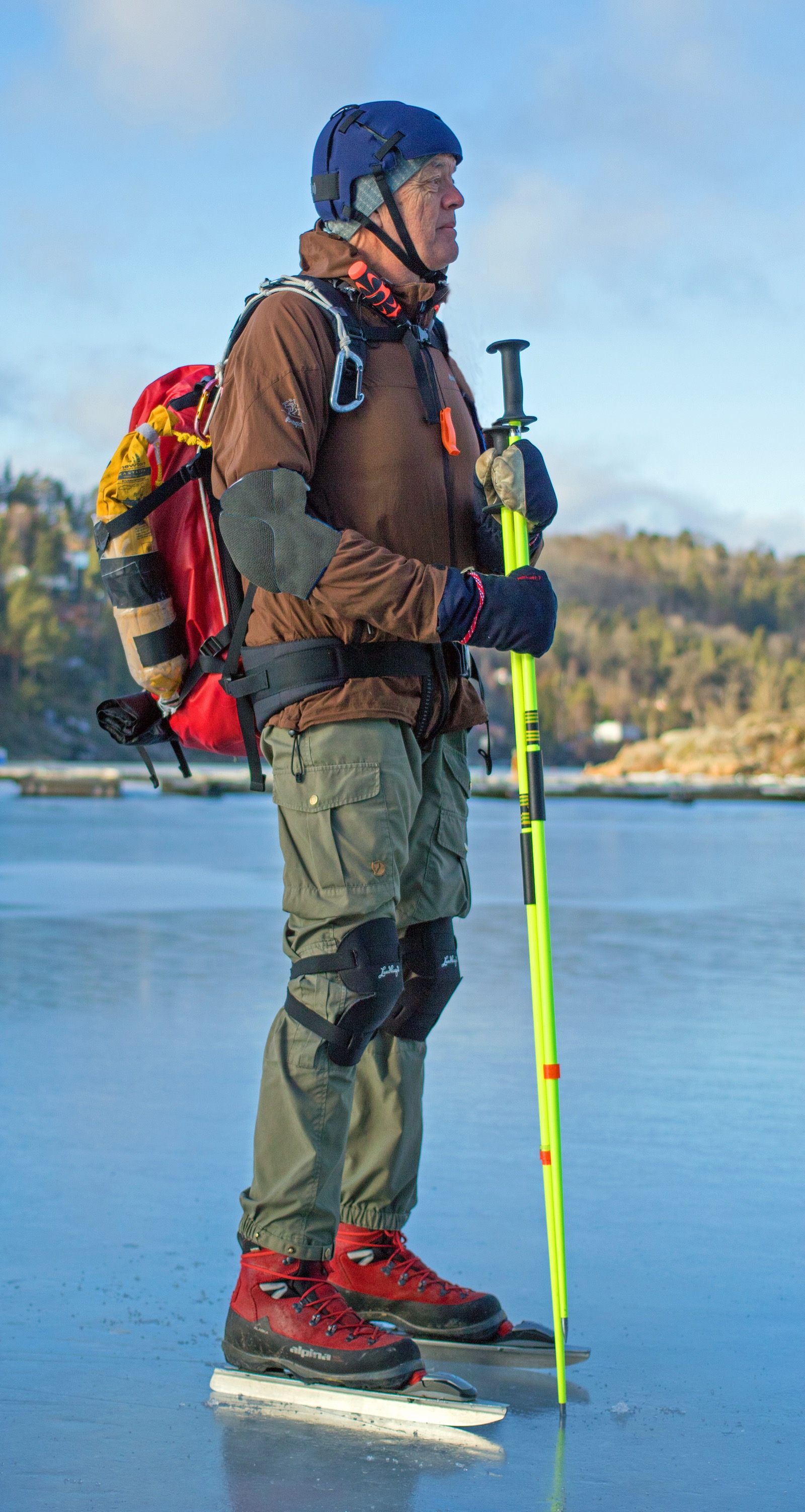
Tour skating is one of the Norwegian outdoor activities that has grown fastest over the past twenty years. Long outings on natural ice — on frozen lakes, canals, and occasionally frozen fjords — give an unusual experience of the winter landscape. You cover kilometres in a short time, glide through a quieter landscape than a ski trip offers, and experience winter nature from an entirely different angle than walking or skiing does.
The sport is imported from Sweden, where långfärdsskridskoåkning has more than a hundred years of tradition. In Norway the activity gathered pace from around 2010, and Foreningen Turskøyting was formally founded in September 2020. Today the association has several thousand members, Stålisgruppa in Trøndelag has more than 7,000 followers on Facebook, and large groups coordinate group tours across the whole of southern Norway throughout the winter season. As SNL describes it: ‘tour skating has gone from a niche activity to a people’s sport’.
The classic mantra is ‘there is no such thing as safe ice, only safe skaters’. The activity has its own safety culture built around ‘knowledge, kit and company’ — the phrasing of Oddvin Lund, a central pioneer in the scene with more than 30 years of experience. For the newcomer the advice is simple: join a local tour-skating group’s group tour before heading out alone. Breaking through the ice is rarely dangerous if you have the right equipment and are in a group — without it, it can be serious.
Tour skating differs from other skating activities in several ways:
Tour skates are long (45–55 cm) and low blades that mount on touring/backcountry ski boots. They are steadier than hockey or figure skates, and built to glide efficiently over long distances. On good ice, trained tour skaters can move at 15–25 km/h — meaning a day trip of 50–100 km is realistic.
Bindings are typically NNN-BC from Rottefella or older 75 mm 3-pin. Ski boots — ordinary BC backcountry-ski boots — serve as the interface. This is one of the reasons tour skating has a low barrier to entry for those who already do backcountry skiing: the equipment overlaps.
The outing can be anything from a couple of hours on a local lake to a full day covering 80–100 km. The world’s largest tour-skating race, Vikingarännet in Sweden (Uppsala–Stockholm, around 80 km), has since its start in 1999 had roughly 4,000 participants in a single day — these are the kinds of distances that trained tour skaters aim for.
The difference from competitive skating: speed skaters can reach up to 60 km/h in a sprint, but that is a different activity with its own rules and focus. Tour skating is primarily friluftsliv — a social outing, nature experience, and long days on the ice.
Norwegian tour skating divides into several variants:
Natural-ice outings on lakes are the classic form. Mjøsa, Tyrifjorden, Femund are recurring classics. Early mountain tarns on Hardangervidda give an early season (October–November).
Cleared tracks are the alternative when natural ice does not work because of snow. Sognsvann (Oslo) has a Bymiljøetaten-cleared long-track of 1.5–2 km when the ice is at least 15 cm thick. Many towns have cleared skating tracks run by DNT or the municipality.
Canal outings — the Telemark Canal and similar — exist as a niche, but are not dominant in the Norwegian tour-skating scene.
Fjord skating — rare because of salt and current, but it occurs in the Trondheimsfjord and parts of inner fjord systems in cold winters.
For those who want to build social outing experience: join a local Facebook group (Turskøyting på Østlandet, Stålisgruppa Trøndelag, and others) or Foreningen Turskøyting. These are knowledge hubs with ice reports and group-tour coordination.
Norwegian tour skating has roots both in long skating traditions in Norway and in modern Swedish ‘långfärdsskridskoåkning’:
Skates have long traditions in Norway — bone skates are mentioned in the sagas of Snorri Sturluson, used for transport, play and competition alike.
Modern tour skating came from Sweden, where långfärdsskridskoåkning has more than a hundred years of organised tradition. Norwegian tour skaters have explicitly ‘learnt from the Swedes’, as SNL puts it.
Norwegian growth gathered pace from the 2010s through voluntary scenes that have held courses and inspired others. Central figures: Oddvin Lund (a tour-skating enthusiast with more than 30 years of experience, central to Foreningen Turskøyting) and a broader circle of instructors who have built the course and reporting infrastructure.
Foreningen Turskøyting was formally founded in September 2020 — to bring together the organising of registrations, courses and group tours. The association has grown from around 450 paying members (2019/20) to 750+ the following season, and today has several thousand followers on Facebook. The theory course, a core activity since 2006, has had around 1,300 participants up to 2020/21.
DNT Oslo og Omegn is, from the 2025/2026 season, building up a team of tour-skating guides with training in leadership, ice knowledge, rescues on ice and first aid. DNT Vansjø Turskøytegruppe is active in Østfold, and DNT Trondhjem and DNT Bergen have their own groups.
Skridskonätet (skridsko.net) is the Nordic communication platform for tour skaters — run from Sweden, but used actively by around 300–400 Norwegian tour skaters for ice reports and trip coordination.
Ice safety is the one core competence in tour skating. The classic guidelines (based on NVE’s Isskole and Foreningen Turskøyting):
Ice-thickness table for clear core ice (clear black ice, the strongest):
Ice types and bearing capacity:
Areas exposed to current (inlets, outlets, narrows) are especially dangerous regardless of thickness. The water below flows actively and the ice can be thin even 20–30 metres from an area with 20 cm bearing capacity.
Varsom.no/iskart.no is run by NVE and provides ice warnings for regions together with RegObs reporting. The service does not have round-the-clock staffing, but gives a comprehensive overview of conditions per region.
For the newcomer: learn how to read ice before you set out. Clear black ice is safe; white or greyish ice is suspect; wet and porous ice is dangerous. The ice pole — the most important piece of safety equipment — gives concrete confirmation: if you do not break through the ice on one or two hard blows, you can normally go on.
For tour skating you need a complete system:
Skates: tour skates, blade 45–55 cm, mounted on touring/backcountry ski boots. Classic makers: Alfa, Lundhags, Zandstra, Isvidda. Price new: 2,500–5,000 kr.
Bindings: NNN-BC (Rottefella) is dominant; also 75 mm 3-pin.
Ski boots: ordinary BC backcountry-ski boots work.
Ice pole: the most important piece of safety equipment. Stouter than a ski pole, with a steel spike that ‘pricks’ a hole in the ice to read the thickness. Price: 600–1,200 kr.
Ice picks around the neck with a whistle — lifesaving for pulling yourself up onto the ice edge after breaking through. Price: 200–400 kr.
Throw line 20–25 m in a throw bag with a throw weight — for companion rescue. Price: 400–800 kr.
Waterproof bag with a full change of clothes in the pack — gives buoyancy when you are in the water, keeps a dry change of clothes for when you come up. This is critical — without buoyancy from the pack it is difficult to get yourself out.
Pack with a crotch strap/chest strap so it does not slide over your head in the water; 30–50 l a typical size.
Helmet, knee and elbow guards — recommended against falls on hard ice. A helmet is the most common.
Ordinary outdoor clothing with wool next to the skin.
For a complete set-up — skates, ice pole, throw line, ice picks, pack system — reckon on 6,000–12,000 kr new. The second-hand market is favourable, and many tour-skating groups hire out equipment to members who want to try first.
If you go through the ice — and it happens occasionally, especially on thinner ice early in the season — the procedure is:
Why the pack helps: a waterproof bag with clothes provides buoyancy, so you float higher in the water and can get yourself out more easily with the picks. Without this flotation aid, getting out becomes considerably harder.
Companion rescue: if someone in the group goes through, the others throw the throw line. 20–25 m is standard. The line is attached to the person in the water, who already has it secured to the body via a chest strap. The others pull them up onto stronger ice.
To build skill: fall-through practice evenings (plumpekvelder) and rescue courses are arranged by Foreningen Turskøyting, DNT Oslo, and local groups each season. You practise breaking through and getting out under controlled conditions (known ice conditions, a dry spare pack ready). That is the difference between knowing the procedure in theory and mastering it under stress.
Norwegian tour-skating areas divide up by geography:
Mjøsa is Norway’s largest lake, around 100 km north of Oslo. A classic tour-skating mecca — large, open surfaces, long possibilities when the ice is in.
Tyrifjorden is eastern Norway’s second-largest water surface (after Mjøsa), consisting of the main basin Storfjorden plus the arms Holsfjorden, Nordfjorden and Steinsfjorden. Foreningen Turskøyting has its own category overview for Tyrifjord outings.
Femund — Norway’s second-largest natural lake, third largest in total, towards the Swedish border. Wilderness-flavoured tour skating; a longer approach but more genuine friluftsliv.
The Ringerike region is described by Foreningen Turskøyting as ‘perfect for tour skating’ because of the height difference from Tyrifjorden (63 m above sea level) to mountain tarns above 1,000 m above sea level — giving a long and varied season.
Hardangervidda mountain tarns freeze early in the autumn (northern Europe’s largest high-mountain plateau). A classic for the early season.
Vansjø — DNT Vansjø’s Turskøytegruppe is one of the country’s most active local groups, with group tours on Vansjø and other waterways in Østfold.
The Trondheim region — Stålisgruppa (an informal group in Trøndelag) meets on newly formed core ice on Jonsvatnet and other lakes. More than 7,000 followers on Facebook make it one of the largest local scenes.
Toten, Hadeland, Skreia (Mjøsa) — classic early-season areas.
For those who want to plan: become a member of Foreningen Turskøyting or a local Facebook group. Ice reports are published regularly through the season, and group tours are arranged when conditions warrant.
The Norwegian tour-skating season is typically October to April, with considerable variation between regions:
Climate change has changed the Norwegian tour-skating season in several ways. Fewer snow days make ice conditions without snow cover more common — that is positive for skaters. But repeated freeze–thaw periods make lowland ice unstable, and the spring melt comes earlier. Late winter demands more competence than it did a generation ago.
For those who want to plan: follow ice reports via Skridskonätet and local Facebook groups. iskart.no (NVE) has official observations.
The classic formulation for tour-skating safety is kunnskap, redskap, selskap (‘knowledge, kit, company’):
Knowledge — you must be able to read ice, know the difference between ice types, recognise areas exposed to current. Not theory alone; it is built through experience and courses.
Kit — a complete equipment package. Ice pole, ice picks, throw line, waterproof bag with a change of clothes. Not optional on natural ice.
Company — go with others. Foreningen Turskøyting advises against going alone. If you go alone and something goes wrong, there is no one to help. With company, breaking through is usually not serious.
Oddvin Lund puts it as: ‘The ice is never safe. It is we who are to be safe.’ — comparing it with mountain and sea safety.
For those who want to build practice: take the theory course through Foreningen Turskøyting (completed by around 1,300 people since 2006), join group tours, and take part in fall-through practice evenings.
For those new to tour skating:
Join a local Facebook group — Turskøyting på Østlandet, Stålisgruppa Trøndelag, or a local DNT skating group. You get access to ice reports and group-tour coordination.
Take the theory course through Foreningen Turskøyting or DNT Oslo. Price typically 200–500 kr.
Join a first group tour with experienced skaters. Many groups have outings for beginners on well-iced lakes with little risk.
Try a fall-through practice evening (plumpekveld) — practise breaking through and self-rescue under controlled conditions. A classic event before the first real start of the season.
Invest in equipment after the first season, once you know what you actually want. Many groups hire out equipment to members.
For those with a background in backcountry skiing: the barrier is low — you already have ski boots and know the winter environment. The main transfer is ice reading and self-rescue.
Tour skating is one of the outdoor activities most affected by climate change. Three main effects:
Shorter ice-forming period — especially in the lowlands. Mjøsa has historically frozen over consistently from January; in mild years now it is not guaranteed before February.
More unstable conditions — repeated freeze–thaw periods give more layered ice and more frequent weak areas.
Longer spring season with ‘rotten’ ice — ice conditions in western Norway and southern Norway are more variable than they were. Competence in spring meltwater ice is more important.
Paradoxically, climate change has also expanded tour-skating activity in some places. Fewer snow days mean that ice conditions without snow cover are more common, and that is ideal for skating. Areas that were previously snow-covered for large parts of the season now get more natural-ice tour skating.
For those planning future practice: follow local developments. What are classic areas in 2010 are not necessarily so in 2030.
If tour skating is new: join a local Facebook group and take part in a local group tour before the next start of the season. Take the theory course and a fall-through practice evening before you set out alone.
If you have done group tours and want to build skill: take DNT’s guide course if it is relevant, or contribute as a merely experienced trip leader in a local group. The social dimension is the heart of the safety culture.
For an equipment upgrade: consider your own set-up after the first season. Used equipment on Finn.no or via local groups is often inexpensive.
For related winter activities: skiing uses overlapping equipment (ski boots, BC bindings). Winter camp and overnighting is relevant for longer winter-trip projects.
Tekst: Snuitide (2026).
Mjøsa, Tyrifjorden, Femund, Hardangervidda — the Norwegian tour-skating classics. What the conditions are like, how long a tour is realistic, and which areas suit what.
Ice safety is the core skill in tour skating. How to read ice — clear black ice vs snow ice vs melting ice — where current-exposed areas are dangerous, and why 'there is no safe ice, only safe skaters'.
Ploughed skating tracks — the alternative when natural ice is snow-covered. Sognsvann and Maridalsvannet in Oslo, Bymarka in Trondheim. How municipal ploughing works, what ice thickness is required, and why it is the easy-access way into tour skating.
Breaking through the ice is not a disaster if you are prepared. Here is how self-rescue with ice claws works, buddy rescue with a throw line, and why the pack with a change of clothes is life insurance.
Tour skates, ice pole, ice claws, throw line, waterproof bag. How the system fits together, what sets Alfa, Lundhags and Zandstra apart, and how much it costs to get started.
How to make your first tour-skating outing — join a group tour, hire kit, take a fall-through practice evening before you go alone. How to choose the day, the place and the company without gambling with ice safety.