Big-game hunting
Big-game hunting — moose, red deer, roe deer, wild reindeer, large carnivores. How the annual shooting test works, why the jaktlag is the core, and what is required beyond jegerprøven.
10 articles
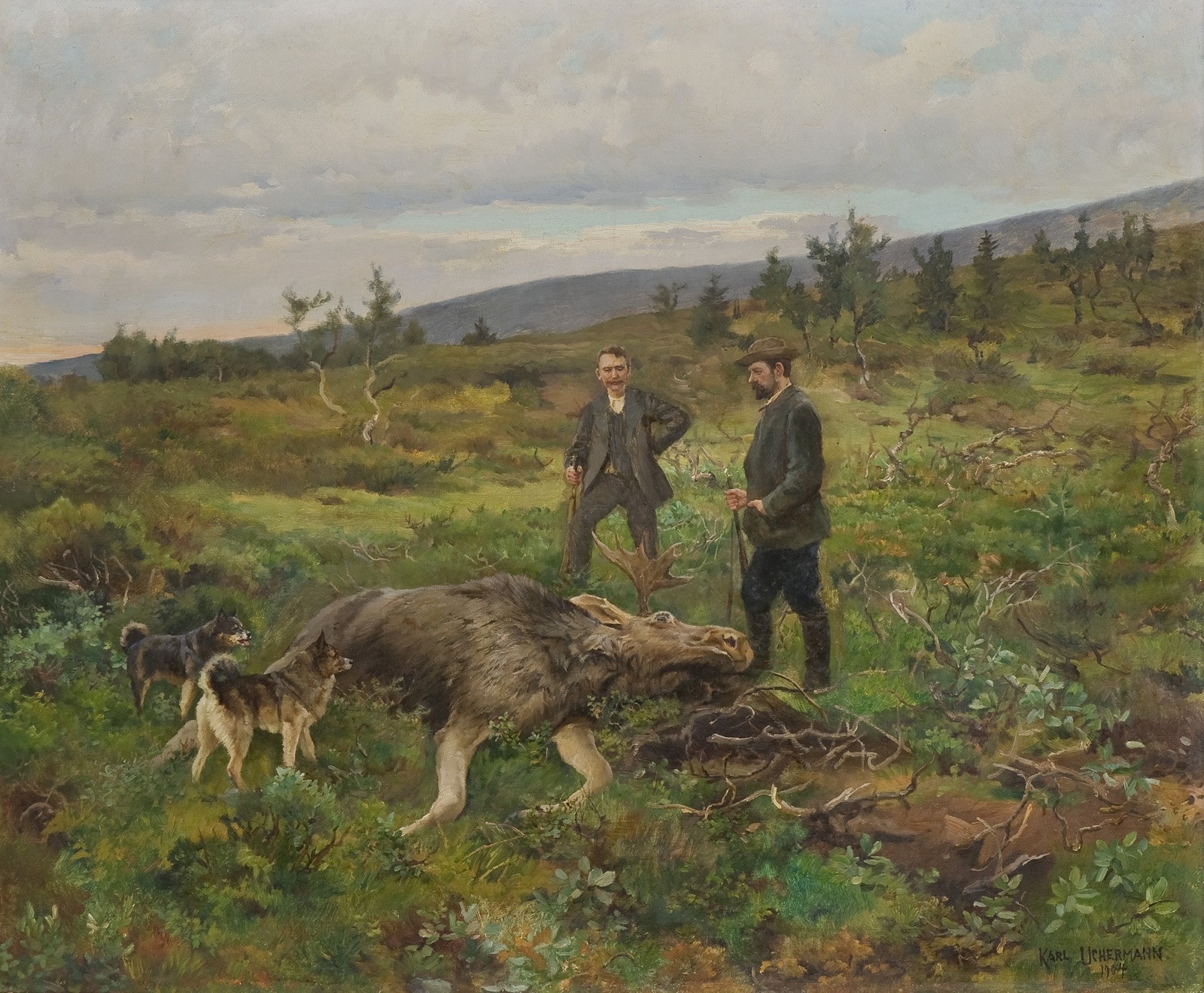
Hunting is an activity with deeper roots in the Norwegian use of outlying land than almost any other form of friluftsliv — and at the same time the one activity that is clearly exempt from allemannsretten (the right to roam). You may walk wherever you like in utmark and pick berries, but you cannot shoot a moose without jegerprøven, the hunting licence fee (jegeravgift) and the right to hunt the area. It is a deliberate limit, written into the Wildlife Act (viltloven) of 1981, and it defines how modern Norwegian hunting works in practice.
Today 558,500 people are listed in the Hunter Register (hunting year 2025–2026), of whom 17 per cent are women. Of these, 171,740 have paid the hunting licence fee and are active hunters — a fall of 11 per cent over two years. Population figures for the main game species are mostly stable or growing; for red deer the hunting take is now larger than for moose nationally (Vestland county alone took 35,191 red deer in 2024–2025).
Hunting differs structurally from other outdoor activities in being regulated through an entirely separate framework: the Wildlife Act, the Nature Diversity Act, the hunting-seasons regulation (jakttidsforskriften), the Firearms Act and the shooting-test regulation. This is not arbitrary bureaucracy — it is the result of hunting bearing directly on population management and requiring public oversight to work sustainably.
Norwegian hunting is spread across several distinct activities with different thresholds and competence requirements:
Small-game hunting covers ptarmigan, hare, woodland grouse (capercaillie/cock capercaillie, black grouse, hazel grouse), rabbit, mink, fox, stoat, pine marten, badger and a range of other species. The SSB figures cover 36 small-game species plus roe deer. Small-game hunting is the usual gateway for new hunters — a lower competence threshold than big game, it can be hunted alone or in smaller groups, and a large share of Norwegian hunting areas give access via Statskog or the mountain boards (fjellstyrer).
Big-game hunting covers moose, red deer, fallow deer, wild reindeer, roe deer, wild boar, mouflon, musk ox, bear, wolf, wolverine and lynx. It requires a passed shooting test (skyteprøve) each year (30 compulsory practice shots plus 5 silhouette shots) and as a rule membership of a jaktlag (hunting team). Classically central in Innlandet and Trøndelag for moose, and Vestlandet for red deer.
Tracking of wounded game (ettersøk) is the follow-up of wounded game with an approved tracking dog (ettersøkshund). The duty is written into law for hunting of moose, red deer and roe deer (Wildlife Act § 26 no. 3). Public tracking work requires a passed approval test (blood-track and fresh-track) and the course “Ettersøk videregående”. The approval is valid for five years.
Seabird hunting covers wildfowl — red-breasted merganser, goldeneye, tufted duck, mallard and others. The eider has been closed to hunting since 2022. Traditionally strong in coastal municipalities and in Lofoten/Vesterålen.
Bear hunting and large-carnivore hunting stand in a category of their own — more politically and culturally charged than ordinary big game. Bear hunting is licensed culling (lisensfelling) from 21 August to 15 October outside sheep-priority areas. Norway has 191 different registered brown bears (2024) — the highest number since nationwide DNA monitoring began in 2009. Population target: 13 annual litters, still below the target.
Hunting has been part of the Norwegian use of outlying land for a thousand years. In the Viking Age, hunting and trapping were an important part of the economy alongside farming and fishing. Throughout the Middle Ages and into modern times the right to hunt was tied to farms and commons — the local community’s own system of rights governing who is allowed to hunt where.
Modern management began with the Wildlife Act of 1899 — the first consolidated wildlife legislation, based on the principle of protection (all wildlife is protected unless otherwise decided). The Act was superseded by the Hunting Act of 14 December 1951, and then by today’s Wildlife Act of 29 May 1981 (Act 1981-05-29 no. 38), which entered into force on 2 April 1982. It regulates hunting, trapping, tracking of wounded game, jegerprøve, the hunting licence fee and the culling fee, and has been substantially amended in 1993, 2000 and later.
The Nature Diversity Act of 19 June 2009 (naturmangfoldloven) introduced management objectives, the knowledge requirement (§ 8), the precautionary principle (§ 9) and an ecosystem approach (§ 10). The consequence for hunting: harvesting requires the species to produce a harvestable surplus. It is a modern formulation of an old principle.
The Norwegian Association of Hunters and Anglers (NJFF) was founded on 10 February 1871 and is Norway’s only nationwide interest organisation for hunters and anglers. The association today has around 120,000 members across 500 local branches and 19 county chapters.
Jegerprøven became compulsory from 1986 — everyone born after 1 January 1967 must have passed the test in order to pay the hunting licence fee. It was a substantial professionalisation of Norwegian hunting in the 1980s, and established the competence threshold that still defines who may hunt.
Norwegian hunting areas vary by geography and game species:
Innlandet is the heartland of moose hunting. 7,427 moose taken in 2024–2025 — the most in the country. Trysil, Engerdal and Rendalen have long traditions of hunting teams, commons and a moose culture that are almost dialect phenomena in their own right.
Trøndelag is broad — moose (5,627 taken), red deer, roe deer. Many state commons (statsallmenning) managed by local mountain boards.
Vestlandet is the red-deer mecca. Vestland county alone took 35,191 red deer in 2024–2025 — a record. The red-deer population has grown dramatically over the past 30 years, and 92 municipalities allowed quota-free calf hunting in 2024–2025 because of large populations.
Sørlandet has roe deer as its main species (Agder took 4,960 roe deer in 2022) and some small game.
Northern Norway (Nordland, Troms and Finnmark) has a ptarmigan tradition and moose hunting. Ptarmigan hunting is extended to 15 March in Troms, Finnmark and parts of Nordland — the season is longest in the country here.
Finnmark has its own arrangement through the Finnmark Act (Finnmarksloven, 2005). Finnmarkseiendommen (FeFo) manages the land, and innenbygdsboende have priority for small-game hunting. Separate arrangements for Sámi reindeer husbandry and customary law.
Statskog SF is Norway’s largest landowner and manages around 58 million decares, of which 26 million decares are state commons. Hunting cards are sold via inatur.no.
Jegerprøven is 30 hours spread across 9 compulsory sessions plus a written exam. Course prices run at 1,000–3,900 kr (typically 2,000–3,500), plus an exam fee of 360 kr administered by the municipality. The minimum age to sit the exam is 16.
Of the 11,225 who sat the exam in the latest reported year, 26.7 per cent were women. It is one of the clearest growth patterns in Norwegian hunting: the proportion of women among new hunters is nearly three times as high as among existing registered hunters.
For big game an annual shooting test (skyteprøve) is also required — 30 compulsory practice shots plus 5 silhouette shots where all 5 hit within a marked 30 cm circle, spread over at least two days.
Training hunting (opplæringsjakt) lets young people take part without their own hunting proficiency test. From the year you turn 14: small-game hunting under the supervision of a hunter with at least three years’ experience who is 20 or older. From the year you turn 16: big-game hunting under supervision (requires a passed jegerprøve and big-game test). Exempt from the hunting licence fee during the training period.
The main rule in the Wildlife Act § 27 is that the landowner has the exclusive right to hunt and trap on their property. The right to hunt can be let, but cannot be sold separately from the property. In practice that means three main forms of access:
State commons (statsallmenning) managed by local mountain boards under the Mountain Act (fjelloven) of 1975. Everyone resident in Norway has an equal right to small-game hunting without a dog. The mountain boards may set quotas and reserve a maximum of 60 per cent for local residents (innenbygdsboende). Big-game hunting and small-game hunting with a dog: local residents have priority.
Statskog sells hunting cards via inatur.no. Norway’s largest landowner (~58 million decares) offers small-game and big-game cards on publicly accessible state land.
Private leasing is most common in Vestlandet and Sørlandet. The price varies enormously — from a few hundred kroner for a small-game day card to 30,000–80,000 kr for a moose-culling right. It often requires a local connection or an intermediary.
For anyone new to hunting: start with Statskog/Inatur for small-game hunting or join a hunting team through NJFF. It is the simplest way in.
The Norwegian game population breaks down as follows (latest reported year):
Moose — 26,400 taken in 2024–2025. Down from 36,400 in 2004–2005 (-28 per cent over 20 years). The population is actively regulated; the decline is intended management, not a crisis.
Red deer — 35,191 taken in Vestland alone in 2024–2025. The population has grown dramatically over the past 30 years; the hunting take is now larger than for moose nationally.
Roe deer — around 30,000 taken annually. Peak in the mid-1990s (~60,000), now reduced.
Wild reindeer — Norway has over 90 per cent of Europe’s wild reindeer (the mountain ecotype). Hardangervidda has around 10,000 animals (estimate). Classified as Near Threatened on the Norwegian Red List 2021. Chronic wasting disease (CWD, skrantesjuke) was detected on Hardangervidda in 2020. Nordfjella zone 1 was culled out in 2017–2018 to combat the infection — a controversial decision that is still debated.
Willow ptarmigan and rock ptarmigan — both red-listed. The hunting take has gone from around 650,000 a year in the 1980s to typically under 200,000 after 2010. The 2021–2022 season took 159,300 ptarmigan (114,500 willow ptarmigan, 44,800 rock ptarmigan). The population fluctuates with rodent years and habitat changes.
Woodland grouse (capercaillie/cock capercaillie, black grouse, hazel grouse) — populations fluctuate considerably. In Nordland (Rana/Hemnes) around 50 per cent of known leks have disappeared between 1984 and 2024. Driven by the loss of older forest.
Brown bear — 191 different bears detected in 2024 via DNA from 1,420 samples. The highest number since nationwide DNA monitoring began in 2009. Population target: 13 annual litters. Norway is still below the target.
Wolf — 59–66 wolves detected in winter 2024–2025 (40–47 wholly Norwegian, 19 in cross-border territories). 4.5 litters recorded in 2024. Population target: 4–6 litters a year, of which 3 wholly Norwegian. The wolf zone (ulvesonen) lies in eastern Innlandet, Akershus and Østfold.
Lynx — the only large carnivore regulated by ordinary hunting (quota hunting (kvotejakt), 1 February–31 March). Population target: 65 litters a year.
The Norwegian hunting season is strictly defined per species through the Norwegian Environment Agency’s hunting-times guide. Main periods:
Hunting on holy days is generally permitted on Sundays except for certain forms of hunting. Christmas, Easter, Whitsun and 1 and 17 May have their own restrictions in regulation.
For up-to-date times, always check the Norwegian Environment Agency’s hunting-times guide before the start of hunting.
Hunting safety rests on three pillars: firearm safety, marksmanship and animal welfare.
Firearm safety — the Firearms Act of 2018 and the firearms regulation of 2021 govern ownership. Hunters may have up to 8 complete firearms registered for hunting. Storage requires an FG-approved safety cabinet when stored in an uninhabited dwelling or cabin during the hunting season.
Marksmanship — the annual shooting test for big game is the core. Wounding is the biggest animal-welfare problem in big-game hunting, and the requirements for expanding ammunition, an approved tracking dog and an annual test are a direct response to it.
Animal welfare — the Animal Welfare Act (dyrevelferdsloven) of 2009 and the Wildlife Act require that wildlife is not subjected to unnecessary suffering. The Council for Animal Ethics (Rådet for dyreetikk) recommends forms of hunting that disturb the wildlife least, and that consideration is given to family bonds (mother–young). The anti-hunting debate in Norway has been pronounced in recent years — NOAH, BirdLife Norway, Naturvernforbundet, WWF and Foreningen Våre Rovdyr have jointly criticised a new Wildlife Resources Act (2025) as deficient on animal-welfare considerations.
Hunting accidents occur relatively rarely — one fatal firearm accident roughly every other year, and the Cause of Death Registry 2016–2020 recorded no deaths from hunting accidents in that period. The number of accidents is stable despite more hunters; better training and a safety culture compensate for the increased exposure.
The gun dog is a central part of Norwegian hunting practice, both culturally and in law.
Norwegian breeds dominate in traditional hunting: the Norwegian Elkhound (grey) — NEG is the country’s most popular gun dog. The Black Norwegian Elkhound — NES is less common, but is used in the same role. Hare hounds — the Halden Hound (haldenstøver), the Dunker, the Hygen Hound (hygenhund) — are classic scenthounds for hare hunting. The Norwegian Lundehund has a history all of its own tied to puffin hunting.
International breeds are also used: the Jämthund, the Karelian Bear Dog (karelsk bjørnhund), the East/West Siberian Laika and the Russo-European Laika.
For moose hunting a distinction is drawn between the bandhund (the hunter keeps the dog on a lead) and løs på drevet halsende (LDH) — two different forms of hunting.
A tracking dog is compulsory for hunting of moose, red deer and roe deer. The dog and handler are approved for five years after a blood-track and fresh-track test. The Norwegian Kennel Club (NKK) and the breed clubs administer the hunting tests; the approval titles N J(B) CH (norsk jaktbandhundsmester) and N J(L) CH (norsk jaktløshundsmester) are established in the community.
Norwegian hunting culture has a strong stewardship tradition — hunters contribute to population regulation, documentation (sett elg, sett hjort) and sample collection for disease (CWD, skrantesjuke). It is not rhetoric — state wildlife management explicitly builds on hunters’ data collection.
At the same time hunting is charged — particularly big-game hunting and large-carnivore hunting — politically and culturally in a way that hiking or paddling is not. The anti-hunting debate is real and critical to how the framework develops.
For anyone new to hunting the advice is simple: join a hunting team or an NJFF local branch before you invest in equipment. You learn more from a weekend with experienced hunters than from several months alone. Hunting culture is socially built, and the community is often the most important part of the activity — especially in big-game hunting, where the hunting team sets the framework and tradition.
If hunting is new: sign up for a jegerprøven course through NJFF or a local hunting association. It is 30 hours over 2–3 months, and you will have your exam ready for the autumn small-game hunting if you start in winter.
If you have jegerprøven and want to go further: join a local NJFF branch or a hunting team. Local group outings for ptarmigan or hare are the accessible way into outdoor hunting.
For big-game hunting: aim for a hunting team in your area. Hunting teams are exclusive social units, but they take in new members each year — especially if you have your own right to hunt, a dog or specific competence.
For more detailed sub-topics — small-game hunting, big-game hunting, tracking of wounded game, gun dogs, the moose hunt, ptarmigan hunting, the right to hunt, jegerprøven, hunting ethics and large-carnivore management — we have separate articles under the hunting category.
Tekst: Snuitide (2026), basert på arbeid av Elisabeth Enoksen og Inger Wallem Krempig (2022).
Big-game hunting — moose, red deer, roe deer, wild reindeer, large carnivores. How the annual shooting test works, why the jaktlag is the core, and what is required beyond jegerprøven.
Elgjakta — the classic big-game hunt of Innlandet and Trøndelag. How the jaktlag works, why 26,400 moose were taken in 2024–2025, and what sets moose hunting apart from other forms of Norwegian big-game hunting.
Norwegian and international gun-dog breeds — elkhounds, hare hounds, pointing and driving dogs. How to choose a breed, how training works, and why the gun dog is central to much of Norwegian hunting tradition.
Hunting ethics is not an add-on to hunting — it is the core. This is how accuracy, wounding shots, tracking and dispatch work as ethical practice. Why good hunting is responsible hunting.
Hunting rights are a matter of private law — the landowner holds the exclusive right. How Statskog, the mountain boards' state commons, private leasing and the rights of local residents work. Where you buy a hunting card, and what it actually gives you.
Jegerprøven is the compulsory gateway to hunting in Norway — a 30-hour course, 9 sessions, and a written exam. How it works, where to take it, and the difference between jegerprøven and storviltprøven.
The four large carnivores — brown bear, wolf, wolverine and lynx. How rovviltforliket works, why the wolf zone exists, and the difference between licensed culling and quota hunting.
Ptarmigan hunting — the classic Norwegian small-game hunt. Willow ptarmigan and rock ptarmigan, the mountain villages as the main ground, and why the harvest has fallen from 650,000 a year in the 1980s to under 200,000 today.
Small-game hunting is the accessible way into Norwegian hunting — ptarmigan, hare, woodland grouse. How rifle and shotgun compare, where in Norway it happens most, and the difference between hunting alone and with a dog.
Tracking wounded game (ettersøk) — the statutory duty in big-game hunting. How an approved tracking dog works, the blood-tracking and fresh-track tests, and why tracking is not optional ethics.