Gear
Head torch
What a head torch needs to do, how much lumen you actually need, choosing batteries in the cold, and why spare batteries belong in your pack.
In Norwegian outdoor conditions, a head torch is one of the few pieces of kit that belongs in your pack all year round — on summer trips too, because at low latitudes the dark comes on faster than you think, and a plan B is worth its weight if the trip runs long. In winter it is even more obligatory: in January the daylight barely stretches from eight to four, and the last descent or the final hours towards the cabin are soon in the dark.
Lumen — how much is enough?
Lumen is the measure of luminous flux. On the market you will find everything from 100 to over 4,000 lumen. For ordinary Norwegian outdoor use the need is far lower than that:
- 100–200 lumen — camp work, reading, finding things in your pack, short paths in snow that reflects the light
- 200–400 lumen — ordinary walking in the dark, terrain orienteering, off-path wandering at lower speed
- 400–800 lumen — running, fast cycling, terrain that demands good distance depth
- 800+ lumen — special tasks: snowmobile, ski-running in steep terrain, search and rescue
The common mistake is to buy too strong and carry unnecessary weight. A head torch of 300 lumen with good optics beats one of 800 lumen with poor optics. Check the shape of the beam — a wide near-beam for terrain, a narrow spot-beam for long distance depth. Most good torches have both modes.
Battery — three options, three compromises
AAA batteries (typically 3) are still the most common on simple torches. The advantage is easy replacement along the way — you can always buy new AAAs at a petrol station. The drawback is shorter run-time and more weight per unit of energy than the other options.
A built-in Li-ion battery with USB charging dominates the mid-range. Lower weight, more energy per gram, and you can charge it in the car, from a solar panel or from a power bank. But: when the battery dies on a trip, it dies completely — you do not have the “buy a new one at SH” solution.
Hybrid solutions (built-in Li-ion plus the option of AAA) are the best of both worlds on paper. In practice they weigh more and are more complex to handle. The Petzl Tikka, Actik and Aria are classic hybrid examples.
For Norwegian winter conditions, cold tolerance matters more than brand: at −15 °C, Li-ion often loses 30–50% of its stated capacity. AAA lithium (not alkaline) handles the cold best.
Red light — not just a gimmick
Many torches have a red near-beam in addition to white. The red light:
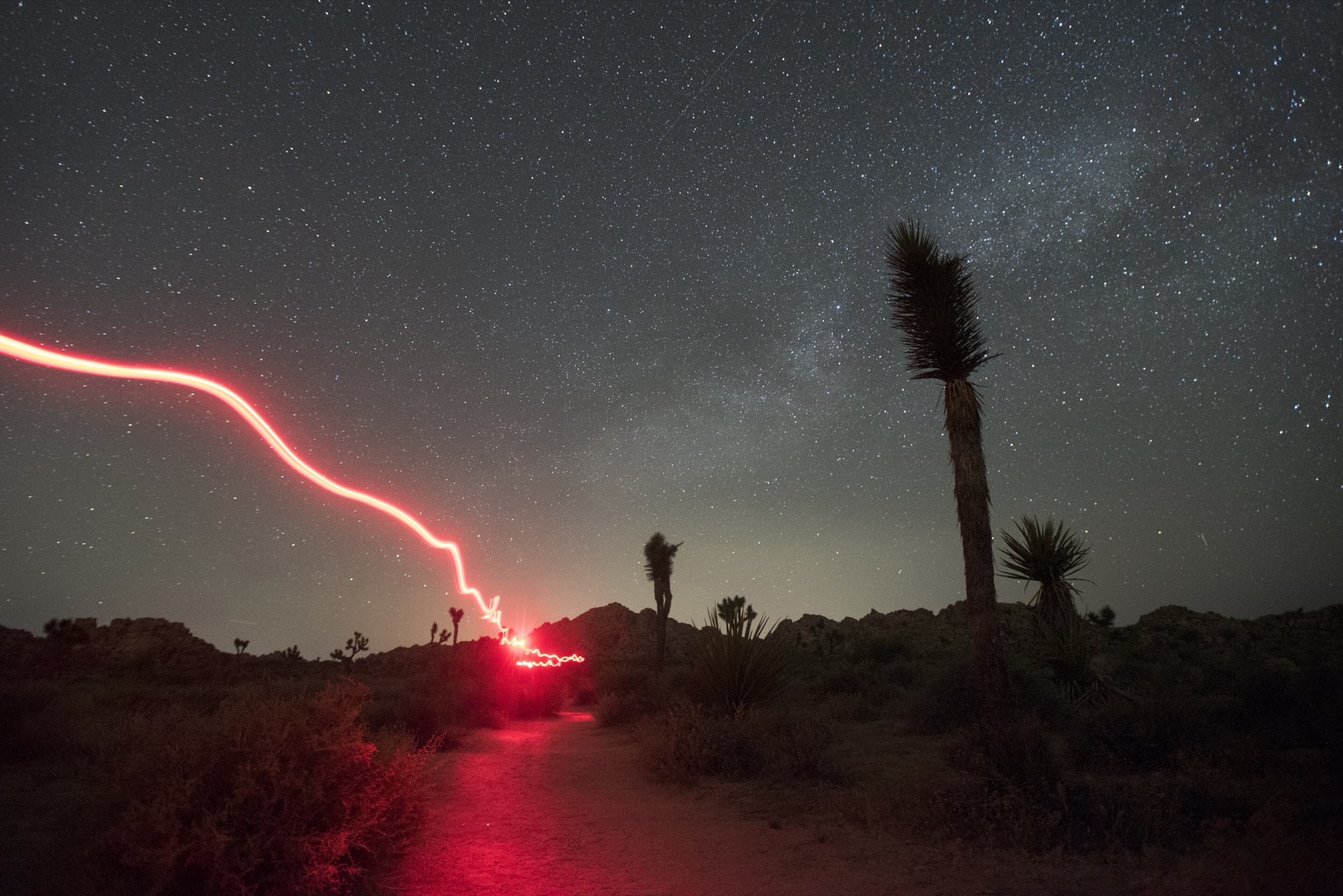
- Preserves night vision — once you have switched off the red lamp you are ready for the night in seconds, against 20–30 minutes after white light
- Does not disturb others in the tent or the cabin
- Attracts fewer insects in summer
Use red light as soon as you stand still — in the tent, at the food break, while you read the map. White only when you walk.
Headband, weight and packed size
For trip use, under 200 g is reasonable. Light models (typically the Petzl Bindi, Black Diamond Spot Lite) come in at 35–50 g and are enough for a summer trip and as a backup. Heavier models with a separate battery pack at the back of the head (200–400 g) are for those who need long run-time or high light output.
Check the headband — comfort matters if you have the torch on for hours. Double bands (one over the crown) sit better during movement.
IP rating — IPX4 is the minimum (rain-resistant); IPX7 means you can submerge it underwater for a short time. For Norwegian weather, IPX4 is enough in most cases, IPX7 if you paddle or spend a lot of time in wet terrain.
Reactive light — worth the money?
Petzl’s Reactiv technology (other brands have something similar) adjusts the light output automatically based on what the sensor sees. Look at the map, and the light dims. Look ahead into the terrain, and it increases. The result is longer battery life and less glare.
It works well — especially if you switch a lot between map and terrain. The price is a few hundred kroner extra and a slightly more complex user interface. For anyone who is out a lot in the dark, it is worth it.
Maintenance
Dry the torch after wet trips — especially the USB port, which is vulnerable to corrosion. Take out AAA batteries if the torch sits unused for a long time, or they may leak and ruin the contacts. Charge built-in batteries to about 50–80% before longer storage, not full and not empty.
Maintenance of outdoor equipment →
Text: Snuitide (2026).