Repair & Maintenance
Gluing holes and tears in tent fabric (PU coating)
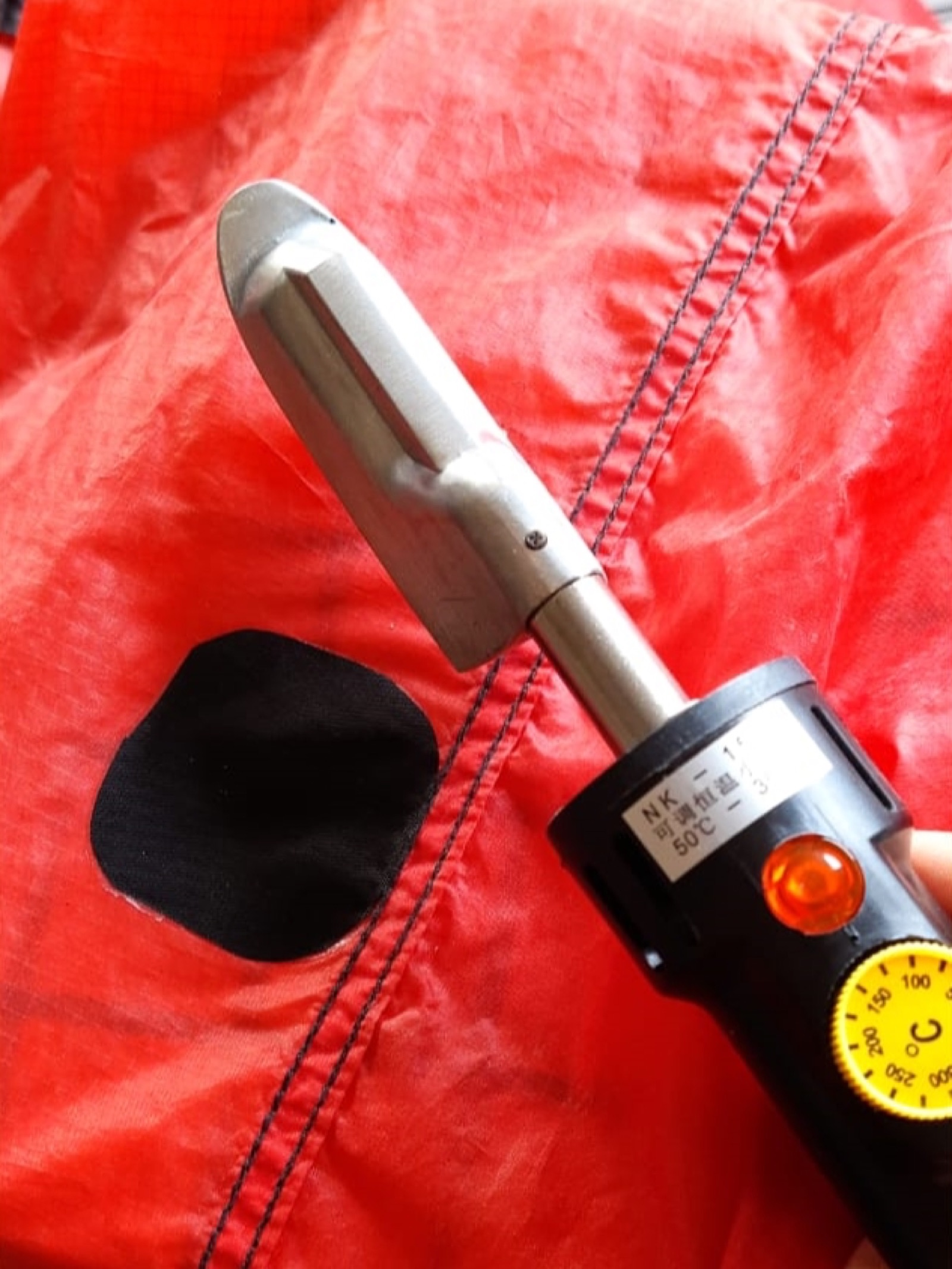
Heat-bonding vinyl plus a patch of tent fabric on the inside makes PU-coated tent fabric waterproof again. How to tell PU from silnylon, and why you must glue from the inside.
Polyester urethane (PU) in tent fabric and tent floors can be glued with heat-bonding vinyl (varmevinyl) and a patch of matching tent fabric. The result is waterproof, durable, and easier than sewing up a hole in tightly woven tent fabric.
How to tell PU tent fabric
PU tent fabric usually has the seams taped on the inside with a thin strip of heat-bonding vinyl that has been melted on. If you see this pattern, it is PU. Silnylon and certain other waterproof fabrics use different sealing methods.
What you need
- Heat-bonding vinyl (varmevinyl) (Vlieseline, Vliesofix, Bondaweb, or manufacturer-specific tent vinyl)
- A patch of tent fabric — ask the tent manufacturer for free patches if you do not have any, or use a piece from an old tent
- Iron or ski-waxing iron (one that can set the temperature precisely between 125 and 175 °C)
- A cotton towel to protect the patch from the iron
How to do it
- Clean the area — scrub with a cloth to remove grease and dirt
- Cut the patches — both the heat-bonding vinyl and the fabric. Cut them square first, lay both on top of each other, and trim to a round shape (rounded edges spread the load and hold better than sharp corners)
- The vinyl patch can be about 1 cm larger than the fabric patch — this gives better adhesion around the edges
- Place both patches on the inside of the tear — the heat-bonding vinyl first, then the fabric patch on top
- Remove the backing film from the heat-bonding vinyl first
- Press with heat — 125–175 °C, always with a kitchen towel between the iron and the patch. Press firmly for 15–30 seconds
- Let it cool before you test it
Check which side
If you use a piece of PU tent fabric as the fabric patch, check the outside versus inside of the patch. The DWR coating is on the outside — heat-bonding vinyl will not adhere there.
Test: After you have applied heat and let it cool, try to pick the patch off. If it just peels away, you have used the wrong side. Turn the patch over and melt it on again — then it will hold.
Ski-waxing iron or ordinary iron
A ski-waxing iron has temperature control in 5-degree steps and is ideal. An ordinary iron works if you:
- Switch off the steam function
- Test the temperature first on a piece of old tent fabric
- Use a cotton towel as an intermediate layer
For tepees (special shape): use a small peach-stone-shaped iron (available from sewing shops, ~150 kr).
When the glue will not hold
If you have tested it and the patch will not stay put:
- DWR coating on both sides of the tent fabric — wash the whole tent with a special detergent to remove the DWR
- Too old a tent: the fabric may have lost its ability to bond with heat-bonding vinyl. Sew the patch on instead — see Tears and holes in tent fabric and hammock
Machine washing after the repair
Heat-bonding vinyl withstands machine washing because it is activated at 125–175 °C. Laundry runs at 30–60 °C — well below the activation temperature. The repair stays put for the whole of the garment’s remaining lifetime.
Back to Repair → · Tears and holes in tent fabric and hammock → · Sealing tent seams →
Text: Lars Peters and Snuitide (2022), revised 2026.