Repair & Maintenance
Broken buckles — in the field
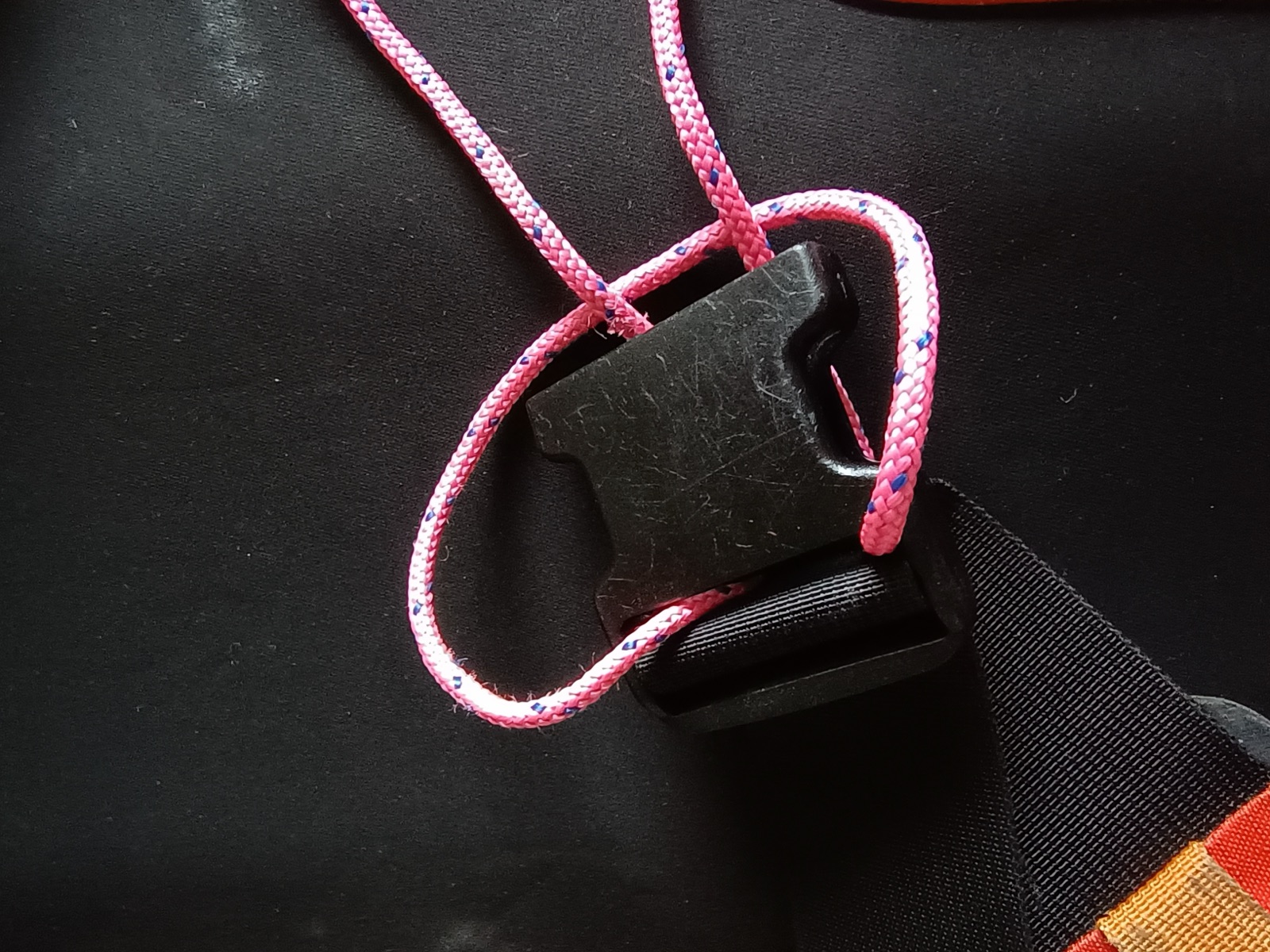
Snapped hip-belt buckle mid-way through a trip? A length of cord and a knot will hold the pack together until you get home. Three fixes for different buckle damage.
Plastic buckles on a pack snap more often than you would think — and when the hip belt goes mid-way through a long trip, it is no fun. With a length of cord and a few knots you can make an improvised fix that will hold until you get home.
What can break
A plastic buckle has three parts:
- The male part (with a tongue that clicks in)
- The female part (with a slot that takes the tongue)
- The ladder-lock adjuster (the opening the webbing runs through)
Each part can break on its own. The fix depends on what is damaged.
Materials
- A length of cord — 4–6 mm diameter for the hip belt (50 mm webbing), thinner for smaller straps (15–25 mm)
- A small stick, pen or twig for extra friction
The adjuster is broken — wedge lock with cord
The most common damage. You can tie a wedge lock with the buckle parts and cord that can still be undone.
- Remove the plastic buckle with the broken adjuster from the webbing
- Make a loop with a double fisherman’s knot. Adjust the loop so it is just big enough to slide over the plastic buckle (especially important if the female part is sewn on). Cord stretches a little under load — have it barely over.
- Lay the knot on the webbing and fold the webbing around the knot. The webbing runs through the loop.
- Cross, tighten and tie off — take hold of both ends, cross them, tighten well. Finish off with a bowline or similar.
- Insert a stick between the webbing and the cord, just behind the cross. The stick acts as a stopper that keeps the cord from working its way over the fisherman’s knot.
- Tighten up the webbing.
If you notice the webbing slipping through after tightening: use a thicker stick or re-tie the cross.
On thin webbing (15 mm) you often do not need the stick — the friction in the knot itself holds.
The male or female part is broken, adjuster intact
Much simpler — the adjuster takes care of the tensioning, you only need to connect the webbing to the other half:
If the female part is sewn onto the pack:
- Make a loop with a double fisherman’s knot
- Thread the loop through the webbing on the female part
- Make the loop just big enough that the male part passes through
- Thread the male part through the loop — you can now tighten
If both sides have an adjuster:
- Take a length of cord doubled
- Thread a bight through the opening in the adjuster of the female part
- Tie it off and it works as a new “female buckle”
Spare parts — for groups on a long trip
If you are out with a large group on a long trip, bring a spare 50 or 60 mm wide plastic buckle. Choose the widest — it also fits narrower webbing if needed.
The spare buckle must have an adjuster on both the male and female part so it can be threaded onto the webbing without sewing. Female parts without an adjuster have to be sewn on.
Home: a proper repair
Improvised cord fixes are good in the field, but once you get home you should:
- Swap in a new plastic buckle — the manufacturer can often send you one free of charge. Or buy one at a haberdashery.
- Sew on the female part if that was the one that came loose — it needs to be fixed on properly
- Check the other buckles — one that fails suggests the others are close
Knots used
- Double fisherman’s knot — large, gives friction, acts as a “stopper” on the webbing
- Bowline — easy to undo after tightening
- Double figure-eight loop — alternative for thinner webbing
- Plain overhand knot — quick and simple
Knots3D — knot library for visual instructions.
Back to Repair → · Repairs in the field → · Pack →
Text: Lars Peters and Snuitide (2022), revised 2026.