Animals & Tracks
The reindeer – the mountain's nomad
Scientific name: *Rangifer tarandus*
Created: May 30, 2022 9:43 AM
Scientific name: Rangifer tarandus
Height: 90–125 cm (adult shoulder height)
Weight: 70–180 kg (bull) 40–100 kg (cow)
In Norway we have two kinds of reindeer. Wild reindeer and domesticated reindeer. From Trøndelag and northwards there is only domesticated reindeer. There is not much difference between them and they live fairly similar lives – except that the domesticated reindeer is controlled by reindeer husbandry through herding and fences. Otherwise they live freely, and are not tame like other livestock. We have around 33,000 wild reindeer and around 250,000 domesticated reindeer.
Reindeer are herd animals. For most of the year they live in two different herds: a bull herd and a nursery herd. The bull herd is thus made up of bulls of different ages, while the nursery herd consists of cows, calves and young animals. As the mating season (the rut) approaches, the herds will join together. The bulls will see one another as rivals, and will begin to compete for the ladies’ favour. The toughest bulls gather a harem, and get the chance to mate. After the rut the bulls will lose their antlers. They then also lose status, and gather again into bull herds. Among reindeer both bulls and cows grow antlers, but they do not grow them at the same time. The bulls have their antlers ready for the rut, while the cows have the food ready by the time they are to calve. This gives the cows status and the right to the best grazing grounds when they need it most.
Large reindeer herds need a lot of food, and in the mountains where the reindeer live there can be little to find. The reindeer therefore have to move about a great deal to find enough. The availability of food varies through the year. In spring the reindeer follow the sprouting of the green growth it eats. In summer it grazes on herbs, flowers on the ground, and the foliage of dwarf birch and willow. The reindeer is nonetheless best known for eating lichen, which is especially important food in winter. The reindeer will dig with its hooves to reach it under the snow.
Show consideration for the reindeer!
The reindeer, especially wild reindeer, will shy away from people. If you see a herd at a distance you should therefore show consideration to avoid disturbing the animals! Wild reindeer are so wary of people that with too many walkers in the same place the animals will not graze in the area at all. This has created challenges for the wild reindeer in popular hiking areas such as Hardangervidda.
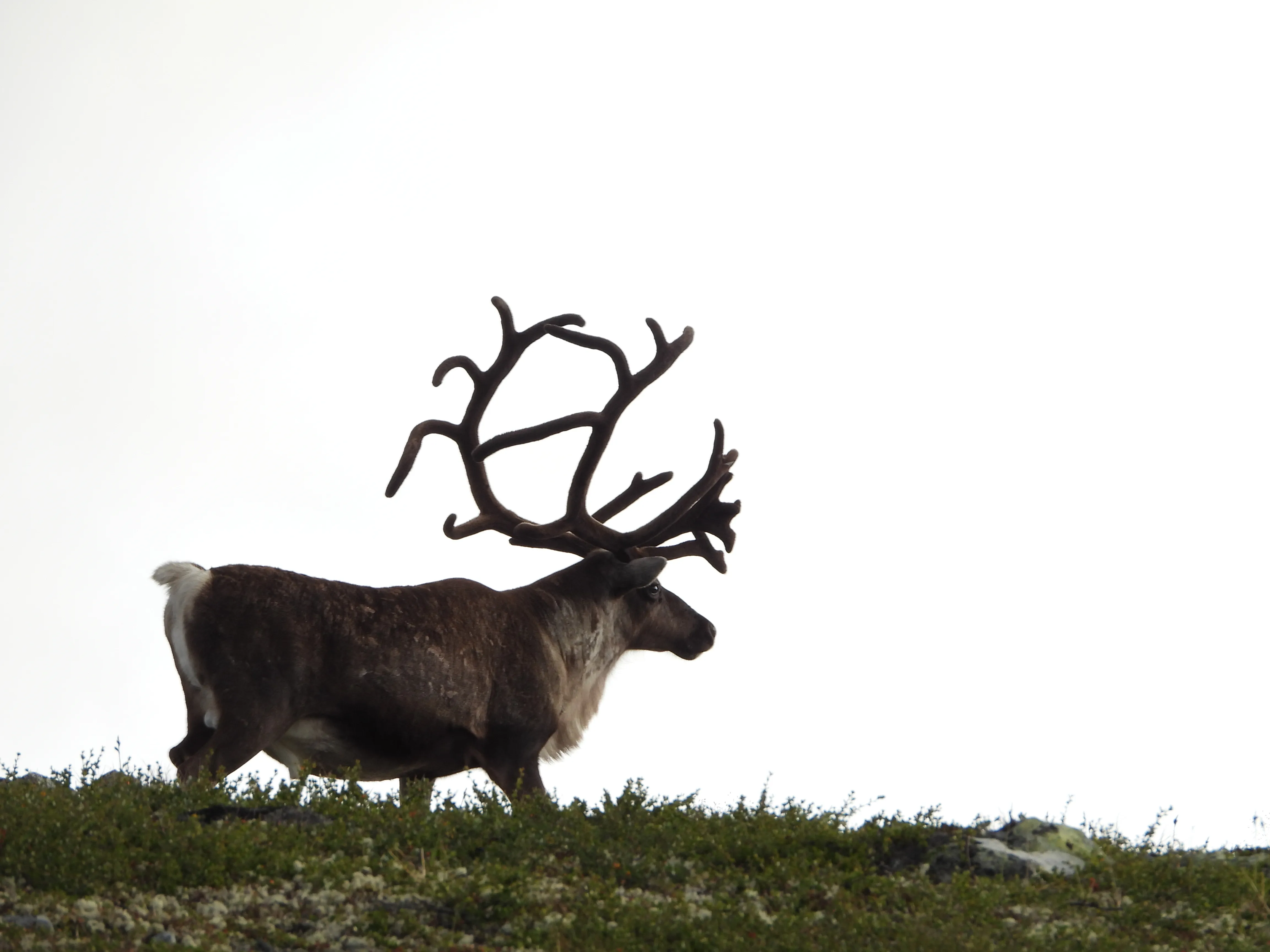
Photo: Bjørn Henrik Stavdal Johansen
The conservation perspective below is reproduced from Den Norske Turistforening / villrein.no, written by Ingeborg Wessel Finstad (2022). DNT is an authoritative voice on wild reindeer matters and we reproduce the text with permission.
The wild reindeer’s habitats are under pressure (from DNT)
The wild reindeer is very shy, it lives in a herd and has a nomadic way of life. The fact that it is both vulnerable to disturbance and constantly on the move between different grazing areas means that the wild reindeer also needs large areas. But the wild reindeer is steadily losing in the contest over land. Artificial barriers prevent the wild reindeer from using its natural migration routes, and it is easily disturbed and displaced.
You too, who are only visiting the wild reindeer mountains, can affect the animals negatively. We should not stop using the mountains for that reason, but we can show consideration and we can plan accordingly.
-
The wild reindeer is vulnerable and needs calm.
- Reindeer have a very well-developed sense of smell, and can become aware of people at a very great distance.
- Once frightened, it tends to run a long way too. Moving steals energy and time for grazing is lost. It is particularly unfortunate if the animals are at the same time displaced from important calving and grazing areas.
- Reindeer are extra vulnerable in the period around calving, and therefore need particular calm in the period 15 April – 15 June.
- Studies show that the wild reindeer tends to avoid an area if the traffic of walkers rises above a certain level. This means that a much-used trail can also act as a barrier that the animals will not cross.
- This nevertheless does not mean that people should stop walking in the mountains, but by showing extra consideration, we can help reduce disturbance.
Show consideration!
- Follow the trails.
- Stop if you see reindeer, let the animals pass in peace.
- Keep your distance, use binoculars.
- The animals have a good sense of smell, so walk in the lee.
- Avoid showing yourself in silhouette.
- Remember the rules about båndtvang (the dog-leashing period) as well.
What makes the wild reindeer special?
The herds of wild reindeer in the mountains of southern Norway are regarded as the last populations of this species in Europe. We therefore have a particular responsibility to look after the wild reindeer and its habitats. The wild reindeer is at the same time very shy and vulnerable, while its natural way of life and habitats are under ever greater pressure.
Far back in time wild reindeer were abundant throughout the Norwegian mountains, and in southern Norway the animals could move about fairly freely within large connected areas. Historically they have also been an important resource in the form of food, clothing and tools. The Norwegian wild reindeer is therefore a very important part of our shared natural and cultural heritage.
The situation today is rather different. The wild reindeer is steadily losing in the contest over its natural habitats. Land is taken up directly in the form of power and cabin developments, and effective barriers are created in the form of roads and railways. As the wild reindeer’s habitats shrink, conflict with various forms of access also increases. An ever-increasing traffic of motorised access and access on foot and on skis means that the reindeer are increasingly disturbed and thereby displaced from their natural grazing areas, calving grounds and migration routes.
Taking a little bit here and a little bit there may not matter so much, but the sum of all the encroachments over many years is problematic for the wild reindeer. This negative development has now also led to the wild reindeer being listed as near threatened on the Norwegian Red List for Species 2021.
Why does the wild reindeer need so much space?
The Norwegian reindeer is adapted to a life in the mountains, without the forest to hide in and with very marginal living conditions. And unlike our other deer, the reindeer live in a herd. These can vary from groups of a few dozen up to several hundred animals. The main reason they live in a herd is thought to be above all a defence against predators.
As the reindeer live in a herd and the larder is at the same time very limited, it is natural that they also need large areas. Climate, vegetation and terrain are decisive for the availability of food from year to year and at different seasons. The reindeer prefer to find spring and summer grazing in lush areas where the snow melts early and there is access to grass and other plant growth. In winter they tend to find areas with little snow and plenty of lichen.
The wild reindeer is constantly migrating between these areas. The fact that they are at the same time very shy and easily stressed and disturbed from grazing, calving and rest, only makes their need for space all the greater and the animals extra vulnerable.
Specially adapted to the mountains
Reindeer belong to the deer family and are ruminants, like sheep and cattle. They differ from our other deer in, among other things, that both sexes have antlers. The calves too grow antlers in their first year of life.
Reindeer are especially hardy and well adapted to a life in the high mountains, even in winter. The winter coat is extremely thick and dense, and they normally tolerate temperatures down towards minus 40 degrees well. The hooves, with their oval shape, function like a snowshoe, and make the reindeer especially adapted to a life in snow and on bog. The shape is also well suited to digging out food under the snow. An especially well-developed sense of smell makes it possible for the animals to locate lichen under more than half a metre of snow.
Like other herd animals, they have a hierarchy in the herd, where the reindeer’s size, age and antlers say something about the animal’s position. The bulls shed their antlers after the rut and mating in autumn, while the cows only shed their antlers after calving. This regulates the balance of power between them, so that the cow is assured better access to food when she needs it most.
In addition to wild reindeer and domesticated reindeer on the mainland, we have the Svalbard reindeer. It is a separate (endemic) subspecies, and is found only on Svalbard. The coat is denser, it has a more compact body with a short neck and short legs, and is to an even greater degree adapted to a harsh climate. The reindeer on Svalbard do not live in a herd either.
Where does the wild reindeer live?
Far back in time wild reindeer were found throughout the Norwegian mountains, and in southern Norway the wild reindeer could move about fairly freely within what is assumed to have been four large connected areas. Loss of land and barrier effects have, however, led to a sharp fragmentation and reduction of the wild reindeer’s habitats. As a result of this, the Norwegian populations of wild reindeer are now split into 24 wild reindeer areas.
The green and orange fields in the map above show today’s 24 wild reindeer areas. The yellow fields show where reindeer husbandry is carried on in southern Norway. In addition there is reindeer husbandry from Trøndelag and in the rest of the country northwards.
Wild reindeer areas in Norway. Illustration: Norsk villreinsenter nord Illustration: Norsk villreinsenter nord
Wild or domesticated reindeer – what is the difference?
How can you tell whether it is wild reindeer or domesticated reindeer you meet in the mountains? In appearance they are fairly similar. Some of the wild reindeer also have wholly or partly domesticated reindeer ancestry. The simplest is probably to judge from the maps: if you are in a wild reindeer area, then it is wild reindeer, and if you are in a domesticated reindeer area, then it is domesticated reindeer. But then it may be that these boundaries do not appear quite as clear to the animals.
The domesticated reindeer is a so-called semi-domesticated (half-tame) animal, which gets regular supervision, is moved between different grazing areas and which can be given access to feed in situations of food shortage. The domesticated reindeer nevertheless lives a fairly wild life compared with other production animals, even though it is normally not as shy as the wild reindeer. These are in any case also animals that are sensitive to disturbance. A sensible rule may therefore be to treat reindeer as if they are all of the wild kind.
Read more about wild reindeer at *villrein.no*
End of DNT reproduction. Original source: Ingeborg Wessel Finstad, DNT (2022) — «Villrein og ferdsel» on villrein.no.
Next steps
- Wildlife and tracks — the hub
- Reindeer husbandry and Sámi culture — cultural and management context
- Access in protected areas — the wild reindeer mountains have their own rules
- Natural areas in Norway — where the wild reindeer lives
Learn more
- Artsdatabanken — species, status, Red List
- Miljødirektoratet — large carnivores — management
- NINA — the Norwegian Institute for Nature Research — research on Norwegian fauna
- Naturveilederen — Bjørn Henrik Stavdal Johansen — nature interpretation