Gear
Whistle
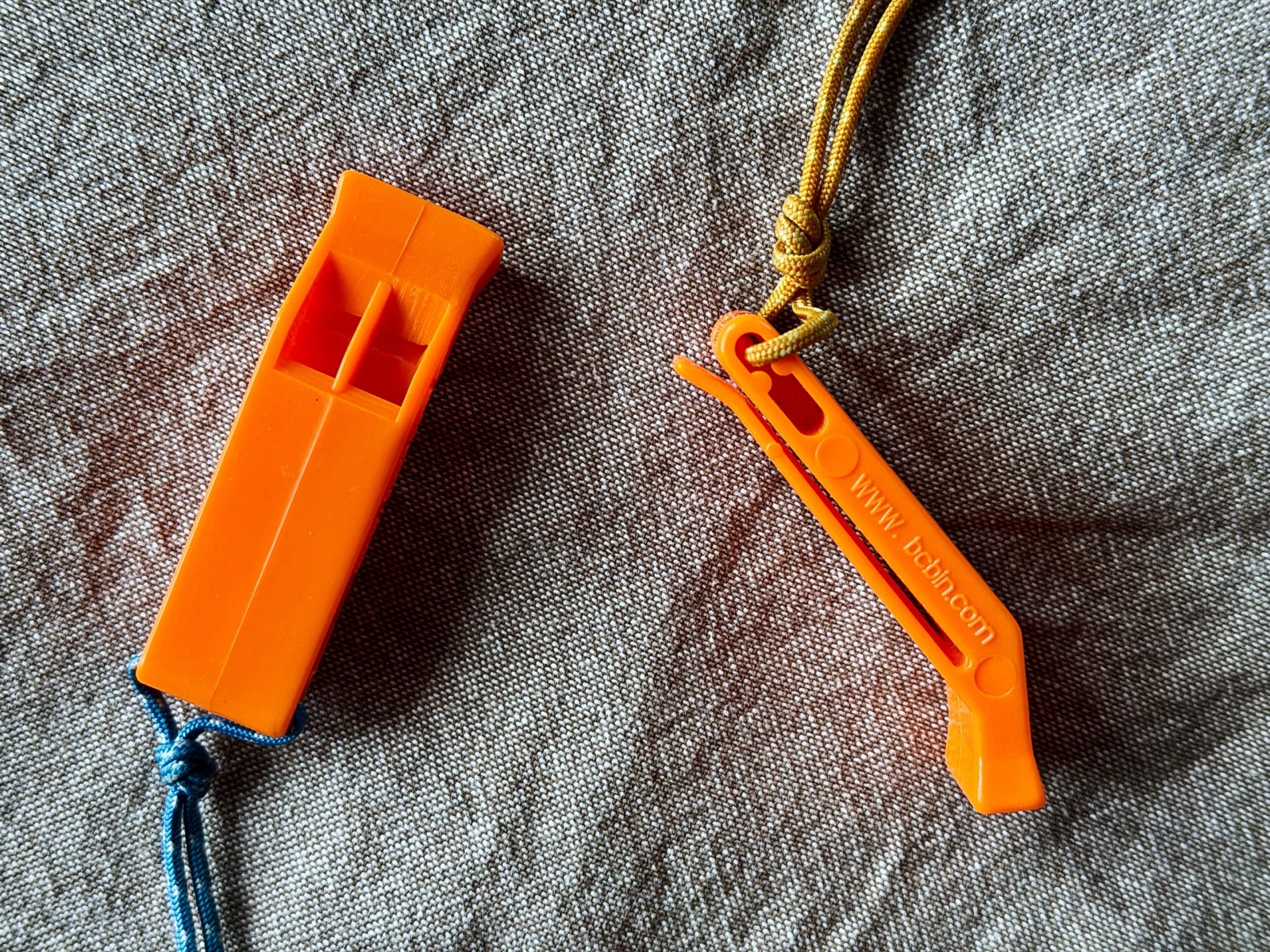
A small plastic whistle in your pack is some of the lightest safety equipment you can carry — the decibel scale, the international distress signal, and where to attach it.
A safety whistle (also called a distress-signal whistle or safety whistle) is a small plastic or metal whistle you attach to your pack or your life jacket. Weight: 5–15 g. Price: 30–150 kr. Function: to be heard from a long distance when your voice is gone or when you need to conserve your strength.
Decibels — how loud?
An ordinary mouth whistle gives 60–80 dB. A safety whistle sits at 100–120 dB — comparable to a chainsaw. Audible over 1 km in open terrain, 200–500 m in forest.
Classic high-volume models:
- Fox 40 Classic (115 dB) — the most common one, used by referees internationally
- Acme Tornado (122 dB) — British make, extremely loud
- Storm All-Weather (130 dB) — extreme decibels, works underwater
Avoid pea whistles (with a wooden ball inside) for distress signalling — they can freeze, fill with water, or lose the ball. Pea-less (without a ball) is the standard.
The international distress signal
Three short blasts, repeated with pauses. Three is the distress signal internationally — across all areas of rescue. One blast means “here I am”, two blasts mean “come towards me”, three blasts (or three short ones) mean “distress”.
Learn this and teach it to your companions. If you hear three short blasts in the mountains, reply with two blasts to confirm you have heard — and start locating.
Placement
Attach it somewhere easily accessible on the pack — typically on a shoulder strap next to the key ring, or on the top of the pack. It should be possible to pick it up without opening the pack.
For children on a trip — attach it directly to the jacket. Teach them how to use it and what three blasts mean.
Material
Plastic (polycarbonate, ABS) — standard, cheap, durable. Metal — heavier, can freeze to the lips in the cold (avoid a metal whistle in winter).
For trip use, a light plastic whistle of around 5–10 g is the standard choice.
Maintenance
Practically none. Rinse the inside if it is full of salt or dirt. Replace it if the chamber is cracked.
Text: Snuitide (2026).