Weather
Weather forecasting
The meteorologist's task, put simply, is first to work out what the weather is like now, in order to
Contents
’How is the weather now?’
The meteorologist’s task, put simply, is first to work out what the weather is like now, so as to be able to predict what the weather will become. Fortunately we have moved on a little from Tobias in Cardamom Town and his ‘look out at the horizon through a telescope’ method. Today we have ‘eyes’ in a fine-meshed observation network across the whole globe, and a great many satellites. All this information gives a good picture of how the weather has been and how it is now. For short-term forecasting, with an estimate for the next two to six hours, you can get very far this way. We can see on a precipitation radar that ‘the precipitation is approaching now – but perhaps I’ll make it home on the bike before the rain catches me’. This does not, however, help us answer whether there will be fine skiing weather in Jotunheimen in five to six days’ time.
The great calculation
A revolution has taken place, and is still taking place, in modern meteorology. We can describe the behaviour of the weather through a set of physical laws. And by writing these mathematically we get a model (an enormous calculation) that works out how the weather behaves. If we feed this calculation with all the observations from across the whole globe, and push the lot into a supercomputer the size of a self-service cabin, we then get suggestions for what the weather will be like in one minute, an hour, a day or ten days. The results of these calculations are called numerical forecasts, and these are the ‘raw materials’ that meteorologists use when they say something about the weather next weekend, or write their text forecasts. They are the same kinds of results that you find yourself when you tap on a weather service on the internet (yr.no, storm.no, weatherunderground, pent.no and so on). See the figure below for a sketch of the process.
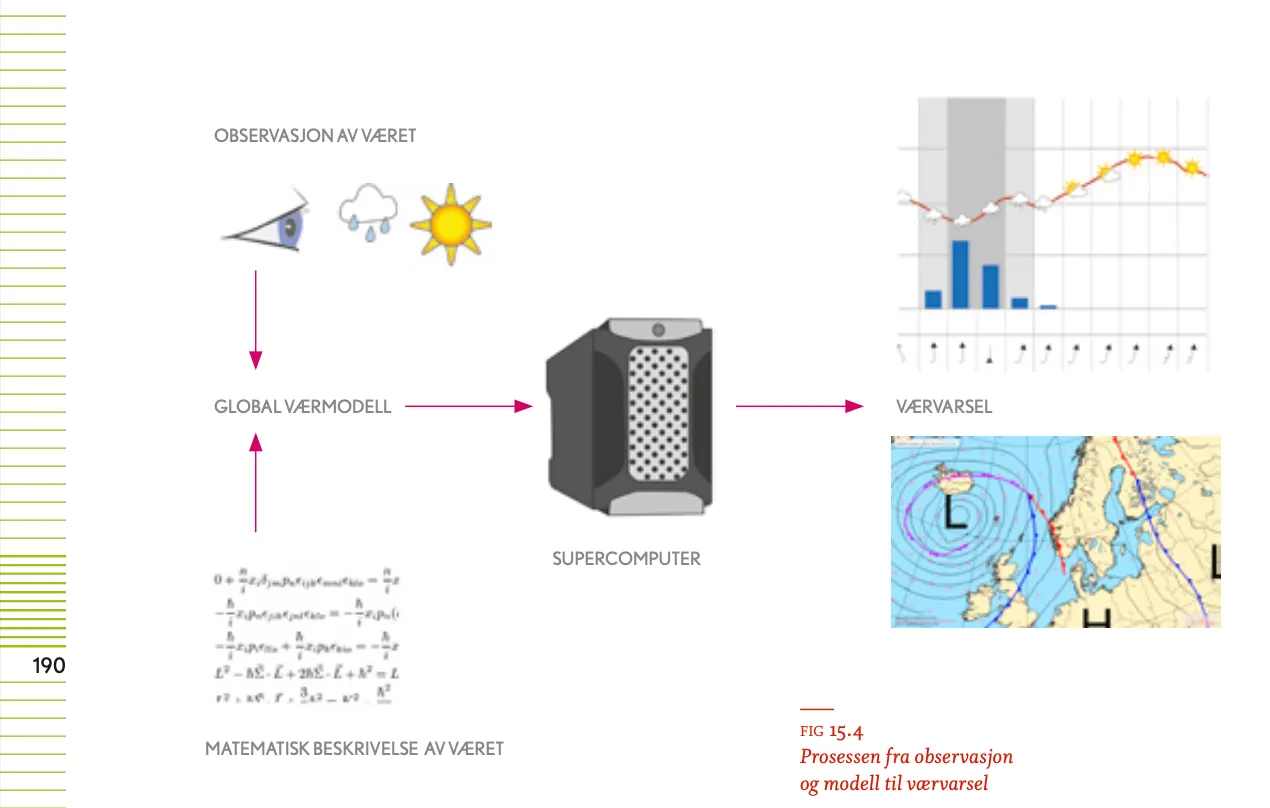
Illustration: Kjartan Nielsen Friis
Weather forecasts from the internet
The numerical forecasts contain an enormous quantity of detailed information about a host of atmospheric parameters such as pressure, wind and humidity, and temperature at all atmospheric levels. This raw material is then used as a source for extracting or setting up still more calculations for the weather parameters that we as trip leaders are interested in: Will it rain? Where is the wind coming from? What will the cloud cover be like? These parameters are shown graphically, often in the form of a meteogram; see the figure below.

Screenshot from Yr Image: Meteorologisk institutt
Why they forecast differently
There are many different calculation models, and although they are getting better and better, none can yet reproduce or forecast the weather perfectly. Depending on which model, assumptions and parameter calculations are used, every source will have different strengths and weaknesses. When we look at the weather forecasts from different sources, we find that they can differ. This difference can be interpreted as uncertainty about what the weather will actually be. But over time we can learn or come to know from experience that in this trip area, with this type of weather, the forecast on this website tends to be right. Automatic weather-forecasting services do, however, share a number of features when it comes to strengths and weaknesses.
Strengths and weaknesses of automatic weather forecasting
| Strengths | Weaknesses |
|---|---|
| The general development of the weather | |
| Wind along the coast | Wind over land, and perhaps especially in the mountains |
| ◦ The forecast can be 2–5 m/s below the actual wind speed | |
| Pressure | Temperature forecasts when it is clear and cold |
| ◦ The forecast can be off by 5–10 degrees, often more | |
| Precipitation and clouds from larger low-pressure systems | Precipitation in shower conditions |
| ◦ Local afternoon showers are often forecast, but the model cannot say whether one will hit your particular climbing crag or the neighbouring mountain |
You can read more about weather forecasting at Store norske leksikon.
Next steps
- The trip meteorologist — interpreting the forecast for a trip
- Wind and the effect of wind — what the wind means
- Nature’s weather signs — reading from nature
- Reading mountain weather — specifically for the mountains
Learn more
- Yr.no — the Norwegian Meteorological Institute’s weather forecast
- Meteorologisk institutt — expertise and research
- Varsom — hazard warnings (avalanches, floods, landslides)
- Storm Geo — commercial meteorology