Weather
Nature's weather signs
Expressions such as the calm before the storm and now all hell breaks loose both have their origins in the weather.
Contents
Expressions such as the calm before the storm and now all hell breaks loose both have their origins in the weather. Many have surely experienced how the wind drops or dies away, and how it can sometimes turn almost ‘oppressive’ before the bad weather sets in.
We can say a fair amount about the weather by watching the wind and the clouds. There are also several old weather signs that hold true. It is worth noting, even so, that weather signs have only limited validity. They cannot predict the weather far ahead (Andersen and Pedersen, 2013).
Wind
In Norway, many weather signs are tied to the fact that weather systems most often come from the west. Changes in the cloud cover to the west can therefore tell us something about how the weather is likely to be over the coming 24-hour period (Andersen and Pedersen, 2013).
Wind directions are defined by where the wind blows from. A north wind comes from the north and blows southward; a south wind the opposite.
West wind
- Østlandet: Good weather and sun
- Vestlandet to Nord-Norge: Bad weather and precipitation
Østlandet lies in the lee of Langfjella, the mountain range that separates east and west south of Trondheim. As a result it often gets fair weather when the wind comes from the west.
Øst-Finnmark can also get good weather during a west wind with an offshore effect. The wind then blows from Finnmark and out into the Barents Sea.
(Pedersen, 2012)
East wind
- Østlandet: Bad weather and precipitation
- Vestlandet and Nord-Norge: Good weather and sun
An east wind works mainly the opposite way to a west wind.
(Pedersen, 2012)
North wind
- Sør- and Østlandet: Good weather and sun
- Midt-Norge and Nord-Norge: Precipitation
- Vestlandet: Some wind along the coast
Østlandet lies largely in the lee of the westerly and northerly wind directions, so the weather is good.
Wind from the north-west gives onshore wind and precipitation in Midt-Norge and the northern mountain areas.
(Pedersen, 2012)
South wind
- Sør- and Østlandet: Grey, with the possibility of precipitation
- Vestlandet: Often precipitation, but it is spread more across the outer districts and not so far inland.
- Nord-Norge: Good weather
With the south wind, that is, wind from the south, a low-pressure system moves from Britain. Rain clouds then blow inland towards Sør- and Østlandet.
A south-easterly wind often gives good weather in the outer districts of Nord-Norge.
(Pedersen, 2012)
Onshore wind
- Clouds and the possibility of precipitation
Wind from the sea and towards land is called onshore wind.
There is a great deal of moist air over the sea. When the wind meets land it has to rise, and clouds then form. In summer there can also be a fair amount of local fog coming in off the sea during an onshore wind (Pedersen, 2012).
In winter the weather turns mild with an onshore wind; in summer it turns cool.
Offshore wind
- Fair weather
Wind that blows from the land and towards the sea is called offshore wind.
Because the wind blows from the land, we do not get the moisture coming in off the sea. That makes the air dry and reduces the chance of precipitation (Pedersen, 2012).
Clouds
Clouds also say something about what the weather will be. Low clouds such as fog clouds and shower clouds give precipitation and wet weather. There are also rain clouds in the middle cloud layer, such as nimbostratus – in Norwegian called nedbørsskylag. In the uppermost cloud layer we find cirrus clouds and mackerel clouds (Velle and Gjelten, 2022). Mackerel clouds herald good weather, while cirrus clouds can indicate a change in the weather (Skolelaboratoriet i realfag, n.d.).
For more information about clouds and the weather they herald, visit Miljølære’s cloud atlas.
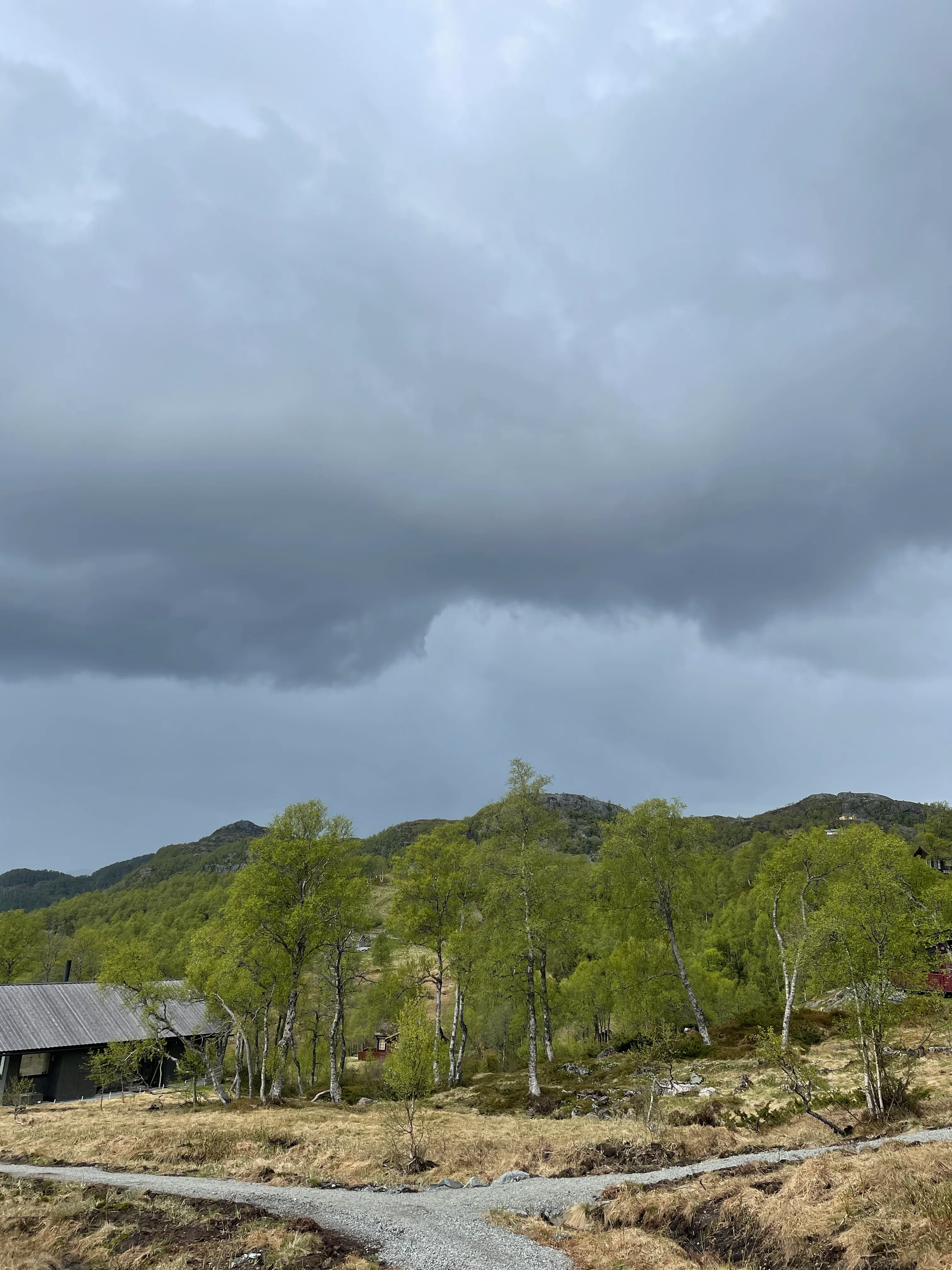
Photo: Gina Wigestrand
Weather signs
By keeping an eye on the weather while you are out, you can notice, among other things, changes in the sky, wind conditions, the way the light bends and precipitation. Perhaps the clouds suddenly turn threateningly dark? Is the mist creeping in, or is snow beginning to drift off the mountaintops? In the old days these were our own observations we had to rely on, for there was no weather forecast then. It was therefore worth looking out for signs of a change in the weather.
Some of the old weather signs are discussed here, with an explanation of why they work. The weather signs say something about weather that happens in the near future — at most one 24-hour period after the observations are made.
-
A ring around the sun (or the moon) – a change in the weather and precipitation
“Today you see a great ring around the sun. Tomorrow you see nothing of the sun.”
“A ring around the moon foretells a change in the weather, snow or other precipitation.”
The explanation is that the cloud systems, which mostly move west —> east, are first seen as a layer of transparent clouds high up in the troposphere. The clouds are formed of tiny ice crystals, and the light bends as the sun, or the moon, shines through them. The most common is a ring around the sun, but individual brightly glowing ‘patches’ or streaks can also appear (Hodne, 2005).
These clouds are often the outer edge of an area of precipitation and thus an early sign that the clouds will increase in quantity and that there will be precipitation in anything from a few hours to the next day.
-
Sunset in clouds – rain the next day
“If the sun goes down in a sack, then it is gone the next day.”
“When the sun goes down in a sack, it rises again in a stream.”
Cloud layers gathering in the west can be the outer edge of an area of precipitation moving from west to east. Over the course of the night the clouds will move eastward and we wake up to overcast weather or precipitation (Hodne, 2005).
-
Sunshine on clouds in the west – rain before evening
“When the sun shines on a cloud in the west, there will be rain before evening.”
If the sun at sunrise shines on clouds lying in the west, it can indicate that there is a larger quantity of clouds gathered below the horizon. The clouds will usually blow from west to east and soon fill the whole sky (Hodne, 2005).
-
A cloud around a mountaintop brings a change in the weather
«When the Ox puts on its hat, the wind blows in over it all night»
A change in wind often happens first higher up on the mountain, since the mountain areas are more exposed and less sheltered than the lowlands. If a ‘cap’ (hatt) settles over a mountaintop, it is a sign that there is moist air in the higher air layers. If the cloud quantity increases, so that the cap grows and perhaps becomes a continuous cloud layer, this can indicate that an area of precipitation is on its way (Hodne, 2005).
-
A red sky in the evening brings fair weather. A red sky in the morning brings rain.
“Red in the morning, wet at night; red at night, sweet in the morning.”
“Red in the morning, pisses in the hay.” “Red in the morning makes evening snow.”
A low sun near or below the horizon colours the clouds higher up in the sky red. If the clouds break up in the west so that the sun shines through, it indicates that the cloud cover is beginning to dissolve. A red sunrise can mean that it is about to cloud over and that precipitation is on its way (Hodne, 2005).
-
A high tide brings bad weather, a low tide brings good weather
It is the sun and moon that bring about high water and low water. But since the air pressure also affects the sea level, low air pressure gives a higher water level than normal. Another word for a high tide is a storm surge, and this often occurs at the same time as bad weather. Sometimes a high tide can also occur ahead of bad weather, in the same way that high pressure can give a low tide ahead of good weather. High pressure often lasts longer, so the good-weather sign has a longer validity than the bad-weather sign (Hodne, 2005).
-
Swallows fly low when the weather turns bad
«Swallows fly high before good weather, but low when the weather turns bad.» Only the last part of the weather sign holds true. Swallows hunt insects, and the insects take cover during precipitation. If the moisture increases in an air layer, the insects will seek a drier air layer, usually at a lower altitude (Hodne, 2005).
-
Livestock come down from the mountain in bad weather
“If the cows (sheep, goats) head towards the mountain, the weather will be good. But if they head for the home pastures, there will be rough weather.”
Changes in the weather often arrive earlier in the high mountains than in the lowlands. The animals will therefore move down from the mountain to find shelter from increasing wind. The second part of the weather sign is not of much value for forecasting purposes, since the weather in the lowlands is already good by the time the animals move back up again (Hodne, 2005).
-
An east wind in winter brings snow – Østlandet
On Østlandet, Langfjella shields most of the cloud systems from the west. Precipitation must therefore come from the south and the east. Wind from the south usually has a higher temperature than an east wind. Precipitation from the south therefore most often gives rain, and not snow. Wind from the east comes from Sweden or Russia and is often cold, and the chance of snow is high (Hodne, 2005).
-
Mist in the valley bottom brings good weather.
In autumn the air cools a great deal on clear nights. The cold then ‘runs’ down into the valley bottom. With a large temperature difference, fog can form where the sources of moisture, in many cases the river, are located. During the day the sun will warm the ground and the air and the fog usually dissolves. In late autumn it can be difficult for the sun to warm enough for all the fog to disappear (Hodne, 2005).
Next steps
- Weather forecasting — the modern weather forecast
- The trip meteorologist — reading the weather forecast for a tur
- Wind and the effect of wind — wind as a factor
- Reading mountain weather — specifically for the mountains
Learn more
- Yr.no — the Norwegian Meteorological Institute’s weather forecast
- Meteorologisk institutt — material and research
- Varsom — hazard warnings (avalanches, floods, landslides)
- Storm Geo — commercial meteorology