Repair & Maintenance
Sewing holes and tears
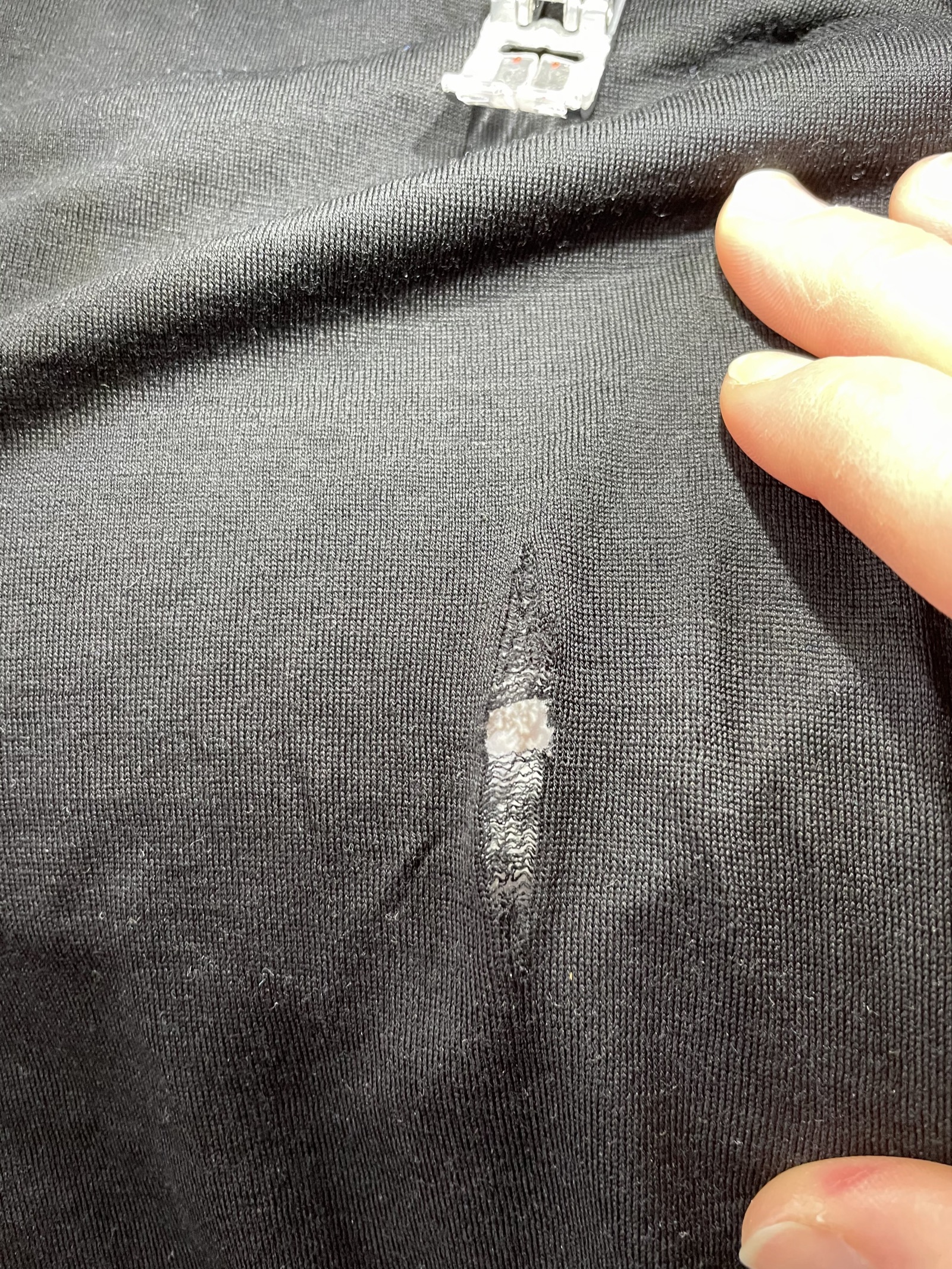
A reinforcing patch on the back + a zigzag over the hole. How to fix tears in wool, synthetics and shell clothing — including when you want to keep the waterproofing.
One of the most common wear injuries is a tear or rip in fabric. The simplest repair is to place a reinforcing patch on the back and zigzag over the hole. The result: even load distribution and a repair that lasts.
Materials
- Reinforcing patch in the same or similar fabric as the garment
- Wool for woollen clothing (preferably elastic, from an old woollen garment that has other holes you do not use)
- Synthetics for synthetics
- Sewing thread in a suitable colour
- Sewing machine with a zigzag stitch (it can also be done by hand, but a machine is stronger and faster)
- Pins to hold the patch in place
How to do it
- Lay the work flat on the sewing table. The garment must not hang and pull at the fabric — that distorts the seam.
- Bring the sides of the tear together so that they overlap just slightly.
- Cut a piece of fabric a little larger than the hole.
- Turn the garment inside out, lay the patch over the hole on the back, and fix it with 1-2 pins.
- Turn it back to the right side.
- Sew with a zigzag stitch — stitch length 0, width 3-4. Pull the fabric slowly through to get even coverage.
- Remove the pins as you sew.
Variant: woollen clothing
Use leftovers from an old woollen garment that has holes elsewhere — use the intact parts as reinforcement. Cut a piece that overlaps well beyond the hole. That gives both a colour match and an elastic match.
Variant: waterproof shell clothing
If it is Gore-Tex or other waterproof shell clothing and you want to keep the waterproofing:
- Sew without a reinforcing patch first — just close the tear with a zigzag
- Glue or melt a patch onto the inside afterwards with a heat-bonding patch (varmevinyl) or urethane-based glue — it seals the seam and prevents water from passing through
For burnt holes where fabric is missing: glue the patch on the outside for a neater result.
By hand, not by machine
If you do not have a sewing machine, you can do the same with hand sewing. The stitch type is called “darning” — go back and forth in parallel lines that cover the hole, then at 90 degrees on top of it. It is slow but durable.
Back to Repair → · Tear in the crotch of trousers → · Gluing holes and tears in outdoor gear →
Text: Gina Wigestrand and Lars Peters, Snuitide (2022), revised 2026.
Video resources: Northern Playground — fix hole in ziplongs · Bykuben — stopping på maskin