Campfire
Finding firewood and a suitable fire site
Use an established fire site if one exists. Make sure there is plenty of distance to buildings and vegetation.
Contents
Use an established fire site if one exists. Make sure there is plenty of distance to buildings and vegetation. Remember that dry grass catches fire easily. Consider the wind conditions and make sure there is no risk of forest fire.
If you have to set up a new fire site, remove the vegetation and lay some stones in a ring. That way you do not damage existing vegetation, and the ring of stones makes it easier to keep the fire from spreading to its surroundings.
Remember to put the stones and vegetation back once you have put out the fire.
Finding firewood
[Finn ved. Ragnhild Kjeldsen, Cathrine Dunker Furuly og Bjørn Erik Rolseth, NDLA](https://www.h5p.ndla.no/s/resources/c43f23be-9165-4c9d-917b-5e0212a6f013)
Finn ved. Ragnhild Kjeldsen, Cathrine Dunker Furuly og Bjørn Erik Rolseth, NDLA
Thick, dry branches make good firewood. The small twigs at the base of spruce trees are good firewood that you quickly get lit. Old resinous pine stumps burn well. So does birch bark. Take biological diversity in the forest into account. We leave dead trees with nest holes standing. At heavily used camp sites there may be little firewood to find. So bring firewood from home unless you know you will find dead branches and twigs.
Round wood should be split, as it then burns better. Have a safe surface to work on, for example a stump. Stand firmly with your feet apart and keep your distance from your trip companions. Let the axe swing in an arc so that it does not hit your legs.
Spruce and pine are best for making a campfire, because conifers are soft species of wood that catch fire easily.
Hard species of wood such as ash, oak, beech, lime and holly burn well and for a long time. Note that it can be difficult to get these species started because the wood is so dense.
NB! In protected areas the plant life is usually protected. This means that we cannot pick either living or dead trees and twigs.
The pine in the picture is a fine sight, and can house both birds and insects long after its death. Trees like this we leave in peace so that others too can enjoy the fine wood sculptures.
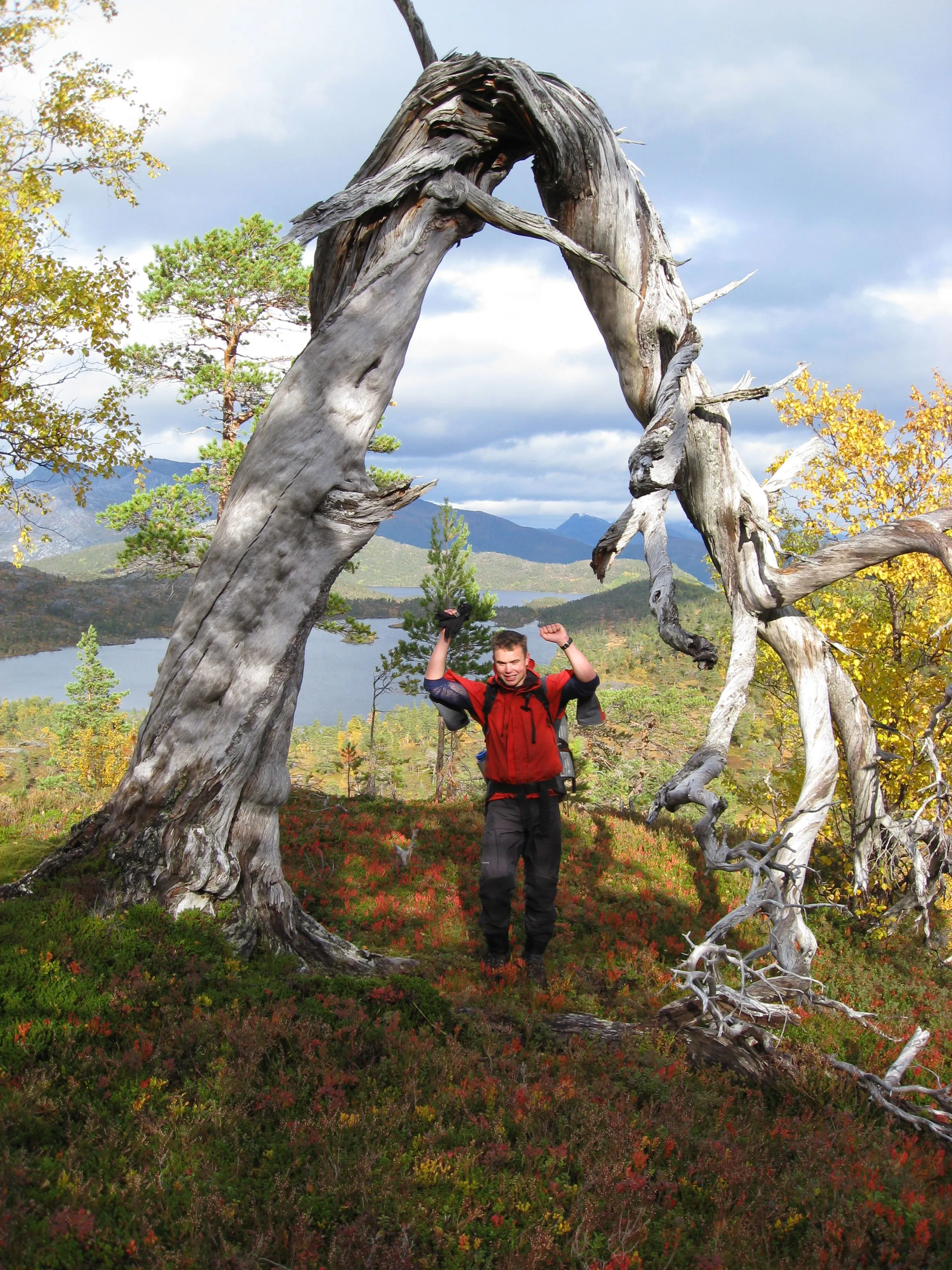
Photo. DNT Archive
The spruce forest
- There is always fuel here — dry twigs or dead fallen trees.
- A saw and an axe for cutting fallen trees, hands and a knife are enough for small wood for the coffee fire.
- Splitting wood without a saw and axe: strike small trees/large branches against a stone or hard tree trunk.
- “Light wood is good wood, heavy wood is poor wood” (because it is usually wet).
The pine forest
- Masses of dead twigs and trees.
- Look for tyrived — dead pine wood that is saturated with resin.
- Windthrows, stumps and damaged parts of the trunk are often good resinous pine.
- Dry pine burns really well — well suited as a log fire that burns steadily.
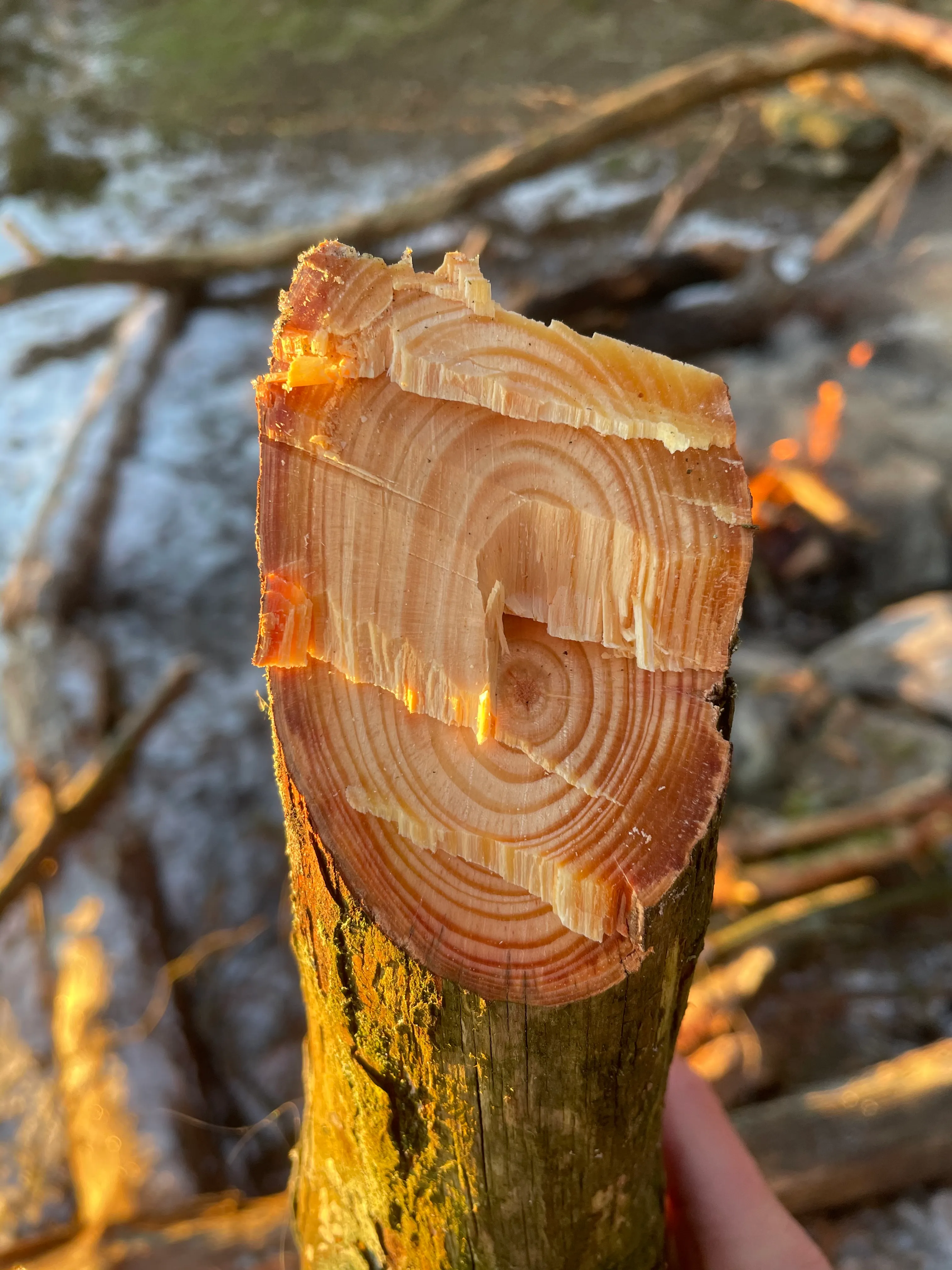
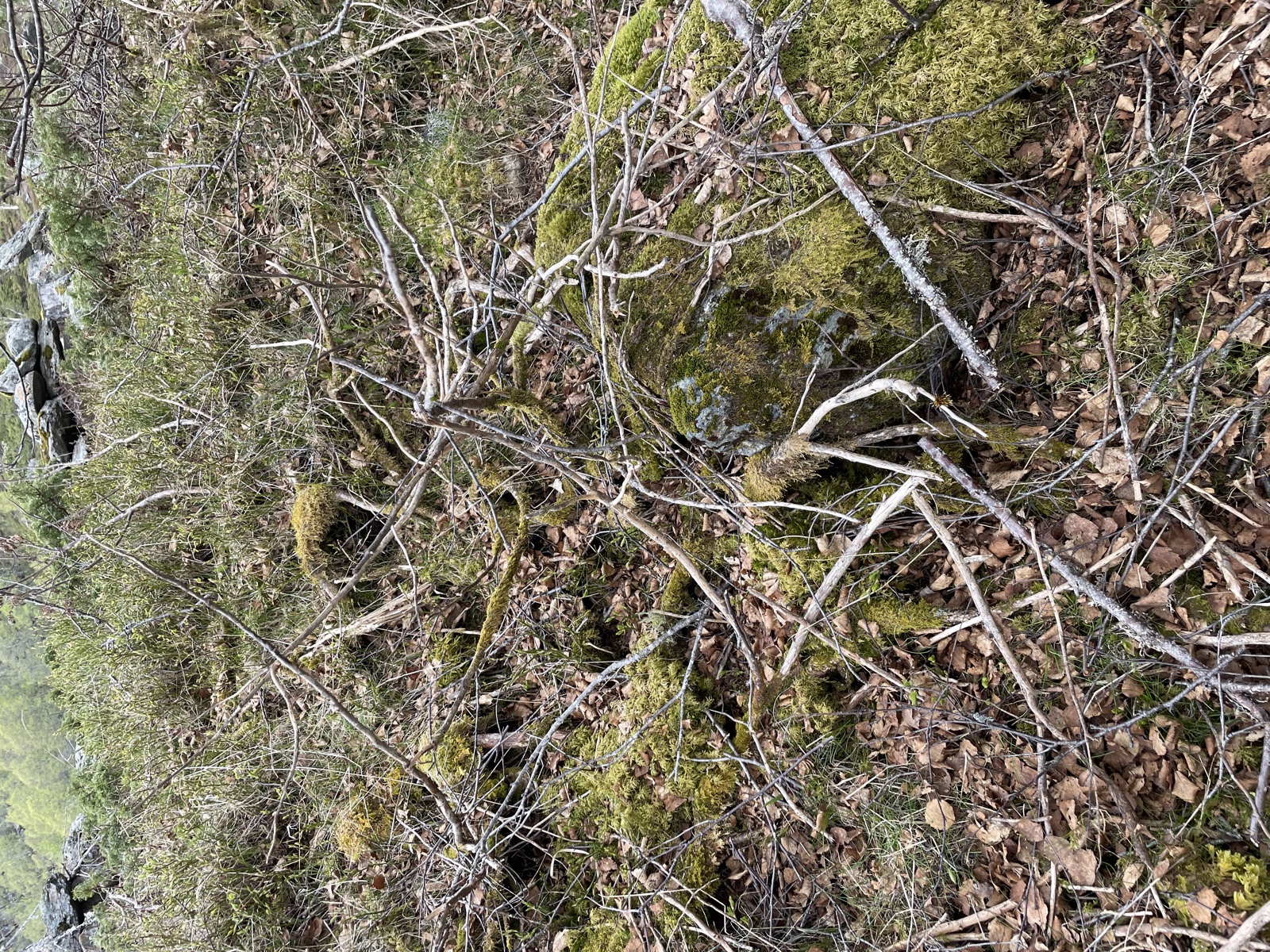
Photo: Gina Wigestrand
The mountain birch forest
Birch is the most commonly used species of wood for camp fires, but this probably has more to do with the plentiful availability of birch than with it being the best to burn. Birch has no heartwood, and so lacks the driest part innermost in the trunk.
- Pick bark-free birch twigs.
- Bark with moss attracts moisture and gives more smoke than embers.
- Gather dry birch bark for kindling in dry weather.
- White bark is best.
The bare mountain
- There is no tall vegetation here.
- Willow scrub and juniper scrub are used for lighting fires here.
- Pick small and preferably bark-free pieces.
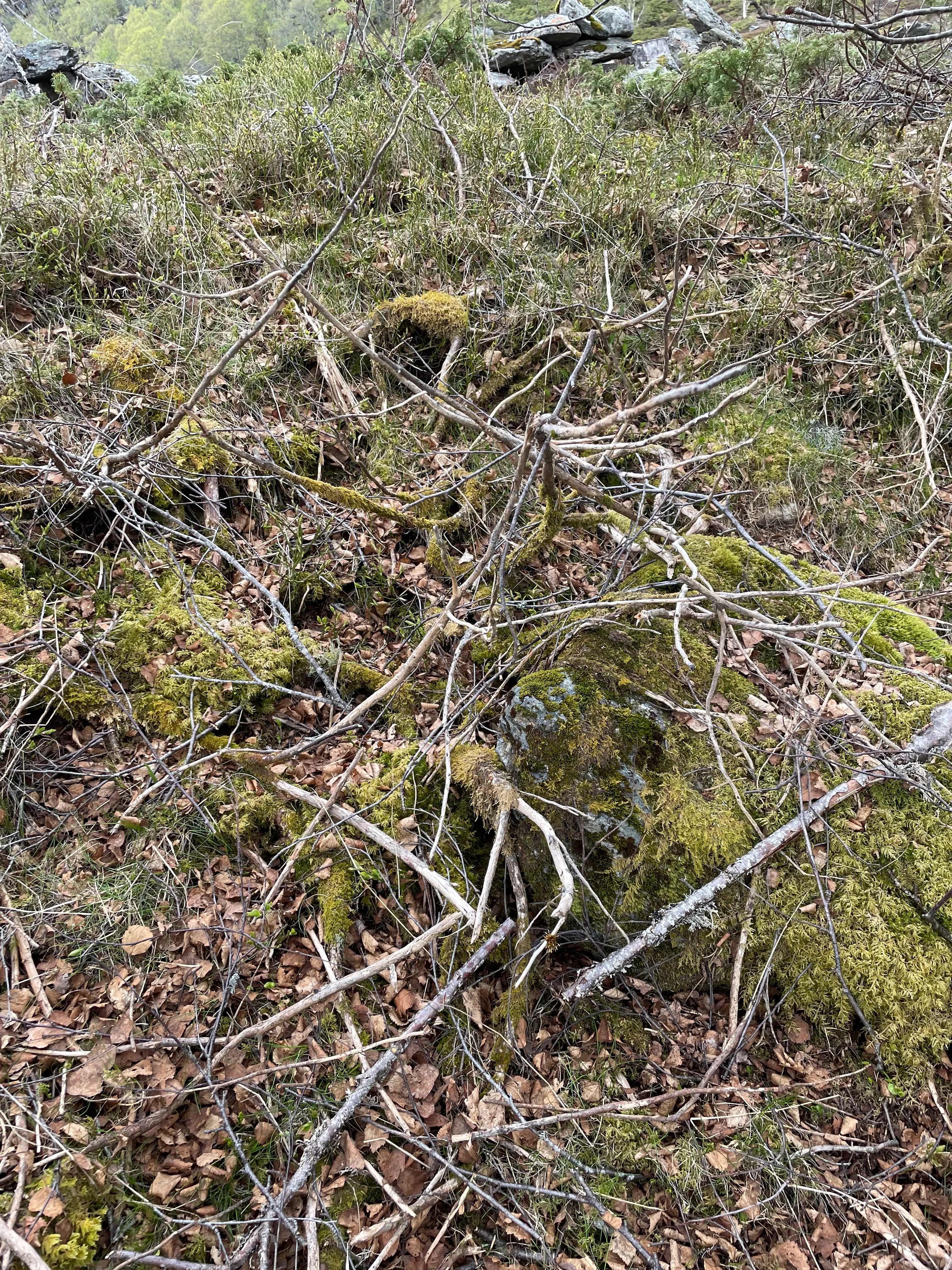
Photo: Gina Wigestrand
Putting out the fire
The fire must be put out when you leave the fire site. Never leave a burning fire. Check that the fire is properly out. Add water or snow.
Leave-no-trace travel
If you have set up a new fire site, you should remove it completely before you leave so that you leave as little trace as possible in nature. Put the stones and turf you have used back where you found them. Take all your rubbish home.
Next steps
- Campfire — the hub
- Cooking on a campfire — cooking over a campfire
- Sustainability and leave-no-trace travel — leave the fire site as you found it
- The Outdoor Recreation Act (friluftsloven) — fire bans and rules
Learn more
- DNT — campfire sense — practical guidance
- The Fire and Rescue Service — fire-ban periods
Text
- Ragnhild Kjeldsen, Cathrine Dunker Furuly og Bjørn Erik Rolseth, NDLA (2019) (CC BY-SA), reworked by Gina Wigestrand, Snuitide