Teacher's Guide
Is friluftsliv a sustainable activity?
Suggested competence aim 'Is friluftsliv a sustainable activity?'
-
Contents
-
Competence aim
Suggested competence aim “Is friluftsliv a sustainable activity?”
Never before have so many people used nature for trips and recreation. That more people are using nature does not, however, mean that more people want to look after it, or that they know what to do to look after it. Here you can go deeper into tasks linked to precisely sustainability and friluftsliv.
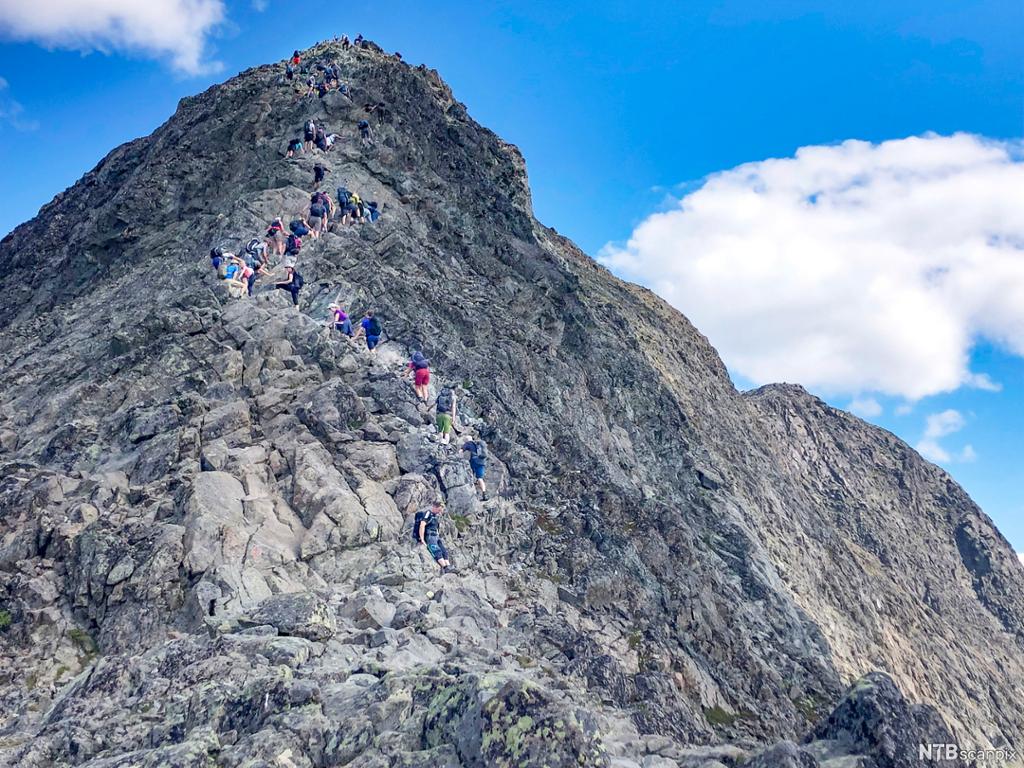
Photo: Mona Langset (CC BY-NC), https://ndla.no/subject:d1fe9d0a-a54d-49db-a4c2-fd5463a7c9e7/topic:a2f5aaa0-ab52-49d5-aabf-e7ffeac47fa2/topic:38165463-f8ca-4089-af63-aa3153a057c0/topic:416e9fe8-f819-4c49-83f3-21ecd4b52ef5/resource:1d089130-9f97-4965-9991-32e4c177a022
Besseggen is a trip destination that has many visitors over the course of the summer.
Here you will find tasks with different angles. Choose for yourself which tasks you want to work on.
Task 1. Friluftsliv in the local area
You are to plan a tur. Take the Trip planning page as your starting point.
- Plan either a day trip in the local area or a trip with an overnight stay in the local area.
- Work out how you can carry out the trip with a focus on sustainable development and on consideration for nature. How can you look after nature in the local area in question? What choices can you make in the trip planning that make the trip more sustainable?
- Make a presentation with a map of the area. Set out which precautions you must take, and which equipment you want to bring along on the trip. Justify all the choices you make.
Task 2. Friluftsliv and carbon emissions
Read through the whole task before you begin.
- Together with a good friend you are to go on a trip to the local area or to a high-mountain area. Take the Trip planning page as your starting point. Plan the trip.
- You are to stay overnight for two nights and have a focus on sustainable friluftsliv. You are to look at all the choices and actions connected with a trip that lead to CO2 emissions, such as travel, equipment, overnight stays and the like. How can you carry out a trip with the least possible emissions? The assessments you make here are more important than working out exactly the CO2 emissions.
- Make either a video presentation or a slide presentation that contains information about
- the journey: start and finish, timing, assessments about the choice of means of transport
- equipment: what you need, justification for the choice of equipment, how to obtain equipment you do not already have, assessments about the choice of materials with regard to both the environment and the weather
- the map: trip destination, choice of route and justification for the choice of route
Task 3. Friluftsliv, popular trip destinations and social media
- Find one popular trip destination that gets a lot of attention on social media, such as Besseggen, Trolltunga, Preikestolen, Store Skagastølstind, Svolværgeita, Reinebringen, Ryten i Lofoten or similar.
- What possible consequences does this attention on social media have for the climate and the environment? Take as your starting point both carbon emissions and consideration for nature in the area in question. Discuss whether the consequences are positive or negative. Look at
- travel
- equipment
- wear and tear on nature and littering
- Make either a video presentation or a slide presentation. In the presentation you are to discuss whether the attention the popular trip destinations get gives positive or negative consequences. Discuss the concept of sustainable development in light of this.
Relevant links you can use to solve the tasks
- Bua: Borrow equipment for sport and friluftsliv
- Framtiden i våre hender: Green and ethical clothes
- Framtiden i våre hender: Greenhouse-gas emissions from different ways of travelling
- NRK: Selfie tourism at Trolltunga
- Vårt Land: Alarmingly high carbon footprint (opinion piece)
Next steps
- Teaching guide — the hub
- Sustainability and leave-no-trace travel — pupil-facing category
- The Environmental Code (miljøvettreglene) — rules of thumb
- The significance of friluftsliv — values and health
Learn more
- UDIR — friluftsliv programme subject — curricula and competence aims
- NDLA — friluftsliv — digital learning resource
- Norsk Friluftsliv — professional organisation
- DNT — school — courses and trips for school classes
Text Cathrine Dunker Furuly og Ragnhild Kjeldsen, NDLA, (CC BY-SA)
-
Sources
Filmkonsulentene (u.å.). Staycation [Videoklipp]. NDLA. Hentet fra: https://players.brightcove.net/4806596774001/BkLm8fT_default/index.html?videoId=6140398171001
Utdanningsdirektoratet. (2020). Læreplan i friluftsliv (IDR07‑02). Hentet fra https://www.udir.no/lk20/idr07-02
Utdanningsdirektoratet. (2020). Læreplan i kroppsøving (KRO01‑05). Hentet fra https://www.udir.no/lk20/kro01-05
Utdanningsdirektoratet. (2020). Læreplan i aktivitetslære (IDR01‑02). Hentet fra https://www.udir.no/lk20/idr01-02
Utdanningsdirektoratet. (2020). Læreplan i norsk (NOR01‑06). Hentet fra https://www.udir.no/lk20/nor01-06
Utdanningsdirektoratet. (2020). Læreplan i historie - fellesfag i studieforberedende utdanningsprogram (HIS01‑03). Hentet fra https://www.udir.no/lk20/his01-03
Utdanningsdirektoratet. (2020). Læreplan i naturfag (NAT01‑04). Hentet fra https://www.udir.no/lk20/nat01-04
Utdanningsdirektoratet. (2020). Læreplan i biologi (BIO01‑02). Hentet fra https://www.udir.no/lk20/bio01-02
Utdanningsdirektoratet. (2020). Læreplan i idrett og samfunn (IDR03‑02). Hentet fra https://www.udir.no/lk20/idr03-02
Utdanningsdirektoratet. (2020). Læreplan i matematikk fellesfag Vg1 teoretisk (matematikk T) (MAT09‑01). Hentet fra https://www.udir.no/lk20/mat09-01
Utdanningsdirektoratet. (2020). Læreplan i matematikk fellesfag Vg1 praktisk (matematikk P) (MAT08‑01). Hentet fra https://www.udir.no/lk20/mat08-01
Utdanningsdirektoratet. (2020). Læreplan i matematikk fellesfag 2P (MAT05‑04). Hentet fra https://www.udir.no/lk20/mat05-04
Utdanningsdirektoratet. (2020). Læreplan i engelsk (ENG01‑04). Hentet fra https://www.udir.no/lk20/eng01-04
Utdanningsdirektoratet. (2020). Læreplan i religion og etikk – fellesfag i studieforberedende utdanningsprogram (REL01‑02). Hentet fra https://www.udir.no/lk20/rel01-02